
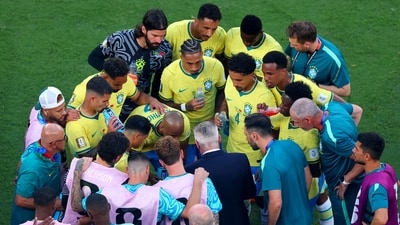
This summer’s FIFA World Cup has introduced a host of changes to the game — some aimed at improving the spectator experience, others at assisting match officials, and one specifically focused on player welfare. Yet it is the latter — the mandatory hydration breaks introduced midway through each half — that has attracted more attention than almost any other innovation, raising questions about who ultimately benefits from them.
In December last year, FIFA announced that the expanded 104-game World Cup, being staged across the United States, Canada and Mexico, would feature mandatory three-minute hydration breaks in both halves.
Hydration breaks are not entirely new to football. Major competitions, including previous World Cups, have used them before, but only at the referee’s discretion or when temperatures crossed a certain threshold. This time, FIFA, after consultations with coaches and broadcasters, made them a standard feature throughout the tournament in the interest of player welfare.
Not everyone, however, has been impressed.
While some have questioned the commercial motivations behind the move, the first 12 matches of the tournament have highlighted another trend altogether: the tactical advantage these breaks appear to provide.
Why were hydration breaks introduced?
When the United States hosted the FIFA Club World Cup last year, extreme heat became one of the tournament’s biggest talking points.
Chelsea and Argentina midfielder Enzo Fernandez said he felt “dizzy” playing in temperatures he described as “dangerous.”
In fact, three of Chelsea’s matches during their title-winning campaign were played in extreme conditions. The club was even forced to cut short a training session in Philadelphia after local authorities issued a “code red” weather warning.
The complaints were widespread. Players from Atletico Madrid and Paris Saint-Germain also raised concerns, while Spain midfielder Marcos Llorente said he felt “terribly hot.”
“My toes were sore, my nails were hurting — it’s incredible,” Llorente said.
The criticism prompted FIFA to make hydration breaks mandatory for the World Cup.
The governing body said the measure was “part of a focused attempt to ensure the best possible conditions for players, drawing upon the experiences of previous tournaments, including the recent FIFA Club World Cup.”
Why have hydration breaks been criticised?
While few dispute the importance of player welfare, some observers argue that the additional stoppages alter the rhythm of football and make the sport resemble American football.
Others have questioned the logic of enforcing hydration breaks at venues with retractable roofs and climate control, or in cooler cities such as Seattle.
United States head coach Mauricio Pochettino was among those unconvinced.
“I don’t like it. I only like it when the conditions are extreme. But when the conditions are good, it is unnecessary,” he said.
FIFA, however, defended the policy, arguing that a universal rule ensured consistency across all 104 matches.
There has also been speculation that commercial interests may have influenced the decision.
During last year’s Club World Cup, broadcaster DAZN used split-screen advertisements during hydration breaks. At this World Cup, several broadcasters have cut away from live action entirely to show commercials.
Former Arsenal and England striker Ian Wright was unconvinced by FIFA’s explanation.
“I just think it’s another way of getting adverts into it from an American point of view,” Wright said.
The criticism intensified after Fox Sports in the United States came under scrutiny for running advertisements during the hydration break in the opening match between Mexico and South Africa.
“They’ve used the fact that it’s for the players, but it’s not for me,” Wright added.
Yet hydration breaks are helping teams
Despite the criticism, the three-minute stoppages have increasingly resembled strategic time-outs, similar to those seen in cricket’s Indian Premier League.
In the Group C opener between Brazil and Morocco at MetLife Stadium, Morocco deservedly took a first-half lead. But just six minutes after play resumed following the hydration break, Vinicius Junior curled home a stunning equaliser.
Brazil head coach Carlo Ancelotti later admitted that the stoppage allowed him to deliver fresh tactical instructions.
“You can explain a problem to the players and make a tactical adjustment that can be very good,” Ancelotti said.
Germany also benefited.
After Curaçao stunned the four-time champions with a historic equaliser, Julian Nagelsmann used the hydration break to reinforce tactical changes. Germany subsequently scored six unanswered goals to secure a 7-1 victory.
“Curaçao played with a diamond today, and we adjusted how we attacked before the hydration break,” Nagelsmann said.
“But even so, there were still two or three moments where it took a little while because, at the end of the day, you actually very rarely play against a diamond-shaped team these days.”
“The water break was actually good to simply reiterate what we had already adjusted on the board.”
Brazil and Germany are not isolated examples.
Canada found an equaliser against Bosnia and Herzegovina after a hydration break in the second half, while Scotland scored their only goal against Haiti shortly after a stoppage as well.
France head coach Didier Deschamps has already embraced the concept.
Ahead of France’s opener against Senegal, he acknowledged the tactical value of the breaks.
“These hydration breaks for three minutes allow you to bring the players close to you and adjust a couple of things based on the first 22 or 23 minutes of the game,” Deschamps said.
“With the high temperatures, it’s important to have this extra opportunity. It’s not two half-times anymore — it’s four quarter-times.”
“The players and coaches have adapted to this new reality, but you get two additional opportunities to speak to your team.”
Whether the hydration breaks were introduced primarily for player welfare, broadcasting opportunities or commercial reasons remains open to debate. What is becoming increasingly clear, however, is that they are evolving into tactical weapons — and coaches are making full use of them.