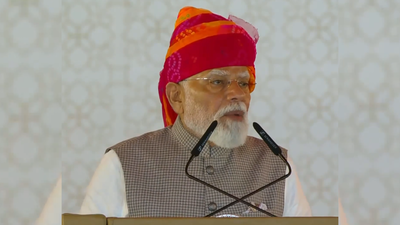
NEW DELHI: Prime Minister Narendra Modi on Saturday unveiled development projects worth around Rs 1.06 lakh crore during his visit to Rajasthan. The projects included the inauguration of the new terminal building at Jodhpur Airport, the launch of the Modified UDAN scheme, the dedication of India’s first greenfield integrated refinery-cum-petrochemical complex to the nation, and the foundation stone and inauguration of several infrastructure projects in Balotra.He also handed over appointment letters to around 54,000 newly recruited Rajasthan government employees. Addressing the public gathering, PM Modi said that the BJP government was committed to completing projects after laying their foundation stones and highlighted the pace of execution.He also thanked people for joining the programme from across Rajasthan and said the large turnout reflected the people’s trust in the government.“I have been informed that today, at 10,000–12,000 locations, lakhs of people have gathered for this programme. Everywhere you look, there are people. Through technology, people from every corner of Rajasthan are connected. I also extend my greetings from here to all my brothers and sisters of Rajasthan.”Referring to the scale of the gathering, he further added, “During this summer season, such a massive gathering of people at so many places, and your blessings for all of us, show how strong your trust is in the efforts of the BJP government. I am indebted to the soil of Rajasthan for your affection. This land has witnessed the bravery of countless warriors. Every particle of this land has taught us to place self-respect above everything else.“
‘India made right decision’
Commenting on India’s energy situation in the face of Middle East adversity, PM Modi said, “India has made the right decisions at every level… accurately assessed the crisis in time… devised an effective strategy… made balanced use of India’s resources. India made positive use of its diplomatic power. And only then has India been able to recover from the crisis.”“Will power and efforts of new India of 21st century have prevailed over century’s biggest energy crisis,” he further added.
Addressing energy disruptions
On the energy supply front, he said, “About 60% of our LPG requirements were met through imports, with 90% of that supply coming from Gulf nations, passing through Hormuz, when suddenly, war conditions brought that supply to a near-halt. You can imagine the massive crisis that was looming over our country.”Highlighting the government’s response to the disruption in LPG supplies, he said that refinery operations were quickly reoriented to boost domestic production. He said facilities that were earlier manufacturing other petroleum products were repurposed to produce LPG, while even refineries that had never produced the fuel before were reconfigured for the task.“As soon as the crisis began, we focused on leveraging our refinery capabilities. Refineries that previously produced other products were directed to manufacture LPG, and within just seven days, LPG production increased. Domestic LPG production rose from 35,000 metric tonnes to 54,000 metric tonnes during the crisis. Refineries that had never produced LPG before were reconfigured to do so.”He added that the government simultaneously worked to reduce pressure on LPG demand by expanding access to piped natural gas (PNG).“The government also ensured that the entire burden of cooking gas demand did not fall solely on LPG. A campaign was launched to expand PNG connections. In a very short span of time, India connected over 1.1 million households to PNG.”These measures helped keep cooking gas prices under control despite concerns over a sharp rise.“Given the prevailing circumstances, the price of a domestic gas cylinder could have soared to Rs 2,000, a figure predicted by major market experts. Yet, even now, a domestic LPG cylinder is being provided for less than Rs 950…”The PM also said the long-standing water crisis in the Shekhawati region was nearing resolution and congratulated residents on the development projects. “The wait to resolve the water crisis in the Shekhawati region is also nearing an end. I extend my heartfelt congratulations to my brothers and sisters for all these projects.”
PM launches Modified UDAN scheme, inaugurates Jodhpur airport terminal
PM Modi began his visit in Jodhpur by inaugurating the new terminal building at Jodhpur Airport, developed at a cost of Rs 480 crore. Spread across more than 23,000 square metres, the terminal is designed to handle up to 20 lakh passengers annually and is equipped with modern passenger amenities. Inspired by Rajasthan’s royal heritage, it combines traditional architectural elements such as arches and jharokhas with contemporary design.He also launched the Modified UDAN scheme, which has been allocated Rs 28,840 crore over the next 10 years to strengthen regional air connectivity. The scheme includes the development of 100 aerodromes from existing unserved airstrips with an outlay of over Rs 12,000 crore, more than Rs 2,500 crore for operations and maintenance support for regional airports, the construction of 200 modern helipads and viability gap funding of over Rs 10,000 crore for airlines. It also provides for the procurement of indigenous aircraft and helicopters, including HAL Dhruv and Dornier platforms.
Development projects worth around Rs 1.06 lakh crore unveiled in Balotra
From Jodhpur, Modi travelled to Balotra, where he dedicated, inaugurated and laid the foundation stone for projects worth around Rs 1.06 lakh crore across sectors including petrochemicals, urban transport, railways, roads, renewable energy and power transmission.He also dedicated the country’s first greenfield integrated refinery-cum-petrochemical complex at Pachpadra to the nation. Developed as a joint venture between Hindustan Petroleum Corporation Limited (HPCL) and the Rajasthan government, the 9 MMTPA refinery-cum-petrochemical complex has been built with an investment of over Rs 79,450 crore.PM Modi said, “From this land, India has taken a major step towards becoming a developed and self-reliant nation. Today, a refinery has been dedicated to the country. This refinery will become a source of employment for thousands of people here. I especially congratulate the youth of Rajasthan on this refinery. Today stands as proof that BJP governments do not merely lay foundation stones for projects and then abandon them. Rather, we work day and night to ensure those projects are completed.”The complex integrates refining and petrochemical production, has a petrochemical capacity of 2.4 MMTPA, a Nelson Complexity Index of 17.0 and petrochemical yields exceeding 26%. It is expected to strengthen India’s energy security, enhance petrochemical self-sufficiency, support industrial growth and generate employment in the region. During the programme, Modi also flagged off refinery production tankers from the complex.He also laid the foundation stone for Phase 2 of the Jaipur Metro Rail Project, which will be developed at a cost of over Rs 13,000 crore. The 41-km north-south corridor from Prahladpura to Todi Mod will comprise 36 stations connecting major industrial and residential areas across Jaipur.Additionally, he dedicated the Churu-Sadulpur and Churu-Ratangarh rail doubling projects, built at a cost of around Rs 900 crore, and inaugurated the four-laning of the NH-125A Jodhpur Ring Road Section-2, developed at a cost of about Rs 740 crore.In the renewable energy sector, PM Modi dedicated SJVN Limited’s 1,000 MW Bikaner Solar Energy Project, developed with an investment of about Rs 5,500 crore, and NHPC’s 300 MW Karnisar Bikaner Solar Energy Plant. He also inaugurated a transmission line built at a cost of over Rs 1,900 crore for evacuating power from the Rajasthan Renewable Energy Zone and laid the foundation stone for a 530-km-long power transmission system for the region.
Hands over appointment letters to 54,000 recruits
During the programme, the Prime Minister handed over appointment letters to around 54,000 youth recruited across various departments of the Rajasthan government. The recruits include personnel from the Departments of Education, Energy, Home, Panchayati Raj, Transport, Higher Education, Skill Development, Planning, Agriculture, Information Technology and Administrative Reforms.Referring to the projects inaugurated during the visit, the Prime Minister said the government focuses on ensuring timely completion rather than stopping after laying foundation stones.
Gujarat visit
After concluding his Rajasthan visit, the Prime Minister will visit Gujarat, where he is set to inaugurate the CG Semi Outsourced Semiconductor Assembly and Test (OSAT) facility at Sanand. Developed under the India Semiconductor Mission with an investment of over Rs 7,500 crore, the facility is expected to have an annual production capacity of up to 5 billion semiconductor chips once fully ramped up.The facility currently employs more than 300 professionals and is projected to generate over 5,000 direct and indirect high-skilled employment opportunities over the next five years. During the visit, the Prime Minister will also inspect semiconductor manufacturing and packaging processes inside the cleanroom facility before addressing a public gathering.