
India’s energy security received a major boost on Friday when two important Memorandum of Understanding (MOUs) were signed during PM Narendra Modi’s visit to the UAE on Friday. India imports close to 90% of its crude requirements, making the country vulnerable to geopolitical disruptions, shipping bottlenecks, sanctions, and price volatility. This vulnerability has been exposed during the ongoing US-Iran conflict, with the disruption of supplies via Strait of Hormuz dealing a blow.The two agreements pertain to building strategic petroleum reserves for India, and ensuring long-term LPG and LNG supply. “This UAE visit also saw the conclusion of key agreements across vital areas such as energy, defence, infrastructure, shipping and advanced technology, giving fresh impetus to the India-UAE Comprehensive Strategic Partnership,” PM Modi said on social media.“In another important development, UAE announced investments worth $5 billion in India. This will further deepen economic ties,” he said.UAE is one of India’s top five crude oil suppliers and its geographical proximity to India makes supply available at a short notice. Hence having UAE store oil for India, and also help build oil reserves in India acts as a booster. UAE’s recent move from OPEC and OPEC+ will also work to India’s benefit since it allows the Middle East country to step up oil production, believe experts.
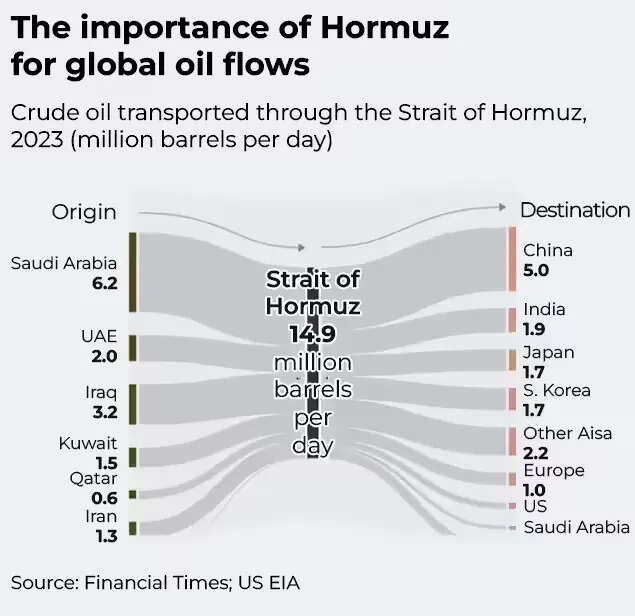
In fact, according to Kpler data recent crude trade flows show that India’s imports from the UAE during late April and May have already recovered to levels broadly comparable to what it was importing prior to the conflict escalation. This highlights how closely both countries have coordinated despite the challenging market environment.What do the new agreements between UAE and India entail? How will India’s energy security plans get a boost?
Energy Security MOUs with UAE: Top Facts
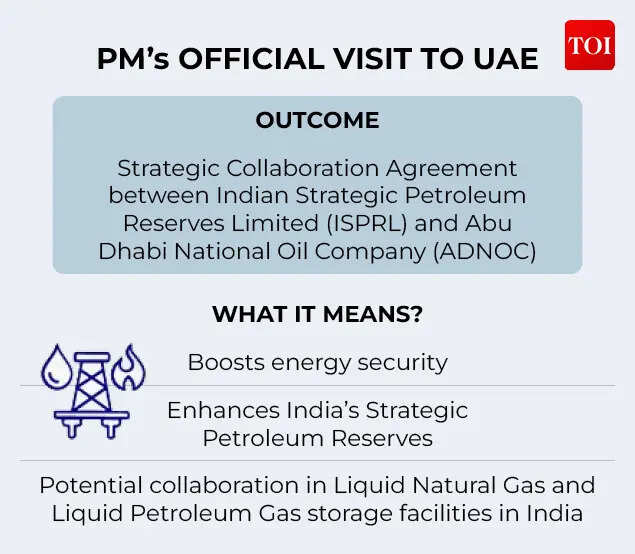
According to press release from the Prime Minister’s Office, the two energy security related agreements signed today will have the following scope:MoU on Strategic Collaboration between Indian Strategic Petroleum Reserves Limited (ISPRL) and Abu Dhabi National Oil Company (ADNOC)
- There will be potential ADNOC crude oil storage in India’s Strategic Petroleum Reserves up to 30 million barrels. This includes its participation in facilities in Vishakhapatnam, Andhra Pradesh; and the development of reserve facilities in Chandikol, Odisha.
- Potential storage of crude oil in Fujairah, UAE, to form part of the Indian strategic petroleum reserve;
- Potential collaboration in Liquid Natural Gas (LNG) and Liquid Petroleum Gas (LPG) storage facilities in India.
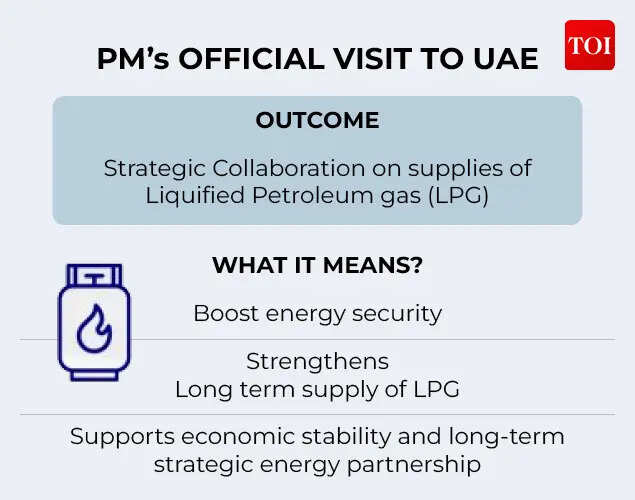
Strategic Collaboration Agreement between Indian Oil Limited (IOCL) and ADNOC on supplies of LPG
- Under this, the agreement is to explore potential opportunities in the sale and purchase of LPG. This includes long-term supply of LPG, and entry into a long-term LPG sale and purchase agreement between ADNOC Gas Limited and IOCL.
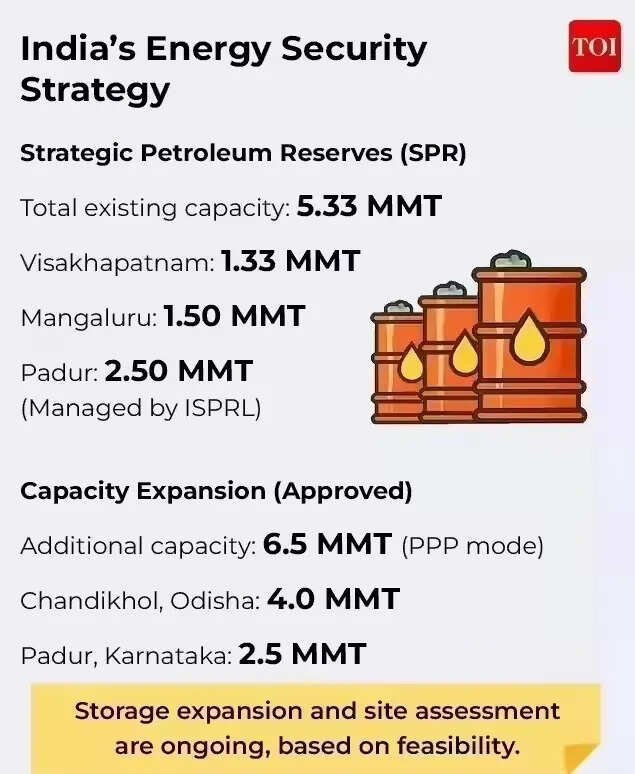
India has strategic petroleum reserves at Visakhapatnam, Mangaluru, and Padur. Capacity expansion is approved with reserves at Chandikol, and Padur. The MOU with the UAE aims to help enhance these reserves in India, while also storing oil in Fujairah for India. Storage of oil at Fujairah will also help reduce India’s dependence on the Strait of Hormuz for transit of oil.
How the energy security agreements with UAE benefit India
Experts have hailed the MOUs, calling them game-changing for India’s energy security in the long-term. The importance of having strategic petroleum reserves has been brought to light with stark clarity due to the US-Iran war, exposing gaps in energy security of major economies. India, the world’s sixth largest economy, has faced shock like never before in recent times.Gaurav Moda, Partner & Leader, Energy sector, EY-Parthenon India says, “India and UAE have a long shared history and diaspora, increasingly closer in recent times. Given the global uncertainties, such bilateral engagement is timely and mutually beneficial to both countries in a major way. It may further pave the way for multiple new avenues in energy cooperation at G2G level as well as across energy majors from both countries.”First, let’s understand why strategic petroleum reserves are important – in times of geopolitical instability or any maritime freight disruptions that may be caused around key chokepoints such as the Strait of Hormuz (as is the case with the US-Iran conflict), it is a country’s strategic reserves that act as an effective buffer against supply shocks. They can help stabilize the domestic supply and also reduce any panic buying that may ensue in the market.
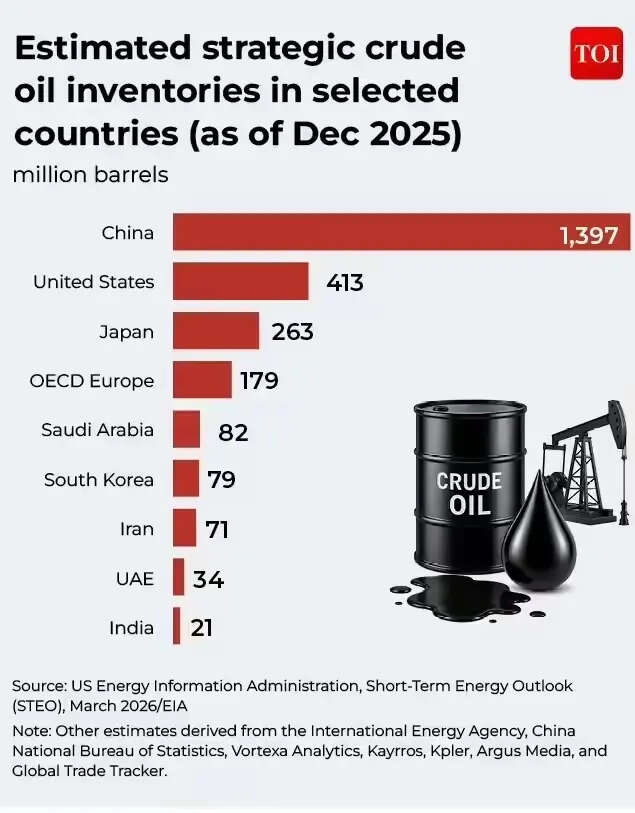
Compared to other major economies in the world like the US, Japan, and China, India’s strategic oil reserves fall way short, and the agreements are a step in the right direction to ramp up capacity.For Sourav Mitra, Partner – Oil & Gas, Grant Thornton Bharat, the announcement on strategic petroleum reserves has ‘monumental implications for India’.The main challenge here is not just securing access to energy but also managing uncertainty arising from geopolitical tensions. The value of strategic reserves lies in creating room for thinking. “Larger and more collaborative reserve arrangements can reduce exposure to short-term volatility, and provide policymakers with more space to respond during crises. It also enables a shift in thinking from immediate procurement to long-term risk management, where energy security is built through buffers and resilience,” Mitra tells TOI.
“The significance of such partnerships is increasing because the global energy landscape is becoming more uncertain. Disruptions today can emerge from geopolitical events, with little warning. In that context, strategic reserves are no longer just emergency storage assets but strategic instruments that strengthen national energy resilience and support more stable long-term planning,” he adds.Hence, the biggest takeaway is clear: The agreements could have significant implications for India’s energy security and supply diversification strategy.According to Sumit Ritolia, Manager Modelling and Refining at Kpler, the MoUs represent an important step in strengthening the long-term energy partnership between India and the UAE, particularly at a time when global energy markets remain highly sensitive to geopolitical disruptions, freight risks, and supply security concerns. “The agreement around Strategic Petroleum Reserves is especially important for India given its heavy dependence on imported crude oil. Enhanced cooperation with the UAE on reserves could help India strengthen its emergency crude storage capabilities, improve access to strategic barrels during supply disruptions, and provide greater flexibility in crude procurement and inventory management,” Sumit Ritolia tells TOI.“Closer cooperation with ADNOC and UAE entities could also support commercial storage arrangements, optimized crude stocking strategies, and potentially quicker access to Middle Eastern crude during emergencies,” he adds.What about LPG? More than crude oil, the US-Iran war dealt a blow to India’s LPG supply. Similar to crude oil, India is heavily dependent on imports for its LPG needs. But unlike crude which has several suppliers across the globe for India, the LPG requirement is majorly met through the Middle East – hence exposing the vulnerability.Sumit Ritolia of Kpler says that the long-term LPG supply agreement is equally significant as India’s LPG demand continues to rise steadily due to residential consumption growth, urbanization, and government-led clean cooking fuel initiatives. “India remains structurally dependent on LPG imports despite increasing domestic refinery and gas processing output. Securing long-term LPG supply arrangements with the UAE can help India reduce reliance on volatile spot cargo markets, improve supply visibility, and enhance affordability and availability for domestic consumers,” he says.Stable long-term contracts can also help India better manage seasonal demand spikes and reduce exposure to sharp price swings in international LPG benchmarks. Given the importance of LPG in India’s household energy mix, ensuring reliable imports remains a strategic priority, he adds.
Broader Energy Cooperation
As the Kpler expert notes: beyond crude and LPG, the broader energy cooperation framework further deepens the India-UAE strategic relationship across the hydrocarbon value chain. This may include collaboration in upstream investments, refining, petrochemicals, storage infrastructure, energy trading, logistics, and potentially cleaner energy transitions over the longer term. “For India, stronger integration with a reliable Gulf supplier such as the UAE improves diversification, strengthens supply chain resilience, and supports long-term energy planning. From the UAE’s perspective, India remains one of the world’s fastest-growing energy demand centers and an important long-term market for crude oil, LPG, and petrochemical products,” he says.Which is not to say that India’s immediate energy supply crunch will disappear. The agreements will yield long-term benefits, but short-term supply constraints remain as the Strait of Hormuz is still closed.“The immediate short-term impact (of the MOUs) may remain somewhat limited as trade flows through the Strait of Hormuz continue to face restrictions and elevated geopolitical risks. However, the strengthening of India-UAE energy ties clearly improves India’s positioning in terms of supply preference, bilateral coordination, and long-term import security,” Ritolia opines.“Overall, the agreements reinforce India’s broader strategy of securing diversified and reliable energy partnerships while improving preparedness against future market disruptions. At a time when energy security has become increasingly intertwined with geopolitics, logistics, and trade flows, these MoUs could provide India with greater supply stability, strategic flexibility, and stronger coordination with one of its key Middle Eastern energy partners,” he concludes.