
Football loves its goalscorers. On a good day, it makes room for the manager. Rarely, though, does the spotlight stretch deep into the coaching staff. Yet in Houston, the most compelling story from Portugal’s 5-0 demolition of World Cup debutants Uzbekistan was not Cristiano Ronaldo‘s record-breaking “I’m back” moment. It unfolded on the touchline, when Roberto Martinez turned away from the pitch before the ball had even settled in the net and headed straight towards assistant coach Austin MacPhee to celebrate.
MacPhee, 46, is from Kirkcaldy in Scotland, and his journey to a World Cup touchline has been anything but conventional. He played college football in the United States, had spells in Romania and Japan, and later worked his way through coaching roles at Cowdenbeath, St Mirren and Hearts before earning broader recognition. He spent five years at Aston Villa under Unai Emery before joining Portugal’s coaching staff in February 2025.
Since then, he has turned set-pieces into the most meticulously rehearsed part of Portugal’s game. Villa scored 18 goals from set-pieces in 2025 across all competitions, nearly a third of their total output. That figure convinced Portugal they needed MacPhee at the World Cup.
The MacPhee effect
Against Uzbekistan, two of Portugal’s five goals carried unmistakable MacPhee fingerprints.
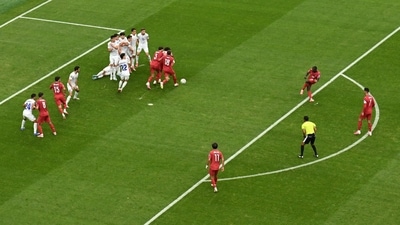
The first came from a free-kick just outside the penalty area in the 16th minute. It was the kind of position from which Ronaldo has built a career scoring spectacular goals. The stage was perfectly set. Ronaldo had already ended a week of criticism with his opening goal and now stood over the ball with Nuno Mendes to his left and Bruno Fernandes to his right.
The crowd rose to its feet. Phones were out. Cameras zoomed in. Ronaldo went through his familiar routine — a few steps back, legs apart, deep breaths, eyes fixed on the wall.
When the whistle blew, he took the first step forward. Uzbekistan goalkeeper Abduvokhid Nematov instinctively drifted to his left, expecting a trademark Ronaldo strike. Instead, Mendes stepped up and hammered the ball into the space Nematov had vacated.
After the game, Ronaldo offered a simple explanation. “I was going to take the free kick myself, but I told Nuno, ‘Let’s trick the goalkeeper, he’ll think it’s me. Shoot hard, it’ll be a goal.'” It worked perfectly. But what Ronaldo described as an on-the-spot idea was, in reality, a carefully rehearsed routine built around exactly that kind of psychological deception.
The second moment arrived later in the match. Portugal won another free-kick, this time from much farther out. Ronaldo stood over the ball again. So did Fernandes. There was curiosity in the air. Surely Uzbekistan would not be fooled twice.
Ronaldo began his run-up. Then he simply ran past the ball. Fernandes clipped a clever pass over the defensive wall, while Ronaldo accelerated through the defensive line into the open space behind it. Suddenly, Portugal’s captain was through on goal with a chance to complete his hat-trick. Only a brave intervention from Nematov prevented another goal.
From the resulting corner came Portugal’s fourth. Fernandes deliberately waved teammates away from the goalmouth, appearing to signal an outswinging delivery. Instead, two attackers made aggressive near-post runs, creating confusion inside the six-yard box. Ronaldo nearly got a touch. The ball then deflected off Joao Felix as Uzbekistan’s defence scrambled to recover. It squeezed through a crowded area and eventually crossed the line after ricocheting off Nematov and a defender.
Why it matters
Set-piece goals have become increasingly influential at World Cups. Before 1990, they accounted for roughly 21-26% of all goals scored at the tournament. By the 2018 World Cup in Russia, that figure had risen dramatically to 40.8%. International football rewards teams that treat dead-ball situations not as interruptions to open play, but as a primary attacking weapon. Most national teams, limited by short preparation windows, never fully embrace that philosophy. MacPhee has spent his entire coaching career arguing for exactly that approach. Long before set-piece coaching became a specialist discipline, he recognised their value when most clubs still treated them as an afterthought.
According to Portuguese newspaper ‘A Bola’, MacPhee has been among the most active figures on Portugal’s training ground. Set-piece routines have featured in every training session leading up to the World Cup, with a wide variety of rehearsed patterns and scenarios. The report revealed that Portugal even use mechanical walls that rise to simulate defensive jumps during free-kick practice, recreating match conditions as closely as possible.
The philosophy is simple: set-pieces are not supplementary. They are a primary attacking strategy. And Martinez has backed that obsession from the day MacPhee arrived.
At a 48-team World Cup featuring 104 matches, the margins become increasingly fine as the tournament progresses. Knockout games are often decided by details most supporters never notice. A team armed with 17 opponent-specific set-piece routines will usually have an edge over a team with three.
Martinez put it succinctly after the win over Uzbekistan. “Set pieces are an obsession for Austin. It can be boring to practise, to focus — but he’s amazing. Both set-piece goals we scored were executed perfectly.”
Obsession, at a World Cup, can become a competitive advantage. And right now, Portugal have one hiding in plain sight — long hair, animated gestures on the touchline, and a habit of designing goals long before the match even begins.