
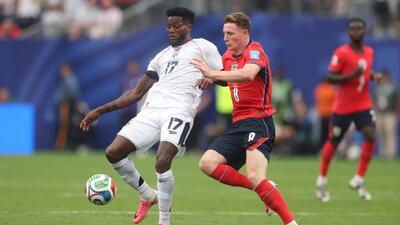
Kolkata: For two decades, possession has occupied an almost sacred place in the football’s tactical vocabulary. The success of Pep Guardiola’s Barcelona and Spain’s golden generation that won the 2010 World Cup bookended by back-to-back Euro titles convinced an entire generation that controlling the ball meant controlling the game. The philosophy was simple – monopolise possession, tire the opposition physically and mentally, and eventually create and convert openings.
The 2026 World Cup however is offering another reminder that football has moved beyond the equation of possession equalling superiority. While top teams still continue to dominate the ball, the ascent of some other sides is offering a different narrative that dominance is being increasingly measured by intrusion rather than possession.
The possession statistics of several of the teams that have qualified for the knockouts illustrate this point perfectly. Ghana progressed despite averaging just 33% possession –the lowest among all the 32 teams – in the three group matches. Cape Verde (36%), South Africa (36%), Paraguay (37%), DR Congo (37%) and Bosnia and Herzegovina (38%) have all demonstrated that compact defending, efficient transitions and clinical finishing can outweigh long spells of directionless control.
Conversely, some of the tournament’s technically superior sides have become examples of possession without penetration. Uruguay averaged 51% possession during the group stage, Turkey 58% and South Korea 56%, yet none consistently translated their territorial dominance into results. Their inability to convert possession into meaningful chances ultimately proved more costly than surrendering the ball.
This is where expected goals (xG) efficiency comes into picture. While possession measures who controls the ball, xG efficiency tells us who makes the most of their opportunities. Bosnia and Herzegovina have emerged the surprise standout performers so far, scoring at a staggering 2.73 times their expected goals in the group stage. Similarly efficient have been Paraguay (1.59x), DR Congo (1.30x) and Ghana (0.96x) who have converted limited opportunities in comparison to Turkey (0.55x), South Korea (0.59x) and Uruguay (0.76x).
These numbers drive home an important point – quite a few teams have monopolised the ball without truly controlling the contest. Some others have been content spending long periods without possession and more intent on being sharper on the counter and in front of the goalmouth. Several matches in this World Cup underline this trend dramatically.
Against Ghana, England enjoyed 78.8% possession – the highest by a team in a World Cup match since 1966 – but were still held to a 0-0 draw. Spain monopolised 74% possession against Cape Verde without finding a breakthrough. Portugal suffered the same fate against DR Congo – they only had 25% possession, mostly from organising stubborn defensive blocks – in a 1-1 draw.
Perhaps the most emphatic illustration came in Turkey’s 0-2 defeat to Australia. Turkey had 72% possession and produced 30 attempts on goal, but Australia’s defensive structure absorbed the pressure before punishing their opponents with two devastating strikes, in either half. It was a textbook example of modern tournament football exploiting quality over quantity.
None of this is news though. The tactical shift was evident at the 2022 World Cup in Qatar where Japan stunned Germany 2-1 despite 26% possession, and creating roughly half as many shots. Saudi Arabia shocked eventual champions Argentina after scoring twice from only three shots. Against Belgium, Spain and Portugal, Morocco averaged barely a quarter of possession but still generated a combined 3.6 xG compared to their opponents’ 2.9.
This World Cup has thrown up a wider spectrum of unexpected results, largely because of the restraint shown by many of the lower-possession sides. They waste fewer possessions because they have fewer of them. They attempt fewer low-percentage shots and force fewer ambitious passes, resulting in more efficient football.
That doesn’t mean possession football is obsolete. The world’s strongest teams will always seek to control matches through the ball, like Spain (62%) or Netherlands (56%) this time. But in a condensed tournament like the World Cup where there are fewer opportunities to develop positional play against teams content to defend deep for 90 minutes, it might not be the overwhelmingly effective tactic.
England manager Thomas Tuchel had hinted at that shift when he spoke not about dominating possession, but about ensuring that “the next pass counts, the next action counts.” Ghana coach Carlos Queiroz also spoke of football’s unpredictability before the tournament. “The final outcome of football is always a mystery,” he said. “There is no formula.”
Possession hasn’t gone out of vogue. Nor should it. The best teams will always value control, rhythm and territorial dominance. But control is no longer synonymous with possession. Defensive structures are becoming more organised with coaches happier to concede ball control knowing that space and opportunity – not possession – is the game’s most precious commodity. Instead of focusing on completing passes, setting up and finishing the goal-bound move is gaining importance. That may ultimately become the defining tactical lesson of this World Cup.