
Jerome Vinith remembers kneeling down on the volleyball court. It was his way of showing gratitude to the supporters. The Indian captain and the rest of his teammates were overwhelmed by the support they received from the stands.
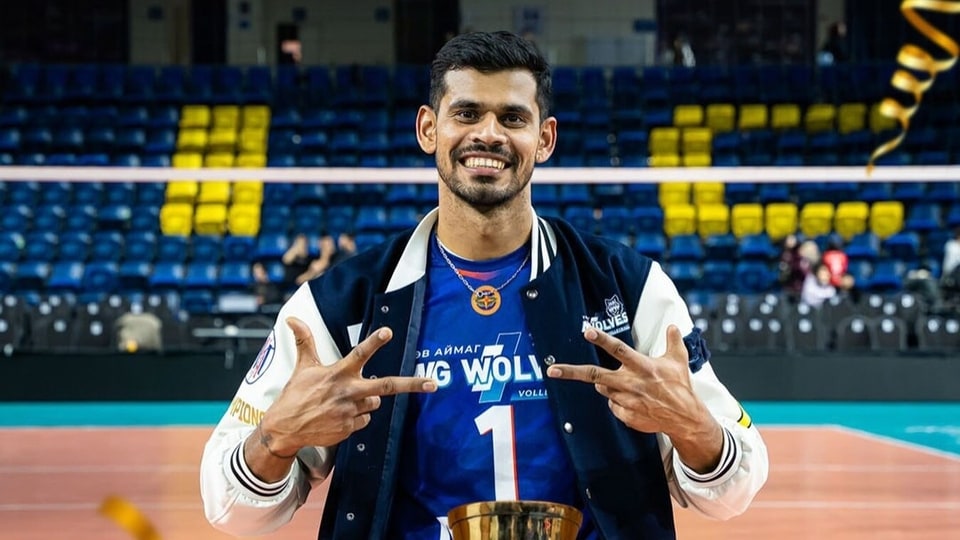
Support that spurred them on as the team won a medal at the Asian Volleyball Confederation (AVC) Cup for the first time, clinching bronze in Ahmedabad in June.
“People had come with their families, and later they waited for us outside the stadium as well,” he recalled.
In all his years playing a sport held back by a national federation mired in administrative turmoil, what he experienced in Ahmedabad was the first big sign that things were changing.
In a few weeks, Jerome will return to that same venue to experience another first. The Prime Volleyball League (PVL) will be hosting its fifth season, starting November 30. But the latest edition will be its first after the competition was approved as the top-division in the country by the Fédération Internationale de Volleyball (FIVB).
For Jerome, this was another big sign that the sport’s ecosystem in the country was improving.
“We should be proud because every country has an FIVB-recognised league,” he told HT. “It’s good for the development of the sport and players.”
All these developments come in the same year that started off with the 34-year-old being left out of the 40 probables for the AVC Cup by the national federation in April. The Volleyball Federation of India (VFI) then inexplicably removed national coach Dragan Mihailovic, prompting protests from the players.
It eventually led to the FIVB stepping in and revoking recognition of the VFI. A steering committee was formed to oversee the sport in the country, and Mihailovic was called back to coach the squad.
“There was a lot of politics but the sports ministry and Sports Authority of India (SAI) backed us and helped organise fresh trials for the squad. And it was important to get Dragan back,” Jerome said.
“In Indian volleyball, we never previously had a foreign trainer, an analyst, or strength and conditioning support staff. Dragan made these things happen. The analyst really helped us understand how to play, who the key players were on the opposite team, and how to control them.”
Armed with the right support, Jerome asserted, the Indian team beat higher-ranked teams to finish with the bronze, and later reached the quarter-final at the Asian Games after beating Qatar.
The recent results have pushed the team into the top-50 of the world rankings after being outside the top 100 a few years ago.
What has also helped bridge the gap between Indian and foreign players is the professionalism the players have been exposed to during the PVL.
“Something as simple as the warm-up routines have changed now,” Jerome, who plays for the Chennai Blitz in the PVL, explained. “Earlier we ran over 10 laps of the court, which just made us tired. Now, warm-up is a systematic activation of core muscles which helps with mobility and stability – the things we need during a game. It’s a shorter time spent on warm-up, but it’s more focused.”
The marquee franchise-based competition had its inaugural season in 2022 with seven teams and has since expanded to 10 teams. FIVB recognition adds to the heft of the PVL, which remains the only high-profile domestic competition in the country.
And since Indian players get to rub shoulders with foreign stars through the tournament, there has been a shift in attitude as well.
“I don’t think they (foreign players) are better than us. Season after season, the best players in the league have been the Indian players and the performances are getting better,” Jerome said.
“It has changed the mindset for us. If we go into an international match thinking the opponent is strong, we have already lost. Now we go thinking we are better, and that mentality helps us.”
After years of struggling without the support of a national federation, volleyball has started to look up. Both on and off the court.