
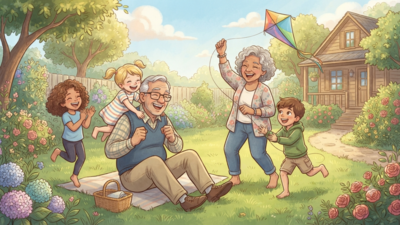
There is something rather peculiar about the way some grandparents behave around their grandchildren. A grandfather who rarely expressed affection towards his children may spend hours playing with a toddler. A grandmother who was particular about discipline when raising her own children may suddenly become the person who allows her grandchildren to eat an extra sweet, stay up a little longer or make a mess in the living room.And the change does not always go unnoticed by the adult children. Many parents have wondered why their mother or father, who seemed so strict while raising them, has become remarkably patient with the next generation.
5 Oct 2026 | 12:06
Parents, when your child refuses to greet relatives, do you make them say hello or respect their choice?
Is it because grandparents love their grandchildren more? Not necessarily. But the relationship can feel different because the responsibilities, expectations and emotional circumstances have changed.Psychology offers some interesting explanations for this shift. Grandparenthood can bring affection without the same everyday pressures of raising a child, an opportunity to revisit old family experiences and a chance to enjoy a new relationship that is no longer dominated by the demands of daily parenting.
The brain may respond differently to grandchildren
A particularly interesting study published in the journal Proceedings of the Royal Society B in November 2021 examined the brain activity of 50 grandmothers while they looked at photographs of their grandchildren, unfamiliar children, the same-sex parent of the grandchild and unfamiliar adults.Researchers used functional magnetic resonance imaging (fMRI) to observe their brain responses.The study, titled The neural correlates of grandmaternal caregiving, found that photographs of grandchildren activated brain regions associated with emotional empathy, including the insula and secondary somatosensory cortex. These areas are involved in recognising and responding to another person’s emotional state.The researchers also found that stronger activity in certain regions linked to cognitive empathy was associated with a grandmother’s desire to become more involved in caring for her grandchild.In simple terms, seeing a grandchild can engage brain systems involved in understanding, responding to and caring for another person.But there is a distinction worth making. This study did not establish that grandmothers love grandchildren more than their own children. It examined how their brains responded to different photographs, not a direct comparison of the strength of love across generations.Still, it offers a fascinating look at why grandparent-grandchild relationships can evoke such powerful emotional responses.Also Read: Psychology says people who make their bed every morning, even when staying in a hotel or someone else’s home, may find comfort in familiar routines, a sense of order and the feeling of starting the day with one small task completed
A second chance to do things differently
For some grandparents, spending time with grandchildren also brings back memories of their own parenting years. They may remember working long hours when their children were young, missing school functions, being impatient during tantrums or worrying constantly about money.With age and a different set of responsibilities, some of those priorities change.A father who once believed that children needed strict discipline may now find himself laughing at behaviour that would have annoyed him decades ago. A mother who had little time for leisurely activities while raising her children may happily spend an entire afternoon listening to her granddaughter’s stories.There can be an element of hindsight here. People understand certain experiences differently after living through them. They may recognise that childhood passes quickly, that not every small mistake needs correcting and that being present sometimes matters more than getting everything right.This does not mean every grandparent regrets how they raised their children. Nor does it mean age automatically makes people more patient. But the distance from active parenthood can give some people a different perspective on childhood.For others, grandparenthood can offer an opportunity to express affection that they struggled to show earlier. A person who grew up in a household where emotions were rarely discussed may have been equally restrained with their own children. Becoming a grandparent can give them another relationship in which they feel comfortable being openly affectionate.And sometimes, they simply have more time and emotional energy than they did during their busiest parenting years.Also Read: Psychology says maintaining distance from certain relatives does not always mean you dislike your family: How emotional boundaries, repeated conflict and the need for personal space can influence decisions to limit family interactions
Grandchildren can offer a sense of purpose
For many people, retirement and ageing bring changes that are not always easy to navigate. Work may no longer provide the same daily structure. Children become independent, move to different cities or build families of their own. The house that once seemed noisy can become unexpectedly quiet.A grandchild can introduce a new rhythm into this phase of life.There may be school pickups, birthday celebrations, stories before bedtime and small family rituals to look forward to. Even a simple phone call from a grandchild can become the highlight of someone’s day.The relationship also gives grandparents an opportunity to pass on things they consider valuable. It could be a family recipe, a language, a childhood memory or a particular way of celebrating a festival.For an older person, these exchanges can create a sense that their experiences still matter and that they have something meaningful to contribute.This is particularly visible in Indian families, where grandparents often play an active role in passing down family traditions. A grandmother teaching a child how to make a particular Bengali dish or a grandfather explaining the history behind a family photograph is doing more than sharing information. He or she is helping the child understand where they come from.
Why grandparents sometimes become more indulgent
There is another reason grandchildren may experience a softer side of their grandparents: the relationship has different boundaries.Parents have to think about long-term consequences. They may refuse another chocolate, insist on homework or restrict screen time. Grandparents may be more inclined to let certain things slide.A grandparent’s role need not be identical to a parent’s. In fact, the difference can be valuable, provided it does not undermine the child’s sense of security.
It does not mean grandparents love their children any less
One of the easiest mistakes is to interpret this change as a comparison of affection. A mother who was strict with her daughter but indulgent with her granddaughter has not necessarily become more loving. Her way of expressing love may simply have changed.The parent-child relationship also carries a different emotional history. Parents and adult children may have disagreements about money, career choices, marriage, responsibilities and old family wounds. Grandchildren are not usually involved in these same conflicts.That can make the relationship feel lighter.