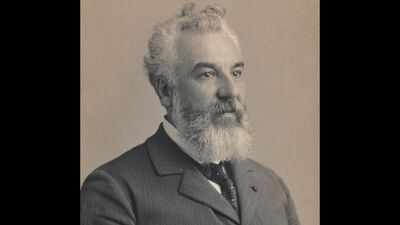
In an age of constant notifications, endless open tabs and competing priorities, Alexander Graham Bell’s words feel genuinely surprising in how modern they still sound. “Concentrate all your thoughts on the task at hand,” he said. “The sun’s rays do not burn until brought to a focus.” The line is extremely widely and consistently attributed to Bell across dozens of independent collections of his sayings, appearing alongside other genuinely documented quotes of his, though no single interview or book has been pinned down as its original source. It captures a genuinely simple idea that is easy to understand and considerably harder to actually practise, that real potential becomes powerful once it is concentrated in one direction rather than spread thinly across many, a lesson that feels genuinely relevant given how much of Bell’s own life was actually spent studying focus, sound and the science of communication.
Quote of the day by Alexander Graham Bell
“Concentrate all your thoughts on the task at hand. The sun’s rays do not burn until brought to a focus”
What is the meaning of the quote by Alexander Graham Bell
Bell compares human attention directly with sunlight. Sunlight spreads its energy across a genuinely wide area, yet once its rays are brought together at a single point, their intensity becomes strong enough to produce real heat, even to burn. Scattered thoughts, in much the same way, may genuinely contain enormous potential, while focused attention is what actually turns that potential into a meaningful result. A person may genuinely have intelligence, creativity and ambition, and these qualities can still produce fairly limited results once attention is constantly divided between too many things at once.
Why concentration is more powerful than constant activity
Being busy and being genuinely productive are not the same thing at all. A person can spend an entire day responding to small requests and still make very little actual progress on something that genuinely matters. Another person may spend a considerably shorter period working without interruption and accomplish far more in that time. The real difference is usually concentration. Focused work lets the mind stay with a genuine problem long enough to actually understand it properly, rather than repeatedly starting over after yet another distraction pulls attention away.
The sun’s rays as a genuinely powerful metaphor
The second half of the quote is really what makes the whole message memorable. Bell never said the sun lacks power. Quite the opposite, since the sun already possesses enormous energy on its own. What genuinely changes is how that existing energy actually gets directed. The same can genuinely be said about people. Someone may already possess considerable talent while still struggling to use it effectively simply because their attention is spread across too many things at once, while someone with genuinely less natural ability can make remarkable progress by concentrating consistently on one clear objective instead.
Focus is what genuinely turns potential into a real result
Potential on its own never guarantees achievement. Someone may genuinely have a great business idea but never actually develop it. A talented writer may genuinely never finish the book they keep meaning to write. In each of these cases, real potential clearly exists. What is genuinely missing is sustained application over time. Concentration creates a genuine bridge between simply intending to do something and actually executing it properly.
Why multitasking can genuinely weaken real attention
Modern work often celebrates multitasking, yet constantly switching between task after task can make genuine concentration considerably harder to sustain. The real problem is never simply the minutes spent answering one extra message. It is that the mind also has to actually return to the original task afterwards, and that repeated switching can make genuinely complex work feel considerably harder than it actually needs to be. Bell’s advice really points toward a different approach entirely, that when something genuinely deserves your attention, it should actually receive it.
Concentration genuinely requires saying no to something else
One of the less obvious lessons hiding inside this quote is that real focus involves genuine elimination. Nobody can concentrate fully on absolutely everything at once. Choosing one real priority automatically means giving considerably less attention to something else, which can feel genuinely uncomfortable, particularly when every task seems urgent at the same time. Meaningful progress, though, very often genuinely requires deciding honestly what can actually wait.
Real deep work genuinely takes patience
Concentration is rarely comfortable, especially at the very start of a difficult task. Checking a phone takes mere seconds. Switching to something considerably easier provides an immediate, if fairly hollow, sense of accomplishment. Staying properly with the difficult task genuinely requires patience instead. The longer someone remains actually focused, the more familiar the real problem gradually becomes, and ideas slowly begin connecting in ways they simply could not while attention kept jumping elsewhere.
Other memorable quotes by Alexander Graham Bell
- “Don’t keep forever on the public road, going only where others have gone. Leave the beaten track occasionally and dive into the woods. You’ll be certain to find something you have never seen before.”
- “When one door closes another door opens; but we so often look so long and so regretfully upon the closed door, that we do not see the ones which open for us.”
- “What this power is I cannot say; all I know is that it exists and it becomes available only when a man is in that state of mind in which he knows exactly what he wants and is fully determined not to quit until he finds it.”
- “The inventor is a man who looks around upon the world and is not contented with things as they are.”
How to apply Alexander Graham Bell’s lesson in everyday life
The quote does not genuinely require someone to eliminate every distraction from their life entirely. It simply encourages considerably more deliberate control over where attention actually goes. At the beginning of a work session, it helps to identify the one task that genuinely matters most, since completing that single thing can be considerably more valuable than making only superficial progress on several others at once. It also helps to remove the most obvious distractions nearby, putting the phone away and closing an unrelated tab, and to give a genuinely difficult piece of work uninterrupted time, since even a focused thirty minutes can be more productive than several hours spent constantly interrupted.
Why the quote remains relevant today
Bell lived through a period of extraordinary technological change, yet his observation applies particularly well to modern life. People now have access to more information than ever before, and the real challenge is no longer simply finding information at all. It is deciding honestly what actually deserves attention in the first place. Every notification competes for a small piece of genuinely limited mental space, and in that environment, real concentration becomes an increasingly valuable skill. Just as sunlight becomes capable of burning once its rays are genuinely brought together, human potential becomes far more powerful once attention, time and energy are actually concentrated on one meaningful task at a time.