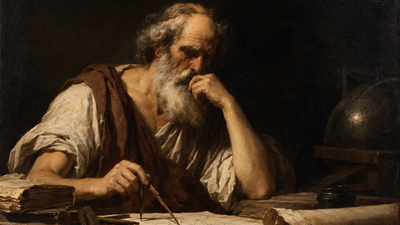
The idea that a single person could move something as enormous as Earth sounds impossible at first. More than two thousand years ago, however, Greek mathematician and inventor Archimedes used the image to demonstrate the extraordinary power of a simple mechanical principle. The statement “Give me a place to stand on, and I will move the Earth” is traditionally attributed to Archimedes and is associated with his understanding of the lever. Rather than being a literal promise to move the planet, the quote illustrates how the right position and mechanical advantage can allow a relatively small force to overcome a much larger load. The famous wording was recorded by the later Greek mathematician Pappus of Alexandria, making it more accurate to describe it as a statement attributed to Archimedes.
Quote of the day by Archimedes
“Give me a place to stand on, and I will move the Earth.”
Archimedes’s advice centres on the power of leverage
The famous statement captures a fundamental idea in mechanics: leverage can transform the effect of a force. A lever consists essentially of a rigid object that pivots around a fixed point known as a fulcrum. By changing the distance between the applied force and the fulcrum, a person can produce a much greater turning effect than they could by applying the same force without mechanical advantage.Archimedes understood this principle and studied the balance of weights and forces mathematically. His statement about moving Earth was therefore not simply an expression of confidence. It was a dramatic way of illustrating what mechanical advantage could achieve when the right conditions were available. The larger the distance between the point where force is applied and the fulcrum, the greater the potential mechanical advantage.The quote has since become a powerful metaphor beyond physics. It suggests that enormous challenges can sometimes be approached differently by changing the position from which we act. Instead of relying only on greater strength or effort, finding the right method can make a seemingly impossible task much more manageable.
Why leverage can make a huge difference
The principle behind Archimedes’s statement can be seen in everyday objects. A crowbar can lift a heavy object that would be difficult to move directly. A seesaw allows one person to balance or move another depending on their positions relative to the fulcrum. Even a pair of scissors uses the principles of levers to multiply the effect of the force applied by the user’s hand.The key is not that a lever creates energy from nothing. It trades force for distance. A person may be able to move a much heavier load with a lever, but the end of the lever may have to travel a much greater distance. The mechanical advantage comes from how the force and movement are distributed around the fulcrum.That is what makes Archimedes’s ancient insight so enduring. A problem that appears to require enormous strength can sometimes be solved through a better arrangement of forces. The lesson applies not only to machines but also to the way people approach difficult problems.
What the quote means
Archimedes’s statement can be understood as a celebration of knowledge, strategy and scientific understanding. If someone tried to move an enormous object simply by pushing against it, their physical strength would quickly become the limiting factor. A carefully designed lever, however, could dramatically increase the effect of that force.The quote therefore presents intelligence as a form of leverage. Understanding how something works can be more valuable than simply applying more effort. A person facing a difficult task may not need to work harder in every situation. They may need to find a better method, identify the right tool or change their position.That idea remains relevant in everyday life. Whether solving a technical problem, building something, managing resources or overcoming an obstacle, the right approach can sometimes achieve what brute force cannot.
Archimedes and the science behind his words
Archimedes was one of the most influential mathematicians and scientists of the ancient world. Born in Syracuse around the third century BC, he made important contributions to geometry, mechanics, hydrostatics and mathematical physics. His work on levers and equilibrium helped establish mathematical principles that continue to underpin mechanics today.His investigations into levers were particularly important because they connected physical observation with mathematical reasoning. Archimedes recognised that the position of a force relative to a fulcrum determines its turning effect. This allowed him to explain how a small force could balance a much larger weight when applied at a sufficiently greater distance from the pivot.The famous quotation is often presented as though Archimedes personally wrote the exact words that have become familiar today. However, the historical record requires some caution. The statement is associated with Archimedes through later ancient sources, particularly Pappus of Alexandria. The scientific principle behind the statement, however, is firmly connected with Archimedes’s work on the lever.
The timeless lesson
Archimedes’s words ultimately offer a lesson about leverage, knowledge and problem-solving. The quote does not suggest that impossible things can be achieved simply through confidence. Instead, it points towards the power of understanding how a system works and using that knowledge intelligently.