
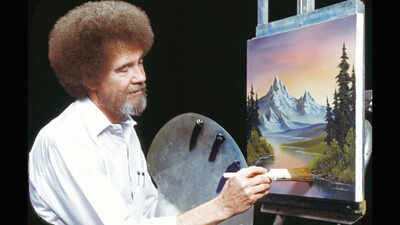
Standing in front of a wet canvas on television, a soft-spoken painter in a denim shirt painted a stroke of dark brown paint onto a bright landscape. He looked directly into the camera and offered a quiet thought:“The very fact that you’re aware of suffering is enough reason to be overjoyed that you’re alive and can experience it.”The sentence sounds strange when you first hear it. Society usually treats pain as a problem—something to fix, hide, or cure with medicine. Yet Bob Ross points to a simple truth about human life. Pain is not a sign that our body or mind is broken. It is proof that we are alive and processing the world. Experiencing heartbreak, grief, or frustration requires an active mind. The pain itself may hurt, but the ability to feel it belongs only to the living.
The quiet studio on public television
Bob Ross spoke those words during an episode of The Joy of Painting, the public television show he hosted from 1983 to 1994. Filmed at a small TV station in Muncie, Indiana, US, the show had a low budget, but Ross reached millions of viewers with his gentle voice and simple painting style.The story behind his comment was deeply personal. Ross was grieving the loss of his second wife, Jane, who had died of cancer in 1992. On camera, Ross rarely talked about his personal sad news. He kept his focus on “happy little trees” and soft clouds. In this specific episode, however, he talked about why dark paint is necessary on a canvas to make the light colors show up.He moved naturally from art tips to human emotions. He explained that life follows the same rules as a painting. Without dark moments, the good moments lose their brightness. Ross was not a college professor giving a lecture. He was an art instructor sharing a lesson learned through personal loss, speaking to an audience of late-night viewers, elderly people at home, and tired insomniacs.
Simple philosophy in a denim shirt
The logic behind Ross’s words matches ideas from ancient Stoic thinkers and modern philosophers. The ancient teacher Epictetus taught that human beings cannot control outside events, only their own reaction to them. Noticing pain without letting it destroy you is a key part of this ancient mindset.In the mid-twentieth century, psychiatrist Viktor Frankl explained a similar idea in his 1946 book Man’s Search for Meaning. Writing about his survival in Nazi concentration camps, Frankl observed that suffering is an unavoidable part of life, just like death. Without struggle and loss, human life cannot be complete. Frankl argued that when a person cannot change a painful situation, they are forced to change themselves. Recognizing pain becomes the first step toward finding purpose.In terms of psychology, Ross was describing how human senses notice contrast. The brain understands life through comparison. Constant happiness leads to a state where nothing feels special anymore, something psychologists call sensory adaptation. Pain resets our baseline expectations. The sharp sting of loss makes quiet moments of safety and love feel much sweeter.
Living mindfully in a fast world
Ross’s point is especially helpful today in a world focused on quick comfort, digital distractions, and instant fixes. Modern culture often treats emotional distress as a personal failure or a technical problem. When human sadness is treated like a bug that needs to be deleted, people lose the ability to deal with basic life struggles.In modern mental health therapy, doctors use a technique called radical acceptance. Created by psychologist Marsha Linehan, this approach teaches people that deep suffering comes from trying to fight or ignore reality. Accepting grief or physical pain as a basic fact of life helps people stay grounded in the present moment instead of panicking about their discomfort.This perspective also changes how people handle failure at work or in life. An athlete healing from an injury or a business owner facing a failed project can view their disappointment as proof that they tried hard. Feeling sad about a loss simply means the goal mattered to you.Ross recorded more than 400 episodes of his show, creating thousands of landscape paintings that were stored in cardboard boxes at his company’s office in Herndon, Virginia. He died of lymphoma in 1995 at the age of 52. His paintings remain largely unsold, but the simple mindset he shared next to his easel continues to give people a practical guide for handling all the ups and downs of life.