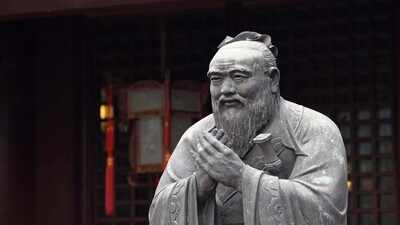
Long before social media rewarded instant opinions and constant visibility, Confucius was making a distinction that still feels remarkably relevant. He did not argue that words were unimportant. He taught for much of his life through conversation, debate and careful reflection. What he questioned was the temptation to let speech run ahead of conduct. A person’s character, he believed, is measured less by what they promise than by what they consistently do.The line appears in the Analects, the collection of sayings and conversations that preserve Confucius’ teachings, where the “superior man” refers to the junzi: an ideal person shaped by discipline, integrity and moral cultivation rather than birth or social rank. In ancient China, nobility was traditionally inherited, but Confucius offered a different standard. Anyone, regardless of background, could become a junzi by developing virtue through education, self-examination and ethical conduct. The quote captures one of the central ideas of that philosophy: genuine worth announces itself through actions, while empty words demand attention they have not yet earned.
A philosophy built on conduct
Confucius lived during the Spring and Autumn period, a time of political instability when rival states competed for power and loyalty. He believed social order could not be restored by harsher laws alone because lasting stability depended on the moral conduct of individuals, beginning with those who held authority. A ruler who governed with integrity inspired trust more effectively than one who relied on force, just as a teacher earned respect by setting an example before offering instruction.That emphasis on conduct explains why the quote has endured for more than two millennia. Words can create an impression in a matter of seconds, though impressions are fragile. Actions accumulate slowly, gathering credibility over months and years until they become reputation. Confucius understood that people eventually judge character through patterns rather than performances. A promise is remembered for a day; keeping it is remembered much longer.Behavioural researchers have long observed that people assess trustworthiness less through declarations than through consistency. A colleague who repeatedly meets deadlines inspires confidence without constantly speaking about reliability. A friend who appears when help is needed rarely has to explain their loyalty. The evidence of character emerges through repetition, making grand claims increasingly unnecessary.
The difference between visibility and credibility
The modern world has made speech easier than at any other point in history. Publishing an opinion no longer requires a newspaper, a television studio or even an audience gathered in one place. Anyone can comment instantly on almost any subject, and that accessibility has brought undeniable benefits. It has also created an environment where speaking can sometimes feel more valuable than doing.Confucius’ observation invites people to reverse that order. There is a quiet confidence in allowing work to speak before explanation. The scientist who publishes careful research instead of announcing breakthroughs that have not arrived yet, the entrepreneur who spends years improving a product before celebrating its success, or the volunteer who gives time to a community without turning every act into a public performance all reflect the spirit of the quotation. Their contribution becomes visible because of what they accomplish rather than because of how often they describe it.This is not an argument for silence. Confucius himself believed language carried enormous importance when used with honesty and restraint. He repeatedly stressed that words should be accurate, sincere and matched by conduct. The problem arises when speech becomes a substitute for action, creating the appearance of commitment without the effort required to sustain it.History is filled with figures who understood this instinctively. Many of the people remembered most favourably are admired because their work gradually outgrew their self-promotion. Their reputations travelled further than their own voices ever could. The lesson extends beyond leadership and public life into ordinary relationships, where reliability, kindness and responsibility rarely need dramatic announcements. They become visible through habit.
A lesson that has outlived its age
The Analects were compiled more than 2,000 years ago, though the tension between words and actions has never really disappeared. Every generation develops new ways of expressing opinions, making promises and presenting carefully shaped versions of itself to the world. Confucius’ advice continues to matter because it shifts attention away from appearances and back to conduct. It asks a simple question that remains surprisingly difficult to answer honestly: if the words are set aside, what do the actions reveal?That question gives the quotation its lasting power. It does not ask people to speak less for the sake of silence, nor does it dismiss the value of thoughtful conversation. Instead, it reminds us that the strongest arguments are sometimes made without argument at all. A life marked by integrity, competence and consistency rarely needs elaborate explanation because, in the end, actions have a way of saying exactly what words cannot.