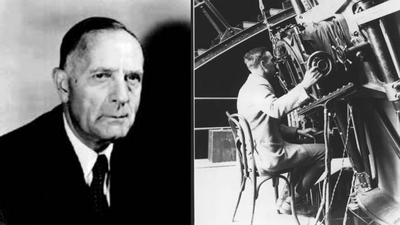
One thing that characterises science in its early stages is the fact that it all starts with the desire to find out more about something that is yet unknown to people. As Edwin Hubble put it in one of his famous quotes, “Equipped with his five senses, man explores the universe around him and calls the adventure Science.” In this quote, the author shows how science should be viewed as something that goes far beyond mere numbers and equations. In other words, this is something that involves a continuous exploration of the world around us. Thus, we discover things and gradually learn through our observations and experiences.Edwin Hubble (1889-1953) was an American astronomer whose observations have changed the way humanity perceives the universe around it. His works have shown that there are many galaxies beyond our galaxy and that these galaxies move away from us.
Quote of the day by Edwin Hubble
“Equipped with his five senses, man explores the universe around him and calls the adventure Science”
What does this quote mean?
The quotation by Hubble implies that science is an approach which starts with observations. Human senses give us opportunities to see, listen, feel and experience the world, while scientific instruments help people go much further and observe things which are inaccessible through our senses. With telescopes we can observe distant galaxies, with microscopes we can observe structures which are invisible to naked eye and with scientific devices scientists can observe phenomena which cannot be perceived with human senses. And all this adventure starts with the observation of something and a question of why this phenomenon takes place.
Curiosity is where scientific discovery begins
Prior to carrying out the experiment, there is usually a question. What makes stars glow? How do organisms evolve over generations? What happens in an atom? Is there anything beyond the universe which can be seen by a human being? These and many other questions were the basis for scientists who investigated the things which were unknown before. And Hubble’s explanation of science as an adventure shows this exploratory process of science very well. Sometimes unexpected discoveries are made.
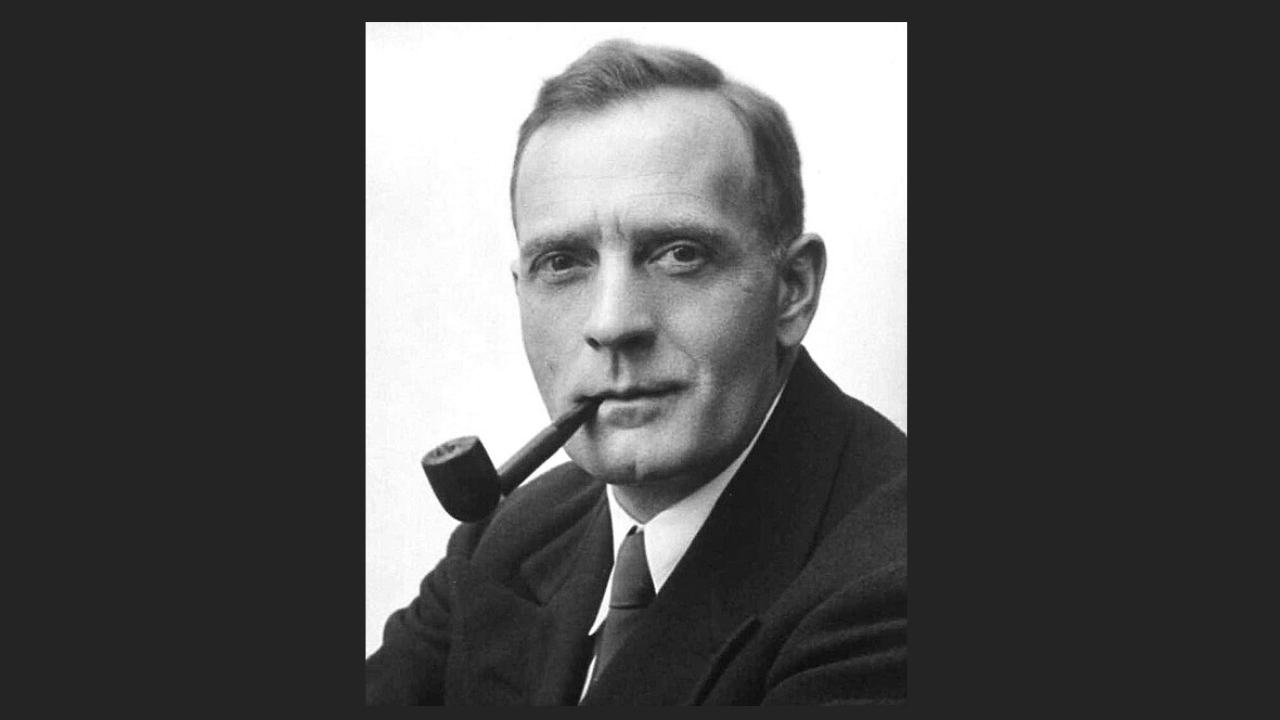
Edwin Powell Hubble (November 20, 1889 – September 28, 1953) (Image: Wikipedia)
Our senses are only the beginning
Although there are five basic senses, science has found incredible ways to enhance human senses. Radio telescopes can see things unseen by our eyes, gravitational wave detectors can see ripples in spacetime, and particle detectors can show the behavior of matter on microscopic scales. In this respect, scientific equipment has turned into an extension of human senses. This allows us to probe parts of the real world which would otherwise be inaccessible for our body.
Hubble’s own work changed our view of the universe
Hubble knew the power of scientific observation through his research as well. Through the study of galaxies far away from us, he showed that the universe is much greater than our galaxy. Furthermore, his observations provided additional proof that the universe is expanding. The small number of stars has been replaced by an unimaginably large space populated by innumerable galaxies. Improved observation methods changed our perception of where humanity is located within the universe.
Every discovery reveals another mystery
What I find most interesting in science is that answering one question does not mark the end of the journey. Quite the opposite, it opens up a lot of new questions. The moment one learns the universe is expanding, there come many more questions about how that happened, how it developed and where will it all end? When one learns about cell activity, there come many more questions about consciousness and living organisms. When one learns about gravity, there come many more questions about its connection to quantum physics. The more people explore, the bigger becomes the field of the unknown.
Science is a journey rather than a finished book
“Adventure”, used by Hubble in his speech, means movement, unpredictability and discovery. Science is not much different. Scientists start from knowledge they already have, learn how to study the unknown and sometimes find out that their initial assumptions were wrong. Therefore, scientific knowledge is ever changing, based on the evidence found.
Human curiosity can reach across unimaginable distances
There is something extraordinary about the fact that humans can investigate objects billions of light-years away despite living on a small planet. Light travelling across the universe can be captured by instruments on Earth and transformed into information about stars, galaxies and cosmic events that happened long before human civilisation existed.That ability is perhaps exactly the kind of adventure Hubble had in mind. We do not have to physically travel somewhere to begin exploring it. Sometimes, observation itself is enough to take us there.
Why this quote still matters today
Hubble’s words remain relevant because the fundamental impulse behind science has not changed. We continue to look, question, test and explore. The tools have become vastly more sophisticated, but the motivation remains deeply human, we want to understand what is around us. The enduring lesson behind his quote is that science is not simply about accumulating knowledge. It is the adventure of turning curiosity into discovery, and recognising that every new answer may reveal an even larger universe of questions waiting to be explored.