
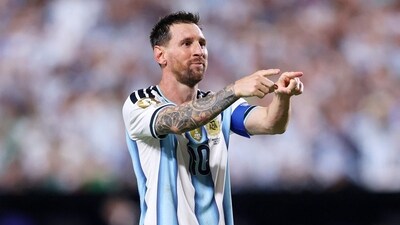
Lionel Messi was left in tears after scoring his first goal en route to a historic hat-trick in Argentina’s FIFA World Cup 2026 opener against Algeria on Tuesday night in Kansas City. Given the emotional weight surrounding what is expected to be his final World Cup, many initially assumed the tears were linked to the occasion itself. Messi later admitted the moment carried deep personal significance, but stopped short of revealing the reason.
A fresh report has now shed light on what was behind the emotional scenes.
According to Argentine radio station Radio Mitre, the most-listened-to broadcaster in the country, Messi’s tears were triggered by a serious health concern involving his father, Jorge Messi. The 68-year-old, who is not only Messi’s father but also his long-time agent and business manager, has reportedly been battling health issues for several months.
The report claims Jorge’s condition worsened during the week leading up to Argentina’s World Cup opener, leaving Messi emotionally drained despite his brilliance on the pitch.
The emotional moment came shortly after Messi opened Argentina’s account against Algeria with a stunning long-range strike. Speaking after the match, the eight-time Ballon d’Or winner hinted at the personal struggles he had been dealing with.
“Honestly, it’s something completely unrelated to sports. It’s been a few difficult days, complicated,” Messi said.
An insider quoted in the report later revealed the issue was linked to Jorge’s health.
“This has to do with his father. His father is not in good health,” the source said. “For quite some time now, several months, since last year. This week there were situations that slightly worsened his condition, and Messi is going through this internal struggle. Like any human being would.”
Argentine media reports further claimed that Jorge suffered a medical episode at his home in January and was subsequently hospitalised. He reportedly underwent cardiovascular and neurological examinations, although the Messi family have not publicly disclosed details regarding his condition.
Despite the emotional burden, Messi delivered one of the finest performances of his World Cup career. In front of a sold-out crowd in Kansas City, he found the net four times, although one goal was ruled out for offside. Before being substituted in the 76th minute, he completed the first World Cup hat-trick of his career and drew level with Miroslav Klose on 16 goals, making them joint-highest scorers in World Cup history.
After the match, Messi thanked those around him for helping him navigate a difficult period.
“I had some difficult, complicated days, but I’m grateful to the entire delegation and all my teammates because they were always by my side, as always, giving me a lot of strength,” he said.
The Argentina captain chose not to elaborate further and instead reflected on another landmark achievement — his 200th appearance for the national team.
“Everything I’m experiencing now is amazing,” Messi said. “I was lucky enough to achieve all my dreams, individually and collectively, even more than I imagined as a kid.
“Today I’m enjoying this, being part of a wonderful group, feeling good and, thankfully, still being able to enjoy football on the field the way I’ve always loved to. Everything I’ve experienced is so much more than I could have imagined when I was a child.”
For one night, Messi’s brilliance once again lit up the World Cup stage. But behind the goals, the records and the celebrations was a private battle few knew he was fighting.