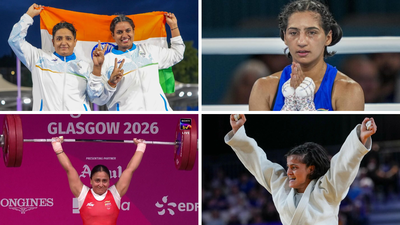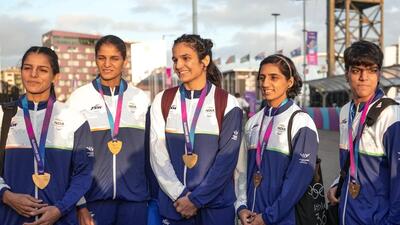
New Delhi: Indian boxers capped their Glasgow Commonwealth Games campaign in style, winning seven gold and three silver medals on the penultimate day of competition. The gold rush sent India into top-five on the medals table, a no mean feat considering that most of country’s stronger sports — wrestling, shooting and badminton — were not in the scaled-down Games. India ended with 39 medals (13 gold, 17 silver, 9 bronze).
With seven of the country’s 13 gold medals coming from the boxing ring, the magnitude of the haul can’t be stated enough. India’s gold count surpassed the previous best at CWG and went past England, who won six gold twice (London 1934, Gold Coast 2018), while Canada had matched that tally at Edinburgh 1986.
While the overall tally in boxing rose only marginally, from nine medals in 2018 to 10 in 2026, the number of gold went from three to seven.
Celebrate we must, but sweeping success like this runs the risk of losing perspective. Indian boxers as well as the Boxing Federation of India (BFI) will do well to assess the success with a degree of pragmatism. The quality of boxers in the women’s field was never going to test the Indians, although the men’s side of the draw was far more competitive.
India’s returns shouldn’t come as a total surprise to those following the sport. While women’s boxing in India is witnessing an unprecedented surge, the men’s group is in transition. Only two Indian men — Amit Panghal and Nishant Dev — made the cut for the 2024 Paris Olympics while Nikhat Zareen (50kg), Preeti Pawar (54kg), Jaismine Lamboria (57kg), and Lovlina Borgohain (75kg) made the women’s team in what turned out to be a medal-less run.
In 2025, at the World Boxing Championships in Liverpool, no Indian man could win a medal while Minakshi Hooda (48kg gold), Jaismine Lamboria (57kg gold), Nupur Sheoran (+80kg silver) and Pooja Rani (80kg bronze) pushed India to overall third in the tally, behind Kazakhstan and Uzbekistan. At the season-ending World Boxing Cup Final in Greater Noida late last year, Indian boxers swept 20 medals, including nine gold, in a severely depleted field and some questionable refereeing.
In Glasgow, the absence of central Asian countries as well as Japan and China gave India a decent shot at history. And credit to the boxers, they took it. Sakshi Chaudhary (51kg), Preeti Pawar (54), Jaismine Lamboria (57), Priya Ghanghas (60), Arundhati Choudhary (70), Sachin Siwach (60) and Ankush Panghal (80) ensured the national anthem barely stopped at the SEC Centre.
Olympic medallist Lovlina Borgohain (75), Jadumani Singh (55) and Narender Berwal (+90) lost in the final to finish with silver medals.
The tougher test will come at the Asian Games in Japan (Sept 19-Oct 4) where China, Uzbekistan, Japan and North Korea, among others, will be present. At the 2022 Asian Games in Hangzhou, the 13-member boxing team returned with one silver and three bronze.
BFI president Ajay Singh was honest in his assessment. “You can’t replicate this performance at the Asian Games. There’s no question about that,” he said in a virtual media interaction with the boxing squad.
“For us, Asian Games is like the Olympics. The top-3 teams of the world — Kazakhstan, Uzbekistan and India — will be there. Then there will be China. This performance will not be replicated but we will still do well,” Singh said.
Santiago Nieva, the women’s team head coach, also sounded a note of caution. “We can’t guarantee that we will win gold all the time but we are on the right track. As a group, we are quite realistic in our assessment of success. We know how strong the field will be at the Asian Games. After that, there’s World Championships where Olympic quotas will be on offer. There will an Asian qualifier later which will also feature a very strong field. We know there are tough tests ahead. The boxers are aware that they can’t sit on their success,” Nieva said.
“England are usually quite strong against us but this time we beat them in six out of eight bouts and we doubled them on the medal table. Couple of months back we were at the Asian Championships and won five gold medals,” he added.
To be fair, not all bouts were one-sided either. Young Ankush Panghal (80kg) made a remarkable comeback after losing the opening round while Priya (60kg) needed to win her last round in all her three bouts.
“You can’t do that by simply throwing punches. You have to outbox the opponent. It’s not that we weren’t challenged. We got quite a few warnings in preliminary rounds after which we worked on maintaining distance and throwing clean, decisive punches. Every match had its moments,” the coach said.
The men got some boost through Sachin and Ankush’s wins. Jadumani, having stepped up to 55kg, was arguably the most entertaining Indian male boxer on view, while Narender Brewal won a rare super heavyweight medal (silver) for India (+90kg).
“I am quite impressed with Ankush as he was playing in his first major competition. He is a work in progress as he needs to be good at long range, otherwise he’ll keep getting warned for head butt. But overall, he and Sachin gave a very good account of themselves,” men’s coach CA Kuttappa said.
Whether that translates into success against Asia’s heavyweights will become clear within weeks in Japan.