
People living along Japan’s Sea of Japan coast had been saying for years that they occasionally spotted dolphins close to shore. Local fishers also reported seeing them from time to time. These sightings were interesting, but scientists did not have enough information to understand how often the animals actually visited these coastal waters or what they were doing there.A new study by researchers from Kyoto University has provided some answers. Rather than waiting to spot dolphins at the surface, the team listened for them underwater using special recording devices. Their findings showed that dolphins visit two bays along the Sea of Japan coast only occasionally, with their sounds being detected about once every 10 days, Science X reported.The research, published in the journal Marine Mammal Science, focused on Wakasa Bay near Obama City and Aso Bay near Tsushima City. These are coastal areas where local residents and fishers had reported seeing dolphins.The Sea of Japan has been changing quickly in recent years. It is partly enclosed by the Japanese islands and the Eurasian continent and is connected to the open ocean through shallow straits. Although dolphins and porpoises have been reported in these waters before, scientists say there has been very little basic information about these small toothed whales, known as odontocetes.
Local reports started study
The idea for the research came from conversations with people living near the coast. “This study began through local connections: we heard from acquaintances and local fishers that dolphins might be visiting nearby waters,” said first author Satoko S KimuraThe researchers wanted to find out how often dolphins visited these bays and what kinds of sounds they produced while using these coastal waters.For this, the scientists used passive acoustic monitoring. This method involves placing underwater microphones, called hydrophones, in the sea to continuously record sounds without disturbing marine animals.The equipment recorded different kinds of sounds made by dolphins and other small odontocetes. These included echolocation clicks, which dolphins use like natural sonar to find their way and locate prey, as well as whistles, which are mainly used for communication.The monitoring continued for nearly three years in Wakasa Bay, from January 2022 to November 2024. In Aso Bay, recordings were collected from March 2023 to October 2024.The project also depended heavily on local communities. Residents helped scientists place and retrieve the recording devices from the water. Fishermen also shared information about dolphin sightings and, whenever possible, took photographs of the animals.
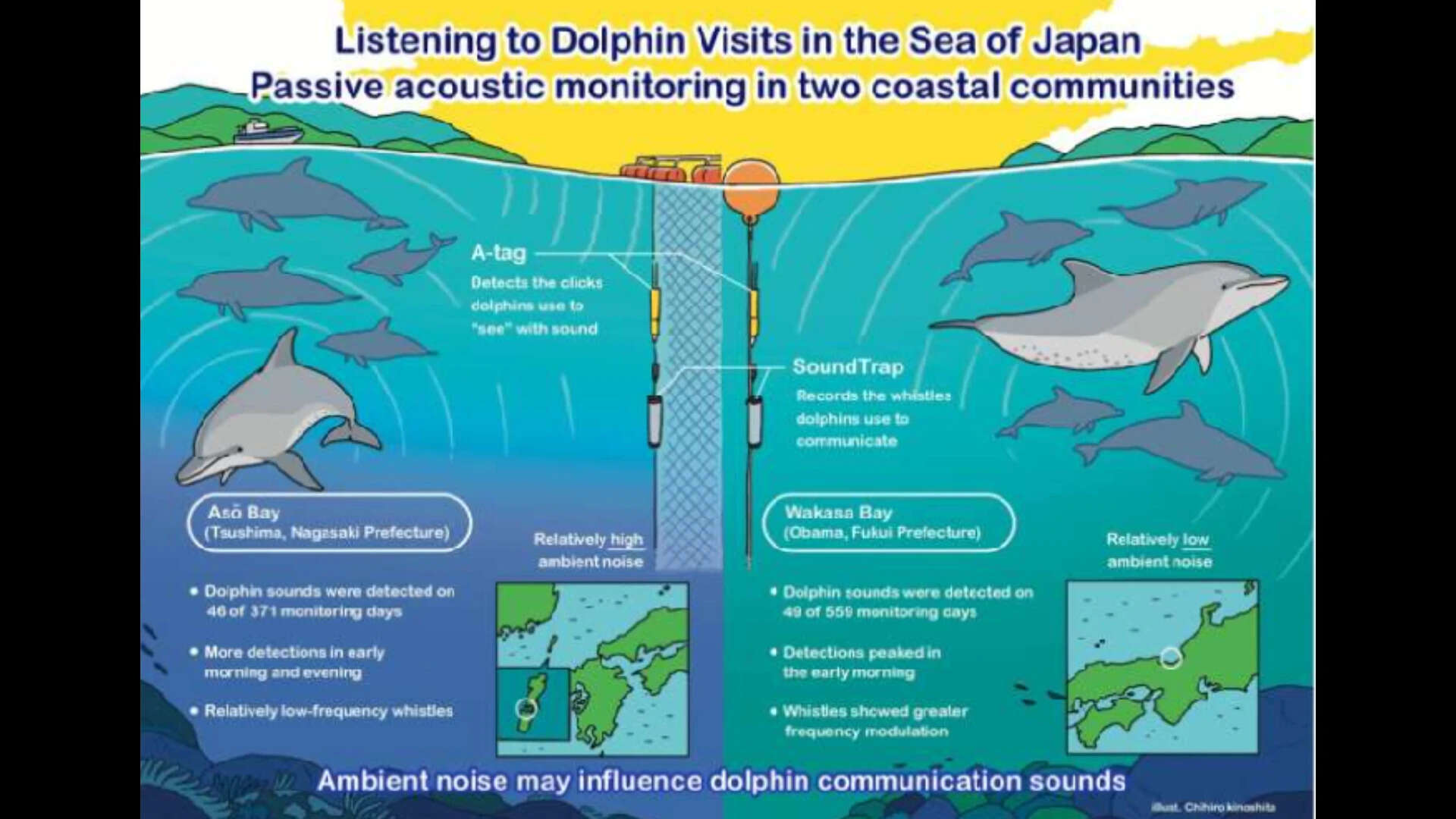
Revelations from passive accoustic monitoring in 2 coastal communities.
What Dolphins revealed
The recordings confirmed that dolphins were visiting both bays. However, the visits were much less frequent than some people may have expected.Researchers detected dolphin sounds only about once every 10 days in both Wakasa Bay and Aso Bay. This suggests that dolphins use these coastal areas from time to time rather than staying there continuously.The researchers also noticed differences in the whistles recorded in the two bays. In Aso Bay, where background underwater noise was higher, the whistle characteristics differed from those recorded in the quieter Wakasa Bay.The team could not determine whether these differences were caused by the noisier environment or whether different groups of dolphins naturally produced different whistles.Based on the recorded sounds, sightings by local fishers and photographs, the researchers believe the visiting animals were most likely Indo-Pacific bottlenose dolphins.Although the evidence strongly points to this species, the study could not identify every individual animal with complete certainty.
Why findings matter
Scientists say the study provides important baseline information about when small dolphins visit these coastal waters and the sounds they make.Such information has been limited for the Sea of Japan coast, making it difficult to understand how these animals use the region or whether their behaviour changes over time.The research also highlights the value of passive acoustic monitoring. Since dolphins do not always surface where people can see them, listening underwater allows scientists to detect animals even when they remain out of sight.Long-term monitoring can also help researchers notice changes in the marine environment. If dolphin visits become more or less frequent in the future, or if different species begin appearing, underwater recordings could help detect those changes.The researchers hope that continued monitoring will improve understanding of marine life along the Sea of Japan coast and provide evidence that supports both conservation efforts and the sustainable use of coastal waters by local communities.