
Despite global uncertainty and geopolitical challenges, he said the company delivered record sales and earnings before interest, taxes, depreciation, and amortisation (EBITDA) during the April-June 2026 quarter. “As new capacities come on stream, we should see a better performance,” he added.
Chari also said Rossari is restructuring its overseas operations under a Singapore holding company and sees good opportunities in Saudi Arabia, although he declined to provide a growth target for the financial year 2026-27 (FY27).
Chari said biosurfactants, textile speciality chemicals and the home and personal care business are expected to remain key growth drivers. He also expects the institutional cleaning and hygiene business to turn profitable by the end of the financial year while the company continues to reduce debt through profit growth and the sale of non-core businesses.
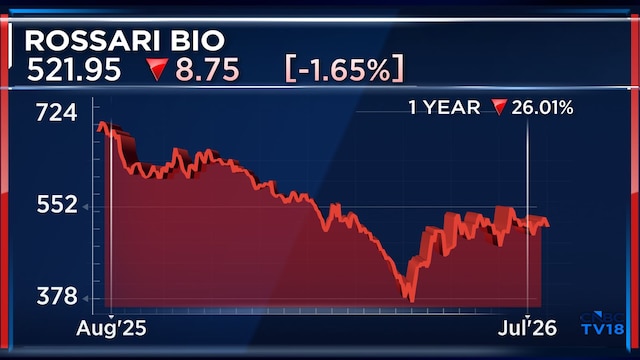
Rossari Biotech, which has a market capitalisation of ₹2,891.17 crore, has seen its shares decline over 26% in the last one year.
This is an edited transcript of the interview.Q: It’s been a good quarter, but if we look at the numbers, your revenue growth is much higher than what we’ve seen on the bottom line and EBITDA as well. This must be led by a lot of inflation in raw material prices. What is the sustainable guidance that you have for 2026-27 when it comes to top-line growth, especially margins and bottom-line growth, considering that you do have some of these expansions coming on stream as well? What is the macro setup on the supply side?A: When we did our IPO, we were just a ₹500-crore company, and for the last four or five years, we did not invest anything. All the capex has been invested in the last few quarters, and we hope for a gradual ramp-up of these expanded facilities in the next few quarters.
The markets have been very volatile and very uncertain. The war also has played its part. But we have navigated through this crisis in a very good way. We have had record earnings before interest, taxes, depreciation, and amortisation (EBITDA) and record sales. We feel that, as new capacities come on stream, we should see better performance.
Q: What do you mean by better performance? I know it’s very volatile, and chemical companies are hit the hardest at times. But what is the outlook, considering you do have a lot of capex coming up? The other plant from Unitop is going to get commissioned. Is there a growth target that you have for revenue? If not for revenue, since it could be volatile because of pricing, then for margins and bottom-line growth?A: So, we are seeing some overseas ventures. The Thailand plant has just started. We are looking at some opportunities in Saudi Arabia, and as you would have seen, we also took the board approval for setting up the Saudi Arabian subsidiary under the Singapore Global Holding Company, which we are planning to establish.
The Singapore Global Holding Company is a 100% subsidiary of Rossari Biotech Limited, India, and the plan is for all global subsidiaries to be transferred to the Singapore subsidiary, so that there is a single subsidiary.
In Saudi Arabia, we see good opportunities for the future. At the moment, it will be difficult to hazard a guess on the exact amount of growth or the percentage. But we have been growing in spite of all the issues in the last five years, and I am confident that we will grow well in the current financial year as well.
Q: The Thailand blending facility is also something that you’re planning to set up in Southeast Asia. Any sort of additional opportunity or guidance that one could expect there from the company if things start moving in a better direction?A: The focus has been on three divisions: Home, Personal Care, and Performance Chemicals (HPPC), animal health and nutrition, and textile specialty chemicals.
If you see the last financial year, we’ve grown between 15% and 20% in all three segments.
Starting with animal health and nutrition, which is the smaller division, we have invested in a very state-of-the-art Swiss plant for trace minerals, enzyme premixes, vitamin premixes and other poultry premixes. This could add a good amount of sales.
We have also added fermentation capacity in terms of biosurfactants. We got the REACH approval for our biosurfactant, becoming the first company in India to get REACH approval.
Over the next five to 10 years, I think biosurfactants will become a significant part of our portfolio.
In textile speciality chemicals, we have added spin finishes, which I think should do very well going forward. We are already seeing very good growth in that segment.
In the HPPC segment, the oil and gas segment and the pharma segment should do very well. Agro seems to be a little slow because of El Niño, and I do not know how it will pan out globally.
In India, the growth is slower than last year, but we have surpassed last year’s sales because of aggressive positioning in the market.
In terms of surfactants for home and personal care, this seems to be a focus area which will continue to grow.
In the next five years, I expect HPPC to account for 90% of our business. The other divisions will also grow, although at a comparatively slower rate. HPPC should account for around 90% of our sales over the next five years. That is my expectation.
Q: A two-part question. Just wanted to touch upon the institutional and the B2C performance. You did incur an EBITDA loss this quarter, and that has lessened on a year-on-year basis, but it’s still in the red. When do you expect a turnaround in that business? In terms of revenue growth, it was absolutely flat this time. What are you expecting within that segment in terms of growth? Secondly, just take us through your balance sheet.A: If you see the institutional cleaning and hygiene business, we have been focusing on reducing our losses on the EBITDA front and making it more profitable.
We are also focusing on our working capital management. If you see the last quarter, we had a significant decrease in receivables, and inventory days also reduced, especially in agro.
Because of this volatile and uncertain environment, we thought that we should focus more on collections rather than sales and not allow any bad debts.
We have a record over the last 29 years of having practically zero bad debts, and that is something we want to continue, both in the domestic and export businesses.
We understood that we need to hive off some divisions that are not core to our strategy, and we are on that path. Hopefully, in the next nine to 12 months, we should see some results as we reduce our debt by selling some divisions that are not doing well or are not part of our long-term strategy.
Q: What is the current total debt on your books? How much will you reduce it by?A: It is around ₹240 crore now, which is not too high compared to our EBITDA.
We have always maintained debt at below 2x EBITDA.
Other than what we invest in Saudi Arabia in the future, our debt in India should go down through profit growth and also the hiving off of some divisions.
Coming to your question on institutional cleaning and hygiene chemicals, we feel that we should be profitable by the end of this year.
The pet business, which is one of the areas where we have a higher loss, is something we also want to focus on to make profitable.
For the full interview, watch the accompanying video

Catch all the latest updates from the stock market here