
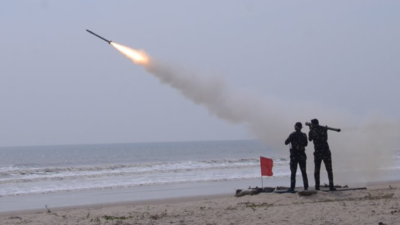
An unusual shoulder-fired air defence missile spotted in Russian military footage may actually be of Chinese or Iranian origin, raising fresh questions about just how interconnected the military supply networks forming a troika between Moscow, Beijing and Tehran have become. The man-portable air defence system, or MANPADS, showed up in Russian television footage of a mobile air defence group operating in the Rostov region bordering Ukraine, during an exercise reportedly involving a unit of Russia’s 51st Air Defence Division.What makes the sighting notable is that the weapon doesn’t closely resemble any of the Russian-made Man Portable Air Defence System (MANPADS) families currently in service. Russian personnel were heard referring to it as “Iva,” though that name alone doesn’t confirm the weapon’s actual origin or model, Iva means ‘willow’ in Russian, with one willow species named Verba, which also happens to be the name of Russia’s most modern MANPADS.Closer examination of the launcher has instead drawn comparisons to both Iran’s Misagh-3 and China’s QW-series systems, particularly the QW-18, QW-18A and QW-19. A box-like component visible near the front of the launcher appears more consistent with photographs of the Chinese QW-series than with the Misagh, though analysts also haven’t ruled out the possibility that this is simply a Russian-built derivative of a Chinese or Iranian design rather than an imported weapon outright.For context, Russia’s existing MANPADS arsenal includes the Verba and the older Igla system, the latter also used by the Indian Army, deployed across terrain ranging from the Siachen Glacier to the deserts of Rajasthan. MANPADS themselves are shoulder-launched, guided surface-to-air missiles designed to threaten low-flying aircraft, particularly helicopters, and increasingly, low-flying cruise missiles and drones. They can also be fired from vehicles, tripods and warships.Within broader air defence doctrine, MANPADS function as the last line of defence in a layered, point-defence network, protecting high-value assets like command centres, airbases and forward troop positions as one of the last layers of an overlapping integrated air defence neytwork. When larger medium or long-range surface-to-air systems fail to intercept a target, or when low-altitude threats exploit terrain to dodge radar, MANPADS step in as the final tier, typically engaging targets below 10,000 to 15,000 feet in altitude and within a horizontal range of five to eight kilometers, whether that’s a loitering drone, a terrain-hugging cruise missile, an attack helicopter, or a jet attempting a low-altitude strafing run. These missiles prove to be more cost effective at shooting down cheap loitering munitions when compared to bigger missiles.India, meanwhile, is developing its own heavy weight contender in this category, the Very Short Range Air Defence System (VSHORADS) a fourth-generation MANPADS built by the Research Centre Imarat in Hyderabad with support from multiple DRDO laboratories and Indian industry partners. Designed to neutralise low-altitude aerial threats at short range, the system forms part of India’s broader Integrated Air Defence Weapon System and has already been through successful test firings.