
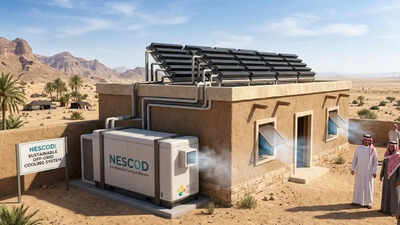
Researchers at King Abdullah University of Science and Technology in Saudi Arabia have introduced NESCOD, a new passive cooling technology. This innovative system addresses the rising global need for cooling solutions without depending on energy-consuming air conditioners. Mechanically, NESCOD leverages the thermodynamic properties of endothermic dissolution to offer an eco-friendly alternative for communities that are off the grid or in very hot areas.It captures solar energy and stores it for later use in cooling, marking a big step forward in environmental engineering. This system can eliminate specific cooling-related electricity costs and provides a scalable way to lessen the environmental damage caused by traditional cooling systems as our planet gets warmer.
NESCOD, a Saudi-developed electricity-free cooling system
The NESCOD system operates through a two-stage thermodynamic cycle: dissolution cooling and solar-driven solute regeneration. In the cooling/dissolution cycle, a specific salt – ammonium nitrate is dissolved in water. This chemical reaction is endothermic, meaning it absorbs heat from the surrounding environment to break the ionic bonds of the salt, rapidly lowering the liquid’s temperature. As noted in research published by the Royal Society of Chemistry, laboratory tests demonstrated that the system could achieve a cooling power of up to 191 watts per square meter under standard conditions.
How NESCOD recharges using sunlight
According to the research published by the Royal Society of Chemistry, researchers came up with a 3D solar regenerator for a sustainable and repeatable system. It works by using sunlight to turn water in the salt solution into vapour. When the water turns into vapour, ammonium nitrate forms crystals again, essentially recharging the system for another cooling cycle. This process means that the cooling effect can be stored and accessed whenever needed, whether it’s nighttime or a different season, as physical dissolution and regeneration happen separately.
How NESCOD maintains consistent cooling power
Research indicates that NESCOD remains effective in cooling even after several cycles. When exposed to solar illumination of one sun, it consistently evaporates water at about 2.2 kilograms per square meter per hour, which keeps temperatures between 5 degree Celcius and 15 degree Celcius – ideal for cold-chain storage and space cooling. On top of that, the system can capture the water vapour produced, enabling water reuse with impurity levels below 1 ppm (parts per million). This feature proves particularly useful in dry areas where water conservation is crucial.
The economic viability of NESCOD
The study points out that the materials in NESCOD, especially ammonium nitrate, are both effective and cheap. Ammonium nitrate finds extensive use in fertilisers, which makes it a sustainable chemical-energy carrier. It’s already being produced in large quantities. On another note, the 3D solar regenerator is engineered with a high-area 3D architecture.Its structure achieves a high evaporation rate even with a small footprint, reducing material costs per cooling unit compared to other solar-thermal systems. This economic efficiency makes the technology a viable candidate for large-scale deployment in developing nations and remote regions where traditional electricity infrastructure is either too expensive or unavailable.