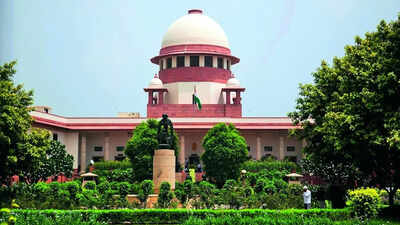
NEW DELHI: Questioning the efficacy of prohibition, Supreme Court Friday pointed to five “evils” associated with the ban on liquor – revenue loss, money spent on its enforcement, corruption in police, illegal distilling, and result-ant drug menace – while also referring to a number of hooch tragedies in Gujarat and other states over the years.A bench of Justices J B Pardiwala and K Vinod Chandran said this while quashing Rules 18A and 18B of Maharashtra Poisons Rules restricting purchase of methanol and making it mandatory to add bitterant and colourant to it before selling to non-drug manufacturers. The rules were framed following the deaths of 93 people from spurious liquor containing methanol in Mumbai in 1991.While allowing the plea of various chemical manufacturing companies, including Indian Chemical Council, the bench dwelled upon the efficacy of the prohibition policy. The court said recent hooch tragedies in Bhavnagar (Gujarat) and Sagar (MP), which claimed 13 and 15 lives respectively, were a reminder for the authorities to wake up and act.“History bears eloquent testimony to the fact that complete alcohol ban often drives the liquor trade underground, increasing the prevalence of unregulated, lethal brews. The state of Gujarat has a strict prohibition policy… It has witnessed at least 10 major mass hooch tragedies since the state’s formation and independence, claiming the lives of over 600 people,” the bench said.
Share your thoughts in the comments
Be respectful · TOI community guidelines
SC rejected Maharashtra govt’s plea and said the rules had no rational nexus with the objective sought to be achieved to prevent hooch tragedies. The court said it was not doubting the intention of the state but intention solely would not pass the test of manifest arbitrariness.“The state failed to indicate that this practice of putting such additives would discourage or rather dissuade continuous usage of methanol or affect its chemical composition so it cannot be used in making spurious liquor. Further, the state has also failed to indicate how mixing of the additives would definitively prevent deaths. Another question that is left unanswered is how the respondent plans to prevent manufacturing of spurious liquor by the use of other adulterants,” the bench said.