
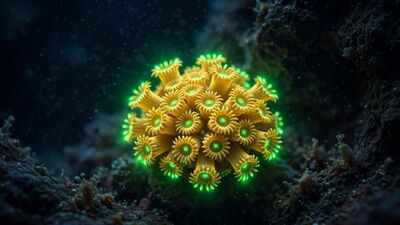
Scientists have discovered a new deep-sea species that flashes green light when disturbed inside underwater caves near Japan. Named Corallizoanthus aureus, the marine animal was found living on colonies of Pleurocorallium coral near the entrances of karst caves around Minamidaito Island. Researchers recorded its blinking light after mechanical and chemical stimulation, including during observations inside the cave.The glow had a measured peak wavelength of 515.4 ± 5.1 nanometres. According to research published in Royal Society Open Science titled ‘Glow in the D-ARK: a new bioluminescent species of Corallizoanthus from southern Japan’, the discovery provides the first documented observation of bioluminescence inside a deep-sea cave. The researchers said the light may serve a defensive role, although its exact ecological function remains unknown.
US Midterm Election Results 2026
A golden-coloured species discovered in deep-sea coral colonies
The researchers found Corallizoanthus aureus during deep-sea surveys around Minamidaito Island in southern Japan. The island lies about 360 kilometres west of Okinawa-jima Island and has steep, complex and difficult-to-reach underwater terrain. The team discovered the species living on colonies of Pleurocorallium coral at the entrances of several karst caves.It was formally described as a new species after researchers combined morphological, genetic, and molecular evidence. The species name aureus comes from the Latin word for golden. Its living polyps, including their distinctive tentacles and oral discs, are bright yellow. The researchers collected specimens from a depth of 385 metres in May 2024 and July 2025.
Deep-sea tests reveal the species’ ability to produce blinking green light
Researchers used remotely operated vehicles (ROVs) to explore the underwater caves as part of the international Deep-sea Archaic Refugia in Karst research project surveys. The team used the ROV KM-ROV with an attached sampling vehicle, TriPodFinder2. They tested the animals’ ability to produce light after collecting specimens.In a dark room aboard the research vessel at sea, they pinched the polyps with forceps and added potassium chloride to seawater containing the specimens. The team also tested living polyps inside the cave by mechanically stimulating them with a suction sampler during the research dives. In both settings, the polyps produced blinking green light after the team applied the stimulation.
What causes the deep-sea animal to produce green light
The light came from the polyps rather than the thin connections, known as stolons, linking some of them. Researchers measured the glow’s spectral peak at 515.4 ± 5.1 nanometres, with results from four replicates. During a separate underwater observation, the light appeared to spread visibly from the area where the animal was stimulated.The researchers did not observe any spontaneous light production during the reported study. They also found no sign of symbiotic bacteria in tissue examinations of Corallizoanthus aureus. Based on existing knowledge, they suggested that the animal’s light may involve the molecule coelenterazine and an unidentified light-producing enzyme called luciferase.
Scientists suggest green flashes may help the animal defend itself against predators
The ecological purpose of this green glow is not yet known. The researchers suggested that it may have a defensive role and discussed a possible ‘burglar alarm’ effect. Under this explanation, light produced by prey could attract larger predators that attack the animal’s immediate predator. Another possibility is a luminous tag.Sticky glowing mucus or detached body parts could remain on a predator, making it visible and more vulnerable to larger hunters. These two ideas remain possible explanations rather than established functions of the species’ light. The researchers said further field observations and detailed studies are needed in the future to understand how bioluminescence works in this group and what role it plays in the deep-sea cave environment around Minamidaito Island.