
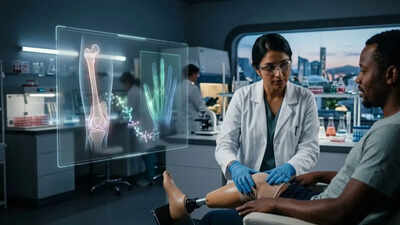
For a long time, scientists believed that only amphibians like salamanders could regrow complex limbs. But then came some groundbreaking findings from Texas A&M University. Researchers there discovered that mammals also have hidden regenerative abilities. They used a sequential two-protein signalling protocol to bypass the usual scarring in mice, which led to the formation of a blastema, a group of cells that can regenerate bones and joints, as noted in research published in Nature Communications. This discovery indicates that humans aren’t missing the genes for regeneration; they’re just not active. By activating these dormant pathways, medical science moves closer to a future in which we might restore limbs rather than rely on prosthetics and endure permanent scars.
Science behind the hidden limb regeneration ability in mammals
The core of this discovery is in tackling the mammalian fibrotic response (scarring), which blocks regrowth. As noted in research published in Nature Communications, scientists figured out that they could change the wound site by adding Fibroblast Growth Factor 2 (FGF2) and Bone Morphogenetic Protein 2 (BMP2) at just the right times. At first, FGF2 stops a collagen scar from forming quickly, letting cells go back to a stem-like state and create a blastema. Then, BMP2 steps in and makes these cells turn into the specific parts needed for a limb, like bones and ligaments.
How humans could heal like axolotls
A blastema is a group of undifferentiated cells, serving as the progenitive engine for regeneration in creatures like axolotls. This study shows that mammalian cells can also create these structures when the wound environment undergoes the right changes. The National Institutes of Health (NIH) mentions that figuring out how to activate these internal progenitor cells is considered the ‘Holy Grail’ in regenerative medicine. By triggering these pathways, scientists could shift from relying on external transplants to promoting natural healing within the body.
Signalling proteins could revolutionise modern surgery
The study used mice as subjects, but the BMP and FGF signalling pathways involved are highly conserved in humans. The Department of Defence has been backing this research for a long time through initiatives like the Armed Forces Institute of Regenerative Medicine (AFIRM). This support is aimed at addressing severe injuries. If we could use a patient’s own signalling proteins to regrow bone and joint tissue, it would revolutionise clinical outcomes for amputees and those with significant musculoskeletal trauma. This approach would mitigate the risk of immunogenic rejection.