
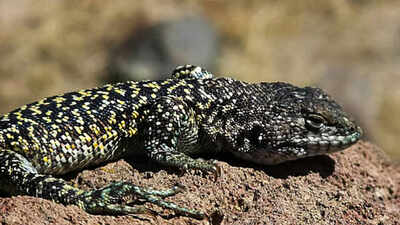
High in the Peruvian Andes, where thin air, cold temperatures and barren rock make survival a daily challenge, scientists have identified a remarkably small new inhabitant. Measuring no more than eight centimetres, the newly described lizard has adapted to a landscape where even the smallest advantages can mean the difference between surviving and disappearing, states the latest report by Gulf News. The species, named Liolaemus archipensis, was discovered at more than 4,800 metres above sea level in Peru’s southern Arequipa region, placing it among the reptiles living at some of the highest elevations in the country, adds the news report.
A lizard built for the high Andes
According to Gulf News, the new species belongs to the Liolaemus genus, a diverse group of lizards found across South America. Its compact body measures between six and eight centimetres, but its appearance changes noticeably between males and females.Females have square-shaped markings across their backs, while males display oblique patterns along with distinctive white scales. Against the area’s rocky terrain, the markings and muted coloration provide an effective form of camouflage, helping the lizards remain difficult to spot among stones and exposed ground, the online report adds. Such adaptations are particularly important in the high Andes, where vegetation is sparse and there are few places for small reptiles to hide.
A varied diet in a difficult habitat
Despite living in an environment that appears almost devoid of life, Liolaemus archipensis has access to a varied diet. Researchers found that the lizard feeds on vegetation as well as small arthropods. Its animal prey includes spiders, beetles, true bugs and insect larvae. This combination of plant and animal food gives the species flexibility in an ecosystem where food availability can fluctuate with altitude and seasonal conditions.The discovery also highlights how much remains to be documented in some of the Andes’ most remote environments. High-elevation ecosystems can appear stark to human observers while supporting highly specialised communities that have evolved to cope with extreme conditions, the report adds.
Adding to Peru’s reptile diversity
The species was identified by researchers associated with the Natural History Museum of San Marcos University, and its description was published in the Swiss scientific journal Diversity. Peru already has an impressive diversity of lizards, with 296 species recorded according to the researchers. The addition of Liolaemus archipensis expands that catalogue while drawing attention to a habitat that can be difficult to study because of its elevation and terrain.Finding a new reptile species at more than 15,750 feet is more than a taxonomic addition. It is another reminder that the Andes still hold biological surprises, even in landscapes that seem too severe to support much life. For a lizard barely the length of a human palm, surviving at such heights is itself a remarkable evolutionary feat.Image Courtesy: Gulf News