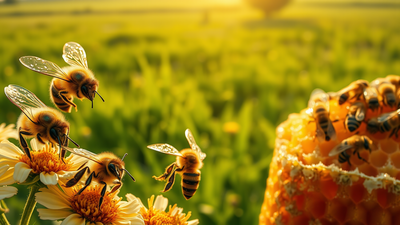
Bees have a reputation for being tireless workers, but it turns out that reputation only really applies to some of them. Researchers at the University of Illinois glued tiny numbered tags onto thousands of individual honeybees and tracked their comings and goings for almost two months across several separate colonies. What they found flips the whole busy bee idea on its head. In every single hive they studied, a small group of bees did most of the actual foraging work, while a much larger share of the colony barely lifted a wing in comparison, spending their days doing very little compared to their harder-working nest mates. The discovery raises new questions about how bee colonies actually organise labour without any single insect giving the orders.
How scientists tracked thousands of individual bees
To pull this off, the team set up five separate honeybee colonies, three outdoors in natural settings and two inside screened enclosures, with each colony starting out with around 2,000 day-old bees. Between 100 and 300 bees per colony were fitted with tiny radio tags, and pairs of scanners placed at each hive entrance picked up a bee’s unique ID every time it flew in or out. This setup let’s researchers quietly log which bees were leaving to forage, how often, and for how long, without needing to watch the hive by eye, which would be nearly impossible with this many bees moving in and out all day.
A small group of bees does most of the work
After almost two months of data, a clear pattern showed up. According to the study, published in the journal Animal Behaviour, around 20 per cent of the tagged bees accounted for roughly half of all the foraging trips recorded across the colony. This held true in every single hive the team studied, with the share of bees responsible for half the workload ranging between 16 and 21 per cent depending on the colony. Researchers call these standout workers elite foragers, and they were easy to spot once the data came in, since they started flying almost as soon as the colony woke up each morning and kept making steady, closely spaced trips right up until activity died down in the evening.
Being an elite forager is not a permanent job
The surprising part was that these elite bees did not stay elite forever. These elite bees were not locked into being hard workers forever. Their activity levels actually rose and fell over the course of the study and across their own lifetimes, which suggested to researchers that this hardworking behaviour was not some fixed trait a bee was simply born with. Gene Robinson, who led the research team, pointed out that scientists had generally assumed this kind of division of labour in social insects was intrinsic, essentially baked into certain individuals from birth. This study challenged that assumption directly, since bees seemed to adjust how much they worked depending on what the colony actually needed at the time, rather than sticking to one fixed role for life.
The rest of the hive may just be a backup workforce

This flexibility opened up a fascinating possibility about the bees who were not part of the elite group. Rather than being lazy or simply along for the ride, these less active bees may actually be functioning more like a reserve workforce, ready to step up and become elite foragers themselves the moment conditions in the hive shift, whether that means a favourite food source drying up or a fresh one suddenly becoming available nearby.
Later research confirmed the same pattern
This was not just a one-off finding either. A follow-up study published in the journal Scientific Reports tracked individual bees across their entire foraging careers and found almost the exact same split, with about 19 per cent of tagged foragers responsible for half of all recorded trips. Researchers even measured how unevenly the work was spread using something called a Gini index, a statistical tool normally used to study income inequality among people, and got a score suggesting real, consistent inequality in how much individual bees actually contributed to the colony’s foraging effort.
Why this matters for understanding how hives function
What makes this discovery genuinely useful is what it says about how insect colonies get things done without any single bee calling the shots. Rather than every worker pulling equal weight, colonies appear to lean on a smaller core of highly active foragers to keep things running day to day, while holding a larger pool of bees in reserve who can ramp up their effort when the situation demands it. This kind of built-in flexibility may help explain how bee colonies manage to stay so efficient and adaptable, even as food availability, weather and hive needs keep shifting throughout a single season.