
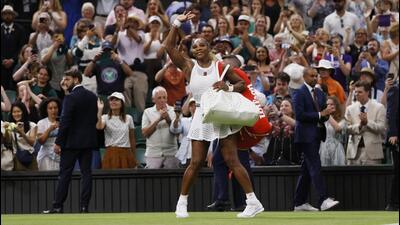
An intense, gruelling tennis match took just under three hours to complete at Centre Court in the All-England Club. Normally, between matches, spectators would take a step outside to stretch and freshen up, before return to their seats by the time the players finish their warm-up in the following match.
On Tuesday, nobody left their seat. They waited patiently for the doors to open and the players, one much more than the other, to step onto the hallowed surface of Wimbledon’s most prestigious court.
All this to greet and get a sight of a “wild card”.
Once those big doors opened, a thunderous roar erupted as the spectators rose to their feet to welcome the great Serena Williams.
This was the end of a wait nobody had really expected. Williams had called time on a stunning and triumphant 27-year professional tennis career after a third round exit at the US Open in 2022. And yet, here she was, the winner of 23 Grand Slam titles, walking onto Centre Court in a casual strut as if it was just another walk around the house, 1,396 days after her last competitive singles match.
In many ways, the fabled stadium is her home. It is here that she won seven of her 23 titles. And it was also where her triumph in 2002 took her to the world No.1 spot for the first time.
Now 44 and a mother of two, Williams said the reason she wanted to get back to playing at Wimbledon was so her daughters could see her compete on Centre Court.
Eight-year-old Olympia and two-year-old Adira River watched from the players box as her mother gave no more than a hint of a smile to the adulation coming her way.
Many of those who did manage to secure entry to Centre Court on Tuesday evening had camped outside the ticket counter two days prior to the match. All to get a glimpse of Williams and bask in the aura of one of the greatest players to ever grace the sport.
This was the Serena effect.
The last time she had played a competitive singles match, in what was her supposed farewell, 6.9 million people tuned in, breaking the record for most-watched tennis telecast ESPN’s history, according to Nielsen data.
The numbers from her match against the young and upcoming Australian player Maya Joint haven’t been crunched yet, but all who saw her were dealt with a dose of nostalgia. Here was Williams putting in another display of heavy-hitting the same way she did from the late 1990s to the early 2020s.
Together with her elder sister Venus, they were the trendsetters for modern tennis. At a time when touch and finesse was paramount in women’s tennis, the Williams sisters brought in power and awe.
It was not much different on Tuesday, as Serena served big and hit hard.
The shots were still there, the movement was slow but not laboured, the court-craft still devastatingly effective. But there was unmistaken, but expected, rustiness in her strokes, as she eventually lost 3-6, 7-6(8), 3-6.
That scoreline was never going to matter. Williams had nothing to prove. She had conquered everything there was to conquer in tennis.
Yet she put in that same fighting spirit with which she always played. It took a while for the grunting to begin, and for those lung-busting roars of “come on,” were nerve-wracking for opponents.
After the match Joint talked about not being able to get any sleep the night prior to the match and her “legs not moving” at the start of the match.
That is the Serena effect.
Yet the 20-year-old held her own. This season, Joint has lost in the opening round in 11 of the last 12 tournaments she’s played. But against Williams, she brought in a different level. She brought in her best for the best.
It takes nothing less to beat Williams.
This match though will not be remembered as a loss for Williams. This was always going to a celebration for the player that Williams was, and perhaps could become once again. It was about getting a glimpse of a history-maker and a chance to relive some of those memories that defined the sport.
Here was a player who dominated the sport like no other. If the last few years of women’s tennis was spent looking for that one player to take complete charge over every event and every surface, it was because of the void Williams left.
That was the Serena effect.
In her box was sister Venus, a five-time Wimbledon singles winner. Back then she would take photos of Serena’s match using a point-and-shoot camera. On Tuesday she used a phone.
Later this week, the sisters will pair up once again in search of a seventh Wimbledon doubles title together.
Olympia will get watch her mother once again, but not Adira. Wimbledon protocol dictates that no child under two is allowed inside the stadium during play. The two-year-old had to leave before the match started on Tuesday.
But she did get a brief glimpse of Serena, looking fit and sporting dyed blonde hair, wearing that same game-face she wore in each win as she became the most successful women’s Grand Slam winner in the Open Era.
Adira will need another three years before she can watch her mother play on Centre Court. Maybe Serena is back for a while.