
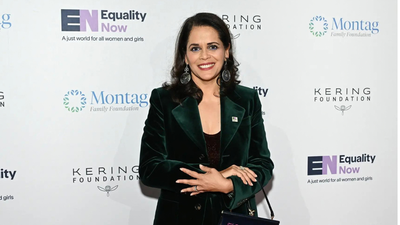
TOI correspondent from Washington: As a little girl growing up in Calcutta, Sharmila Mona Sinha was often reminded of a familiar Indian “disappointment”: she was the third daughter. In a society where the arrival of a son was treated as a family dividend and another daughter as a deficit, she absorbed the message early and decided to do something about it. “I wanted to be a boy and do what boys did,” she recalled.Last week, the Kolkata-born daughter entered the National Women’s Hall of Fame in Seneca Falls, New York – the cradle of the American women’s-rights movement – becoming only the second woman of Indian origin to receive the honour, after former PepsiCo CEO Indra Nooyi. It is a fitting destination for a woman whose journey has taken her from Kolkata to Smith College, Wall Street, corporate America and, ultimately, the global campaign for women’s equality.Sinha’s journey did not begin with grand ambitions of changing the world; it began with family, expectations and an encounter with poverty that left a lasting impression. As a volunteer at a Mother Teresa orphanage in Kolkata, what struck her was not simply the deprivation around her but something more unsettling: the orphanage had few boys because, she was told, abandoned boys were more readily adopted. Even among abandoned children, gender could determine who got a second chance.Another influence came closer to home. Only in her teens did she learn that her grandmother had helped organise women during India’s freedom movement. The discovery gave her a sense that challenging the status quo was not alien to her family. “I don’t receive this extraordinary honor as mine alone. I receive it as a fistful of rice, placed in my hands with a responsibility to pass it on,” she said in her induction speech, recalling how her mother in Kolkata set aside a fistful of rice each morning for someone in greater need.At 18, she left India for Smith College in Massachusetts, graduating in economics and art history before earning an MBA from Columbia Business School. She entered Wall Street as an investment banker at Morgan Stanley and later moved into corporate America, working for companies including Procter & Gamble, Unilever and Elizabeth Arden. It was a world of balance sheets, brands, mergers and markets — seemingly far removed from the women’s-rights movement.Over time, however, Sinha began wondering whether the tools she had acquired in business could be deployed for a different kind of return. Rather than abandoning the language of capital, management, and organisational efficiency, she brought it into philanthropy and social change.She became a leader of Women Moving Millions, a network of women philanthropists whose members have committed roughly $1 billion to organisations working for women and girls. She co-founded Raising Change, which helps social-impact organisations strengthen fundraising and organisational capacity, and helped establish the Asian Women’s Leadership University. At Smith, her alma mater, she became a trustee and helped lead the Women for the World campaign, which raised approximately $486 million.Her portfolio eventually expanded beyond philanthropy. Sinha became an executive producer of documentaries, including the Oscar-nominated To Kill a Tiger, while also supporting the campaign for the Equal Rights Amendment and the planned Smithsonian American Women’s History Museum. Since 2022, she has served as CEO of Equality Now, the international organisation working to eliminate discriminatory laws affecting women and girls. Her work now takes her into the harder terrain of changing laws and legal systems, addressing issues from child marriage and sexual violence to women’s economic rights.Sinha’s story offers an unusually Indian lesson about the evolution of feminism. She did not begin by marching in the streets; she began as a daughter in a Kolkata household, went to an American women’s college, entered investment banking, learned corporate strategy and eventually turned those skills toward changing institutions. Her Hall of Fame induction is therefore more than another accolade for a prominent philanthropist. It is a long-distance answer to the question that confronted the little girl in Calcutta: What might that “wrong” daughter become if nobody put a ceiling on her?Four decades later, the answer has been inscribed in the National Women’s Hall of Fame. And alongside it is an increasingly familiar Indian-American footnote: after Indra Nooyi, another daughter of India has entered America’s pantheon of women leaders.