
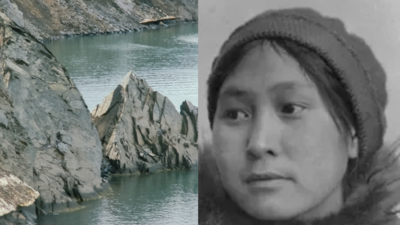
Have you seen Life of Pi and wondered how life would be if you were stuck in a nowhere location with your pet? Well, not necessarily like in the movie, but someone did get stranded somewhere with no one around, no access to food or basic necessities, and no idea when help would arrive, with just her cat by her side. Cat parents would be thrilled, but for most, being surrounded by nothing but snow, freezing temperatures and an endless stretch of wilderness, even a few days would be difficult to imagine. But for Ada Blackjack, a 23-year-old Iñupiaq woman, this became her reality when she found herself stranded on an isolated Arctic island, with only her cat for company.Who knew the journey meant to pay for her son’s medical treatment would soon turn into an adventure? She joined the expedition as a cook and seamstress, and what appeared to be an exciting opportunity to support her family soon turned into a fight for survival.
Why did Ada Blackjack join the Arctic expedition?

Ada Blackjack (public Domain image)
The year was 1921. Ada joined an expedition led by explorer Vilhjalmur Stefansson’s associate, Allan Crawford, which aimed to establish a presence on Wrangel Island. The group consisted of four young men and Ada, who was the only woman among them. She was responsible for cooking, sewing and other domestic work.Little did she know that the expedition was poorly equipped for the conditions it was about to face. As supplies began to run short, the situation became increasingly dangerous. Eventually, four members of the group attempted to cross the frozen sea to seek help, leaving Ada behind with the expedition’s cat, Vic. They never returned.
How did Ada survive alone on a frozen island?
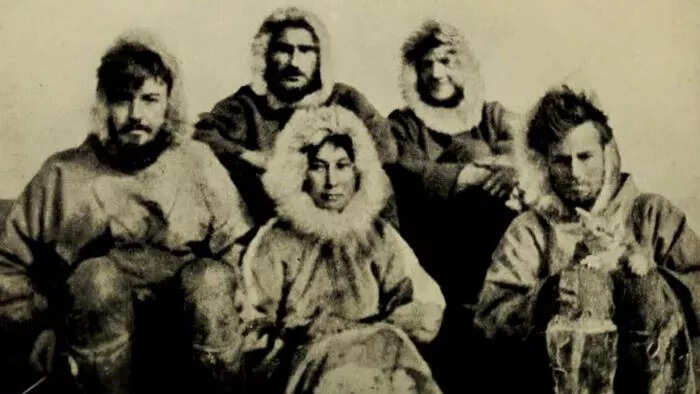
The Wrangel Island expedition party. Front row left to right: Allan Crawford, Ada Blackjack, Milton Galle. Back row left to right: Fred Maurer and Lorne Knight. (Public Domain)
Surviving in the Arctic is not something meant for so-called experts either. With harsh conditions and no signs of vegetation or civilisation, people would soon lose hope of surviving. And in such a situation, getting stranded with a person suffering from scurvy and a cat would be no less than life’s test. When the three men left the camp in January 1923 to seek help, Ada stayed behind with Lorne Knight, who was suffering from scurvy. She cared for him for months, looking after his needs while trying to find enough food for both of them. But Knight’s condition continued to deteriorate, and he eventually died on June 23, leaving Ada alone with the expedition’s cat, Vic.With no sign of anyone returning or any rescue call, Ada had to learn how to survive on her own. She taught herself to shoot a rifle, hunted birds and seals, set traps to catch foxes and collected eggs for food. She also gathered whatever edible plants she could find. To protect herself from polar bears, she reinforced her shelter with driftwood and even built an elevated platform from which she could watch for approaching animals. Her sewing skills also proved invaluable, as she made and repaired warm clothing to withstand the freezing temperatures.Despite the isolation and the constant uncertainty, Ada kept going, driven by the hope of seeing her son again. She even made a pair of slippers for him, hoping to bring them home when she was rescued. On August 20, 1923, a rescue ship finally reached the island. After nearly two years on Wrangel Island, Ada and Vic were finally brought back to safety.
The rescue after nearly two years

Ada holding her cat Vic (Public doamin image)
By August 1923, nearly two years after the expedition had first arrived on Wrangel Island, Ada’s ordeal finally came to an end when a rescue ship reached the island and found her alive, with her cat by her side. In that span of time, she had seen it all: the loss of a member, isolation, danger, the constant fear of death and the struggle to keep herself alive. The only light she had on the island that motivated her to keep going was the hope of seeing her son once again and embracing him in her arms. This feeling gave a gentle warmth on the icy-cold island.After returning to civilisation, Ada received the money she had been promised for her work and travelled to Seattle, where she hoped to secure medical treatment for her son. She eventually reunited with him and continued to live a relatively private life. Ada Blackjack died in 1983 at the age of 85. Her story remains a remarkable account of survival, but it is also the story of a mother whose journey into one of the world’s harshest environments began with a simple hope: to give her son a better chance at life.