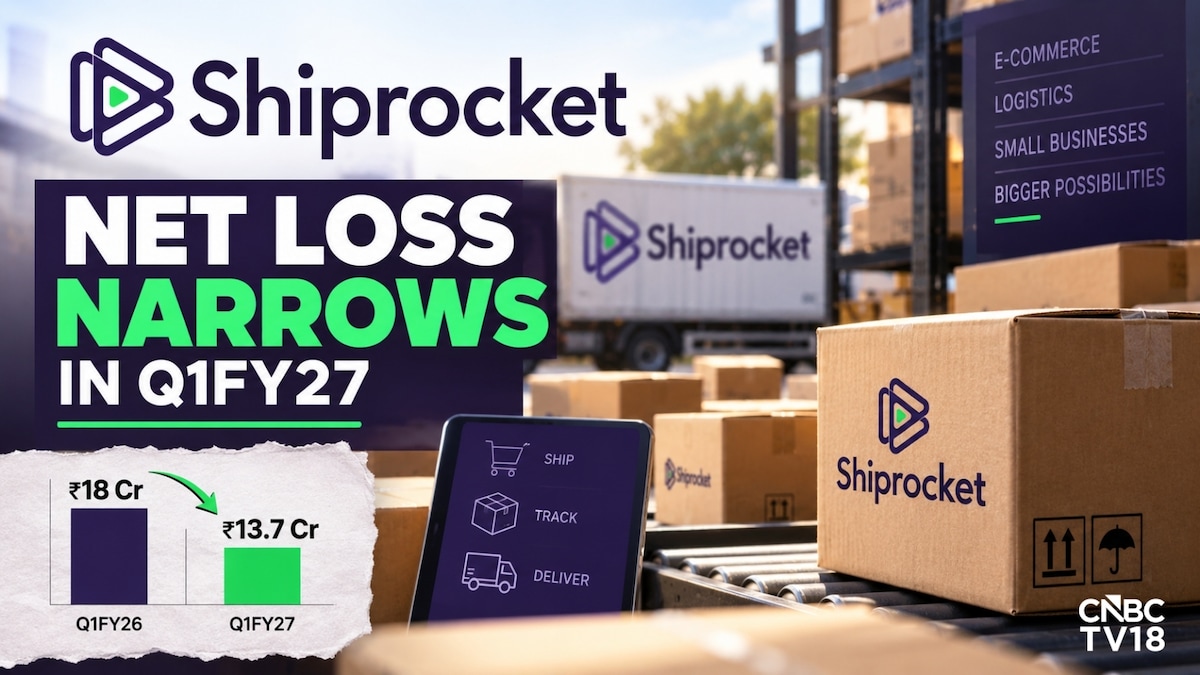
Earnings Before Interest, Tax, Depreciation and Amortisation (EBITDA) loss narrowed to ₹21 crore from ₹26 crore a year earlier. On an adjusted basis, however, Shiprocket reported positive EBITDA of ₹8.9 crore, compared with ₹1 crore in Q1FY26. The company said it remained adjusted EBITDA positive throughout the quarter.
The improvement in adjusted profitability came even as Shiprocket continued to invest in its faster-growing businesses. Its Core Business generated adjusted EBITDA of ₹52.7 crore, with a margin of 12.8%, compared with 12.3% a year ago.
Shiprocket Managing Director and CEO Saahil Goel said that the Q1 results were consistent with the company’s strategy. “We are only a few years into a decade-long build, and we continue to double down and invest behind unlocking the true potential of India’s businesses,” he said.
Emerging Business grows 70%
Shiprocket’s Core Business revenue grew 22% YoY to ₹411.7 crore, while its Emerging Business revenue jumped 70% to ₹180.4 crore. The Emerging Business comprises checkout and marketing solutions, cross-border and omnichannel solutions.
The company said the Emerging Business grew 3.2 times faster than its Core Business and now contributes 30% of total revenue, up from 24% a year ago.
The contribution margin of the Emerging Business also improved sharply to 15.3% from 9.3%, with its absolute contribution rising to ₹27.7 crore from ₹9.8 crore. Its EBITDA margin improved to -24% from -38%.
Within the segment, Checkout and Marketing Solutions grew around 193% YoY, according to the company. Management said businesses such as Ads were barely present two years ago, but are now among the faster-growing parts of the platform.
Overall contribution margin rose 43% YoY to ₹115.1 crore, while the contribution margin expanded to 19.4%. Shiprocket said the improvement reflected its two-business model, with the cash-generative Core Business funding investments in the faster-growing Emerging Business.
Shiprocket scales platform, adds AI-led products
Shiprocket ended the quarter with 224,314 active merchants, while its trailing 12-month GMV stood at ₹34,661.8 crore and unique transactions at 216 million.
The company also continued to expand its technology offering during the quarter. It launched an upgraded RADAR AI-powered courier intelligence platform that can flag SLA breaches and return-to-origin risks at the pincode level before an order is dispatched.
It also rolled out an AI Ads platform for static, editable, short-form and 360-degree creatives, along with AI Assist and AI Calling for order confirmation. Shiprocket additionally introduced appointment-based cargo deliveries to quick-commerce dark stores, with integrations including Blinkit and Zepto.
India’s e-commerce market is expected to more than double to $180–200 billion by 2030, Goel said. He added that almost none of the merchants driving that growth will build their own logistics, payments and growth stack, saying, “They will rent it. That is what we are building.”
Goel said India has roughly 60 million MSMEs, most of which are part of the long tail of commerce and have not had infrastructure built for their scale. “They need a stack they can take pieces from and grow into,” he said.
First results after strong IPO debut
Shiprocket’s Q1 results come weeks after its shares made a strong stock market debut on August 19. The stock listed at ₹131 on the NSE, a 35.05% premium to its ₹97 issue price, while it debuted at ₹129.50 on the BSE, a 33.5% premium.
The ₹1,617.5-crore IPO was subscribed 99.38 times, with the QIB portion subscribed 122.8 times, NII at 88.99 times and the retail portion at 46.42 times. The issue comprised a fresh issue of ₹885.5 crore and an offer for sale of ₹731.9 crore. The company had earlier reduced the IPO size from the ₹2,342.3 crore proposed in its updated DRHP.
Ahead of the IPO, Shiprocket had raised ₹727.41 crore from anchor investors, including the New York State Teachers Retirement System, Nomura Funds Ireland, Société Générale-ODI and ICICI Prudential Life Insurance Company.
The company is backed by investors including Bertelsmann, Tribe Capital, Temasek and Eternal. Bertelsmann was its largest shareholder with a 21.32% stake, followed by Tribe Capital at 14.14%, Eternal at 6.85%, KDT Venture Holdings at 5.49% and Temasek-backed MacRitchie Investments at 5.29%.
Of the fresh IPO proceeds, ₹365.6 crore is earmarked for expanding the Core and Emerging Businesses, while ₹210 crore is to be used to repay debt. The remaining proceeds are meant for inorganic growth opportunities and general corporate purposes.
FY26 performance
Shiprocket’s Q1 performance follows 24% revenue growth in FY26 to ₹2,024.1 crore. Its net loss stood at ₹79.2 crore in FY26, compared with ₹74.4 crore in FY25, although this was substantially below the ₹595.1-crore loss reported in FY24.
The company said it is only a few years into what it sees as a decade-long build and will continue investing in its newer businesses. CFO Tanmay Kumar said the expansion in profitability alongside revenue growth reflected both the Core and Emerging businesses working together, with merchants increasingly adopting more products across Shiprocket’s platform.
Overall, Shiprocket’s first post-listing quarter saw revenue growth accelerate, reported losses narrow and adjusted EBITDA turn positive, while the company’s Emerging Business continued to grow significantly faster than its Core Business.
Shares of the company ended more than 1% lower at ₹134.50 ahead of the results announcement on Monday. The stock is trading nearly 3% below its listing price.