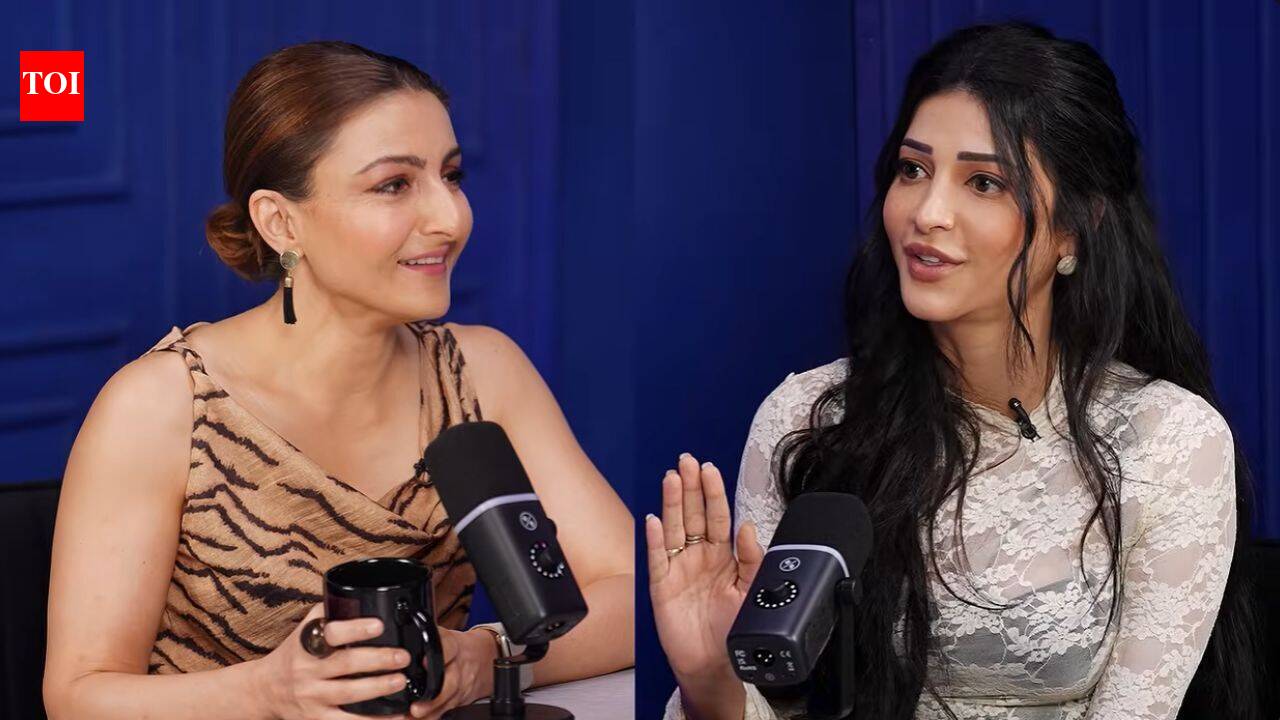
For years, Shruti Haasan had carried a fear that motherhood might not be possible for her. She had been told from a young age that PCOS could make conception difficult, a message that stayed with her and eventually made the subject of having children difficult to approach. Now, at 40, the actor says a conversation with her gynaecologist gave her a different perspective. Instead of being told to worry about time or her “biological clock”, she was encouraged to understand the choices available to her, including egg freezing and adoption. Speaking to Soha Ali Khan on the podcast ‘All About Her’, Shruti opened up about her experiences with reproductive health, motherhood and the painful periods she has dealt with since adolescence.
A childhood message that stayed with her
10 Sept 2026 | 12:19
What’s one thing you swore you’l never do as a parent now you find yourself doing?
Shruti said concerns about her ability to conceive were raised when she was still very young. “I have been told throughout that I have PCOS (PMOS) and childbirth or conception, just forget about that. Like since I was 14. It is going to be difficult,” she said. Because of those conversations, motherhood became something she was afraid to discuss. She explained that she had avoided having the conversation because she expected a doctor to tell her that she would not be able to conceive. That changed when she met Dr Dhrupti Dedhia. According to Shruti, the doctor approached the subject differently. Rather than making her feel that she was running out of time, the doctor explained that there were options she could consider whenever she felt ready.“It was a way of saying, in a beautiful way, ‘If that’s what you want, we will figure it out,’” Shruti recalled. The conversation also introduced her to the possibility of freezing her eggs. She acknowledged that the procedure can be physically, mentally and financially demanding, but said simply knowing that she had choices was eye-opening.
‘I would really just love to be a mum’
For Shruti, motherhood is not limited to one particular path. She said she is open to adoption while also wanting to explore the possibility of having a biological child. “I am even open to adopt. I would really just love to be a mum. But I would also like to try it definitely as an extension of myself in some biological way, and that conversation was really eye-opening,” she said. Her comments also highlighted how strongly early medical advice can influence the way women think about fertility. What Shruti had heard since her teenage years had made her approach the subject with fear. The conversation with her current doctor, however, made her feel that motherhood could still be something she could explore on her own terms.Soha Ali Khan, who hosted the conversation, shared that she had experienced something similar. She recalled speaking to a doctor at 35 about freezing her eggs because she was not ready to have a child at that stage. According to Soha, she was told that it was too late. The contrasting experiences show why personalised medical advice and discussions around fertility can matter, particularly when women are making decisions about motherhood at different stages of their lives.
The painful periods she has lived with since 13
Shruti also spoke about another deeply personal part of her health journey: severe period pain. She got her first period at 13 and remembers how her mother reacted when she began experiencing intense cramps. “And my mum was really sweet about it… I could see her waiting with bated breath, and then the cramps kicked in almost immediately within two hours. She was like, ‘I am so sorry. You got it from me,’” Shruti recalled. Her experience was far more severe than what some of her classmates experienced. “I would be at school, faint, puke, get rushed to the hospital and be put on IV fluids and painkillers every month because of my period cramps,” she said.According to Shruti, it was only in 2020 that her gynaecologist recommended a different oral contraceptive pill. She said the treatment reduced her pain by around 60 per cent. Her story brings together two subjects that many women continue to find difficult to discuss openly: reproductive health and painful periods. By speaking about both, Shruti has highlighted how important it can be for women to have conversations with doctors without fear or shame. For her, the most significant change was perhaps not receiving a definite answer about motherhood but finally being told that she had options. “I would really just love to be a mum,” she said, making it clear that whatever path she eventually chooses, the decision is one she wants to make when she feels ready.