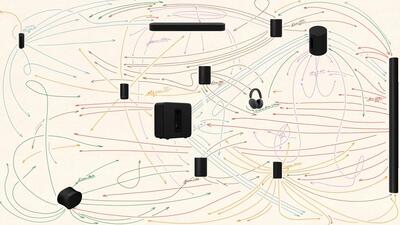
This is undeniably a new era for US audio giant Sonos. The company has rolled out Sonos 27, which you might think of as partly the operating system underpinning each Sonos audio product, but the scope is broader still. New additions are rolling out in stages between the Sonos app on your iPhone or Android phone and the Sonos speakers you have at home. This includes portable surrounds that become part of surround speaker system with a compatible soundbar such as the Arc Ultra, or a Sonos Ace Ultra headphones linking to move audio between themselves and compatible Sonos speakers depending on whether personal listening or room filling sound is prudent at any moment, as well as a Sonos 27voice assistant that evolves from Sonos Voice Control.
That isn’t all. Sonos is also adding Model Context Protocol (MCP) support that will bring your preferred artificial intelligence (AI) service into the fold for extensive functionality, including playing music from connected services, controlling playback for an individual or a group of speakers, grouping products with simple commands, moving audio playback between groups and specific features such as Night Sound and Speech Enhancement. As an industry trajectory, Sonos is the latest major brand to extend support for MCP as the standard for weaving AI and smart tech together in homes—Amazon Alexa+, and Google Home have also shipped MCP support.
I had the chance to set this up with ChatGPT (you can do the same with Anthropic’s Claude models or other AI models), and two main observations emerge from this. First, the integration works exactly as intended, which means the ChatGPT app on your phone or Mac, or via the web browser, can manage the Sonos systems. It may take a couple of seconds longer than intended depending on how loaded the chatbot is at that time, but I didn’t notice any failed commands or hallucinations while managing playback or identifying what tracks were playing. That said, not entirely sure of having AI access my Apple Music or YouTube Music library, so that’s that.
Secondly, all these tasks are more than easily achievable from the redone Sonos app (which is brilliant by the way). But then, everything these days needs an AI infusion, so that may well be. That’s not all, because the company suggests that at some point in 2027, Sonos would bring Custom Agents into the fold, allowing users to create their own agents within the system, and completely customised with its own model, persona and voice. Sonos 27voice also comes later in the year.
Sonos, with their typical attention to detail, shared their top-of-the-line Arc Ultra soundbar ( ₹99,999) and two Sonos Play speakers (each ₹31,999) for the vibrant, interchangeable set-up across different rooms in the home, and also as the extended home theatre experience. The setup for each remains unmistakably Sonos-like, simple and uncomplicated. This is where you begin to experience the magic of what they’ve tried with Sonos Fabric, a new system that makes each system understand their dynamic role at that moment and coordinate as different systems working together as one.
Being able to move two Sonos Play speakers to be the surrounds for the Arc Ultra when watching a movie, is just the sort of brilliant flexibility one would hope for when spending top money on pristine sound. Two key things to note here—first, the two portable surrounds must have line of sight of the soundbar and secondly, the Sonos Positioning Technology will detect when they need to work as surrounds as you place them behind the couch, and when they must revert to portable speakers (standalone or pair) when you set them down at another location in the same or different room. This may just be too smart for consumers in the first go!
At this point, you may be asking what exactly is the list of compatible speakers—Soundbars include the Arc Ultra, Arc, Beam Ultra and Beam (Gen 2), while the speakers include Sonos Play and Sonos Move 2.
Sonos is actually building up to quite an AI-laden and contextually smart arsenal of capabilities for some of its speakers, and showcasing its new app for phones and the iPad in tandem. The new Sonos 27 OS architecture is bringing a lot of smart capabilities that rivals don’t have, and this is exactly the sort of versatility and future-proofing that will hold it in good stead for many years. Their hope also is, with the MCP in place, that a collective of this functionality becomes a habit that keeps you in the Sonos family when speaker upgrades are in consideration. To that end, I believe Sonos has efficiently and painstakingly ticked the checklist.