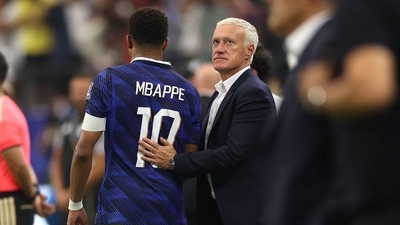
For more than a decade, Didier Deschamps built France around one unwavering belief: major tournaments are won through control, not entertainment. The philosophy delivered extraordinary consistency. Four years after taking charge, he guided France to the UEFA Euro 2016 final, won the 2018 FIFA World Cup to become only the third man in history to lift the trophy both as captain and coach, reached another World Cup final in 2022, followed that with a Euro 2024 semifinal and, now, a World Cup 2026 semifinal. Few international managers have sustained success at that level for so long.
And yet, as Deschamps prepares to bring down the curtain on his 14-year reign after Saturday’s third-place playoff in Miami, the consistency also tells another story.
For a manager blessed with arguably the richest pool of attacking talent in world football — Antoine Griezmann, Karim Benzema, Olivier Giroud, Kylian Mbappe, Ousmane Dembele, and later Michael Olise, Bradley Barcola and Desire Doue — France won just one major trophy. That return feels surprisingly modest for what could be the country’s greatest footballing generation.
Fittingly, the team that ultimately closed the book on Deschamps’ tenure was Spain — his tactical kryptonite.
How Spain repeatedly exposed Deschamps’ France
The first major crack appeared in the UEFA Euro 2024 semifinal in Munich. France struck first through Randal Kolo Muani after just nine minutes, but Spain calmly seized control. Lamine Yamal and Dani Olmo turned the game around before the half-hour mark, exposing the limitations of Deschamps’ pragmatic blueprint against a side capable of monopolising possession and dictating tempo.
For perhaps the first time, Deschamps accepted that France needed to evolve.
Drawing inspiration from France’s Olympic silver-medal campaign later that summer, he gradually abandoned his trusted 4-3-3 and rebuilt the side around a far more adventurous 4-2-3-1, finally allowing Mbappe, Dembele, Olise and Doue to operate together in attack. The experiment suffered another defeat when France lost an extraordinary 5-4 thriller to Spain in the 2025 UEFA Nations League semifinal. Yet, unlike Munich, Deschamps left encouraged. France had created chances, attacked with freedom and, for long periods, matched Spain blow for blow. The scoreline suggested defeat, but the performance convinced Deschamps that his rebuild was heading in the right direction.
That belief shaped France’s entire World Cup campaign. This was arguably the boldest France side Deschamps ever assembled. The four-man attacking quartet started almost every match. France won all three group games, swept aside Sweden, Paraguay and Morocco, and entered the semifinal as the tournament’s highest-scoring side.
Then Spain arrived once more. And the story barely changed.
Rodri, Fabian Ruiz and Dani Olmo suffocated France’s midfield, while Spain’s aggressive counter-press denied Mbappe, Dembele, Olise and Barcola the transitional moments on which their entire attacking system thrived. France’s greatest strength simply disappeared. Spain dictated possession, controlled territory, won the midfield battle and restricted one of the most feared attacks in world football to just three shots on target—the first arriving only in the 81st minute. Unai Simón endured one of his quietest evenings of the tournament because Spain’s defensive structure rarely allowed France to threaten.
The familiar ending
Deschamps searched desperately for answers. He dropped Olise deeper to help ball progression, introduced Manu Kone for Adrien Rabiot at half-time and later turned to Rayan Cherki for fresh creativity. None of it disrupted Spain’s control. In trying to preserve France’s attacking threat, Deschamps also left Mbappe and Dembele high up the pitch during defensive phases, a gamble Spain eventually punished when Pedro Porro doubled the lead after exploiting the space France left behind.
For years, Deschamps had been criticised for prioritising balance over spectacle. Critics argued that France consistently played beneath the level of their extraordinary attacking talent. This World Cup felt like his answer. He embraced risk, trusted youth and finally unleashed the attacking freedom many had demanded. Ironically, the semifinal reinforced why he had spent so much of his career resisting exactly that.
Against most opponents, France’s individual brilliance solved every problem. Against Spain, collective organisation defeated individual talent.
Deschamps departs as one of international football’s finest managers, having restored France as perennial contenders and delivered the nation’s second World Cup title. Yet one question will define his legacy as much as the trophies.
Did his pragmatism maximise France’s chances of winning? Or did it ultimately prevent arguably the greatest generation of French footballers from building an even greater legacy? In the end, Spain asked that question one last time. And answered it.