
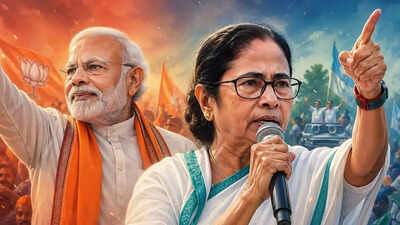
NEW DELHI: West Bengal witnessed an intensely polarised and high-decibel campaign in the second phase of assembly elections, marked by massive roadshows, sharp political attacks and allegations of violence.The Election Commission confirmed that Phase 2 campaigning officially ended at 5 pm today. The second phase of campaigning began on April 24 after the conclusion of Phase 1 voting on April 23.
From Prime Minister Narendra Modi’s open letter and symbolic outreach in Bengal’s cultural heartlands, to Mamata Banerjee’s street-level campaigning and Amit Shah’s aggressive law-and-order pitch, the phase was defined by competing narratives of governance, security, identity and electoral trust.
Phase 1 sets the tone: Record turnout intensifies stakes
Before Phase 2 campaigning began, Bengal had already witnessed an unprecedented voter response.The state recorded a historic 93.2% turnout in Phase 1, with more than 3.36 crore voters participating across 16 districts. Cooch Behar led with 96.2%, followed closely by South Dinajpur at 95.4%, Malda at 94.8% and Jalpaiguri at 94.7%.The exceptionally high turnout set the tone for Phase 2, increasing political urgency on all sides and intensifying voter mobilisation efforts.Here are the key moments from Phase II
Mamata Banerjee: Roadshows, market outreach and EVM allegations
Chief minister Mamata Banerjee led a high-energy campaign push in South Kolkata, holding a roadshow just hours before campaigning ended. Accompanied by senior TMC leaders, she moved through dense crowds as supporters gathered on rooftops and streets.Alongside the roadshow, Mamata also carried out ground-level outreach, visiting local markets where she interacted with vendors and shoppers. She was seen moving through narrow lanes, speaking to vegetable sellers, checking prices of essentials and assuring continued welfare support through state schemes. The outreach was framed as an attempt to highlight her direct connect with everyday voters.Politically, her campaign sharpened into a strong attack on the Election Commission and BJP.Raising concerns over electoral fairness, she said: “Look at EC! It is your job to ensure EVMs are not captured. Why is there so much load-shedding? This is clearly an indication of malicious intent. Everyone must cast their vote. They will try to tamper with EVMs… Central forces will try to capture EVMs; they are influenced by EC.”Reviving her 2021 Nandigram loss narrative, she alleged irregularities: “I was leading by 4,000 votes before power went off… the trend reversed after supply resumed.”Mamata’s campaign also included a pillion bike ride during campaigning across constituencies, reinforcing a ‘people-first’ outreach narrative.Her Bhabanipur campaign carried strong emotional framing, with TMC messaging projecting massive public participation and unity behind her leadership. Mamata also carried out padyatra there to connect with the voters.She also rode pillion on a bike while campaigning across four constituencies in the Kolkata region.The constituency also became a flashpoint in the larger narrative battle between unity versus polarisation.Banerjee also said that she is going to file a ‘legal case’ against home minister Amit Shah over his ‘violent remarks’ targeting TMC workers.Addressing a gathering in Hoogly, she said: “We are going to file a legal case against Amit Shah for his violent remarks. As Home Minister, he cannot make such comments.”
Jhalmuri politics: PM Modi ’s optics vs Mamata’s counterattack
One of the most talked-about symbolic moments came when Prime Minister Narendra Modi was seen eating ‘jhalmuri’ during a campaign stop in Jhargram.The incident quickly became part of BJP’s outreach optics. PM Modi later used similar symbolism in rallies, saying: “They will distribute jhalmuri after victory… I ate the jhalmuri, but the spice hit TMC.”However, Mamata Banerjee turned the episode into a political counterattack, alleging staging and media scripting: “They had fitted TV cameras and CCTV cameras earlier… they had prepared jhal muri from home for security concerns and gave Rs 10 to the shopkeeper.”
PM Modi’s campaign pitch: Hooghly river visit and Matua community outreach
PM Modi’s campaign combined cultural symbolism with emotional and political messaging.During his Kolkata visit, he spent time on the banks of the Hooghly river, describing it as spiritually significant:“For every Bengali, the Ganga occupies a very special place… I spent time on the banks of the Hooghly, expressing gratitude to Maa Ganga.”He also undertook a boat ride and interacted with boatmen. PM Modi also shared the stage with Ratna Debnath, mother of the RG Kar rape and murder victim who is also the candidate from Panihat assembly constituency.In North Bengal’s Matua belt, PM Modi made a strong identity-based pitch:“I pledge before Matua Namasudra community members that they will receive citizenship through CAA.”He also invoked Netaji Subhas Chandra Bose quote saying, “You vote for us and we will give you azadi from TMC’s maha jungle raj, corruption, fear and unemployment.”His campaign included visits to Thakurnagar and Thanthania Kalibari.PM Modi concluded his campaigning with a deeply personal open letter addressed to the people of West Bengal, in which he reflected on his campaign journey and reiterated his vision of a “Viksito Bangla” (Developed Bengal).In a post on X, he wrote, “Throughout the entire election campaign in West Bengal, the boundless love and blessings I have received from my family members have filled me with a new strength. Be it the youth power or the women’s power here, our farmer brothers and sisters, workers or businessmen—everyone is resolute in building a ‘Vikasito Bangla’. In this letter, I have expressed my sentiments towards them…”In his letter, PM Modi described the election as a “festival of democracy” and said his experience in Bengal had been emotionally and spiritually significant.
Amit Shah: UCC promise, anti-crime messaging and governance pitch
Union home minister Amit Shah sharpened BJP’s governance narrative, promising major legal reforms:“We will implement Uniform Civil Code, end polygamy and enforce triple talaq ban in Bengal. Rs 3,000 will be deposited monthly into accounts of mothers and sisters of Bengal.”On law and order, he took a hardline stance: “I am asking Didi to lock her goons in the garage… we will not spare anyone who harms mothers and sisters.”
Rahul Gandhi: Corruption allegations and political equivalence attack
Congress leader Rahul Gandhi in a poll rally targeted both BJP and TMC, questioning selective investigative action: “Why are there not 36, 38 or 40 cases against Mamata Banerjee?”He alleged widespread scams including Saradha and Rose Valley, and claimed: “Mamata Banerjee and PM Narendra Modi are two sides of the same coin.”
Arvind Kejriwal: Democracy, force deployment and governance critique
AAP leader Arvind Kejriwal criticised heavy security deployment during polling, questioning the narrative around Bengal voters: “Are people of Bengal terrorists?”He also accused the Centre of targeting opposition-ruled states: “Modi has three friends: ED, CBI and Gyanesh Kumar.”Kejriwal warned that welfare schemes could be rolled back if opposition parties were elected out of power.
Violence reports, bomb recoveries and security escalation
The Phase 2 campaign period also saw multiple incidents raising security concerns across West Bengal. In North 24 Parganas, eight crude bombs were recovered near a primary school in Habra, triggering panic among residents and prompting immediate police action.Tension further escalated in parts of the state after violent clashes broke out between TMC and BJP supporters outside Jagatdal Police Station. The confrontation reportedly began after groups gathered following a complaint filing, leading to a large crowd assembling outside the police station. The situation quickly escalated into violence, prompting police intervention.TMC alleged that Arambag MP Mitali Bag’s vehicle was attacked by BJP-linked individuals, with claims of injury and vandalism.The BJP denied the allegations, calling them politically motivated ahead of polling.Voter anxiety drives travel surge across IndiaAhead of polling, flight and train fares to Kolkata surged sharply due to fear among migrant voters of deletion from electoral rolls following SIR revisions.One voter said: “What if my name disappears from the rolls? I am not risking that.”Many voters opted for same-day return trips despite steep prices.
Conclusion: Bengal enters decisive Phase 2 battle
With campaigning now officially closed, West Bengal heads into Phase 2 polling on April 29 across 142 constituencies.The counting of votes will take place on May 4, setting up a high-stakes verdict shaped by record turnout, symbolic politics and sharp ideological confrontation between competing political parties.
Elections 2026 mark a pivotal year for democratic processes across various regions in India and globally. This includes key state assembly elections, local body polls, and by-elections that could significantly impact national-level politics. Get real-time updates, important dates, voting procedures, and verified news — all in one place. Whether you’re tracking results or exploring candidate profiles, this is your go-to hub for Elections 2026.