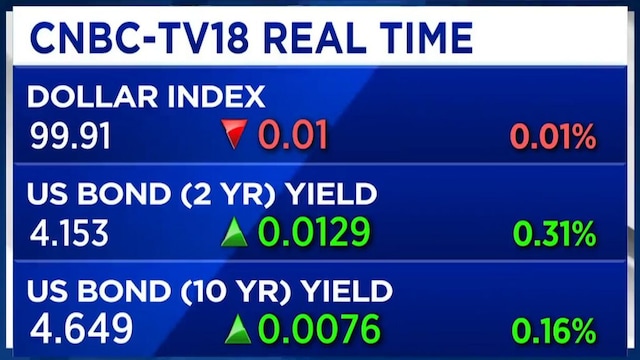
Baig also sees a growing risk for equities as long-end yields rise. While strong AI-driven momentum and investor appetite continue to support US stocks, he says the widening gap between equity yields and risk-free returns could eventually make it harder for equities to attract flows.
This is an edited transcript of the interview.
Q: I just wanted to address the steepening. What does it indicate? And does it have markets worried at some point, especially equities?
A: It’s a big story in the making, and in fact, it is tied to the measures that the US has taken to coordinate with Japan to intervene on the yen. I don’t think the US did that as a favour to the Japanese. They did it to stabilise their bond market, because the rising long-end yield and the steepening of the curve do worry the US Treasury and the Federal Reserve alike.
Consider the following: in the lead-up to Donald Trump’s election, Scott Bessent, who was hoping to get the Treasury job at that time, used to criticise Janet Yellen for pursuing irresponsible fiscal policy. What was she doing? She was issuing a whole lot of bonds at the short end of the spectrum because the view was that the long end was not capable of absorbing the multi-trillion-dollar issuance that the US was doing at that point.
Well, two years later, nothing has changed. The US is still relying on multi-trillion-dollar issuance, over $1 trillion worth of interest payments, and all of those things require even more issuance of US Treasuries. Who’s going to absorb all that?
Well, in the case of Scott Bessent, after he became Treasury Secretary, he followed the exact same path as Yellen, which is to double down on short-term issuance. So, the long end would tick up. There is not that much support there, even if there is not a lot of issuance there.
And, by the way, it has a real cost, which is US mortgage rates, which take their cue from the long end. So, the steepening is not just an artefact of lack of supply on that side. Its impact on the US residential real estate market is substantial.
So, going forward, we will probably see a scenario of financial repression, under which the US comes up with innovative ways to force both local financial institutions, as well as nudge foreign allies, quote unquote, to hold and not sell US Treasuries. Otherwise, the steepening would get even more acute.
Q: Very simply put for our readers, what does the steepening mean when the near-term cost of funding drops and the long end rises? What does it indicate?
A: There are two kinds of steepening. There’s a bull steepening and a bear steepening. So, if we are going to think of a situation in which we’re giving up on the Fed from hiking rates anymore because inflation is not that huge a concern, then the focus entirely shifts on the fiscal aspect. Is there sufficient capacity of the market to absorb all the issuance that is coming in?
If the answer is no, then the long end will start selling off, and as a result, even if the Treasury and the Fed are coordinating to keep the short end anchored, there is only so much they can do under the current toolbox, and we will start seeing what we call a steepening of the curve.
Now, if inflation were to completely disappear tomorrow, if the US were to enter a massive growth spurt around which tax revenues surprise on the upside and fiscal starts to improve, then of course, we can expect a gradual shifting down of the curve.
We’re not in that territory at all. There is no signal whatsoever coming from the US fiscal authorities about any meaningful consolidation down the road. And despite the artificial intelligence (AI0 boom, there is no indication of a massive spurt in US gross domestic product (GDP).
So, it is hard to see a situation under which, without additional jawboning from the Fed and Treasury, the steepening is prevented.
Q: What does this mean for the equity markets? Debt markets and equity markets are connected, and yet, you almost get the sense they’re disconnected. The US bull run is now in its fourth year. It was a record high for the S&P 500, and at the same time, we’re talking about this credit market, which is in a way flashing a warning sign. How is this going to feed into what’s happening with the equity markets?
A: You are absolutely right that there is a very strong connection between the yield and the equity market. We call it the yield gap, the dividend that is being issued by the stock market vis-a-vis the risk-free return that you can get by investing in debt.
That yield gap right now is basically at an all-time high. Basically, the kind of highs that we saw in the lead-up to the global financial crisis, that’s the kind of yield we’re seeing.
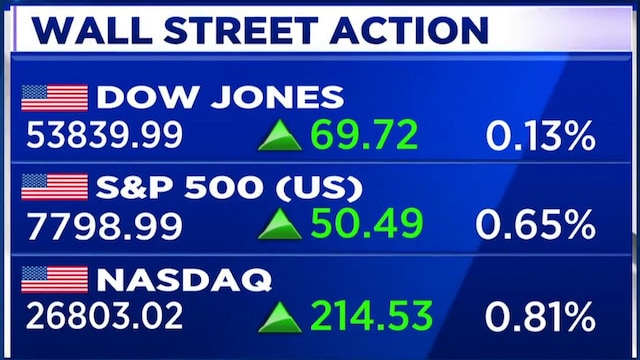
So as the curve steepens, from a risk-free return perspective, the stock market’s ability to attract flows just on the dividend versus risk-free return, it just diminishes extraordinarily.
Now you could argue nobody cares about this yield gap measure anymore, we only care about growth, and therefore all those tech stocks that give you zero dividend, but promise 20-30% gain every single year, that’s what matters.
I suppose it is true to some extent that we are talking about a long-term measure of valuation versus short-term market momentum. Clearly, the short-term market momentum is massive.
Watch the full conversation here

New initial public offerings (IPOs), all sorts of new promises from the AI spectrum are keeping investors, both American and global investors. You know, I’m sure at some point we’ll talk about Japan. One of the reasons why Japan’s flows of funds is so unfavourable despite running such a large current account surplus is because the Japanese want to be long the US stock market and they want to put their money in the US.
Catch all the latest updates from the stock market here