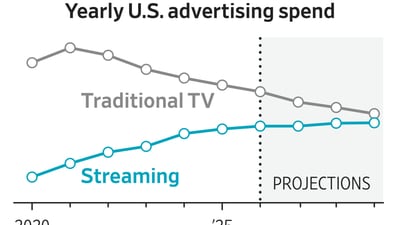
The hottest destination for television advertising these days isn’t traditional national TV. Rather, streaming platforms are gobbling up a growing share of ad dollars as their audiences expand.
After increasing rapidly in recent years, streaming ad spending is projected to approach $20 billion by 2029, not far off linear TV ad spending, according to estimates from ad consulting firm Madison and Wall.
The shift is expected to be a major theme at this week’s celebrity-studded upfront ad-selling event, when media and tech giants will be making a full-court press to convince brands to commit billions to their TV networks and streaming platforms.
While the launch of ad-free streaming services like Netflix initially provided relief to consumers who had grown weary of long TV commercial breaks, the ad-supported streaming model has proven more popular of late.
Ad-supported plans now represent almost 50% of all premium subscription video-on-demand sign-ups in the U.S., up from 39% just two years ago, according to research firm Antenna.
More striking: Over the past nine quarters, ad tiers drove 78% of the nearly 65 million net subscriber adds across the major streamers. Antenna data excludes free tiers, select bundles and some other distribution channels.
Ad-supported streaming is the preference for most adults, but a recent Morning Consult online poll conducted for The Wall Street Journal reveals a generational divide. Older viewers are much more willing to watch ads to save money than younger viewers.
Major streaming services including Netflix, Peacock, Paramount+ and Disney+ have raised prices in the past year, as the “streamflation” phenomenon continues. Some have recalibrated pricing to offset the eyebrow-raising sums they have shelled out to secure the rights to sports programming such as the National Football League and Major League Baseball.
Sports is expected to get top billing at this week’s upfront presentations, a must-buy for brands because of its massive scale for live audiences.
Streamers also provide brands with access to younger audiences and more sophisticated ad-targeting capabilities that move beyond the demographic-based approach largely offered by conventional TV networks for years.
In some cases, streamers allow companies to target ads based on viewers’ purchase history and behaviors, including their online search activity.
While streaming is gaining steam with advertisers, media companies shouldn’t uncork the champagne just yet.
Total TV ad spending—national TV and streaming combined—is in a secular decline, according to Brian Wieser, founder of Madison and Wall.
“Marketers are prioritizing spending where they can drive immediate sales,” so they are shifting ad dollars to digital platforms such as Meta, Google and Amazon.com, Wieser said. Those three control more than half of the $428 billion U.S. ad market.
YouTube is another attractive target for advertisers and has established itself as a major player in upfronts. The Google-owned video streaming site will host its “Brandcast” event alongside major networks in New York this week. Comedian Trevor Noah is slated to emcee, and singer Chappell Roan is expected to perform for deep-pocketed advertisers.
Write to Suzanne Vranica at Suzanne.Vranica@wsj.com and Nate Rattner at nate.rattner@wsj.com