Anil Satwani, Chairman and Managing Director, and Raghavender Ramachandran, Chief Financial Officer, said the company has completed most of the heavy capital expenditure required for the new businesses and is now entering the monetisation phase.
“The proof of concept is behind us. We are just waiting for these two big opportunities to get monetised in the coming years,” Satwani said.
Symbiotec invested ₹800-850 crore over the past few years to build new manufacturing capabilities, funded through a mix of internal accruals and borrowings.
IPO proceeds to reduce debt
Symbiotec Pharmalab’s ₹1,757 crore initial public offering (IPO) opened today (August 24).
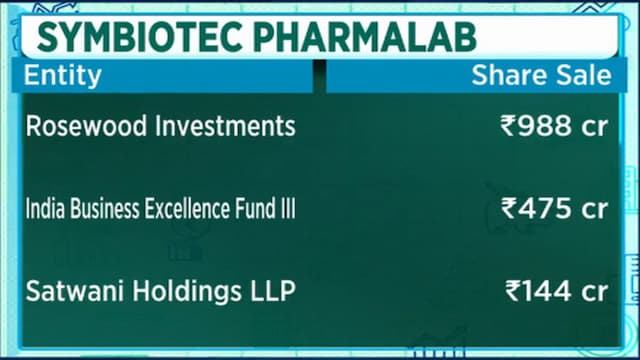
The IPO comprises a fresh issue of ₹150 crore and an offer for sale (OFS) by existing shareholders. The fresh issue proceeds will be used primarily for debt repayment and general corporate purposes.
As of March 31, 2026, the company had debt of around ₹380 crore. Following the IPO, that is expected to decline to about ₹230 crore.
Revenue capacity can expand without major capex
While management stopped short of giving financial guidance, it indicated that the company’s existing manufacturing assets have significant room for scaling up revenue.
Ramachandran said the core API business currently generates an asset turnover of around 1.5 times, while the new investments are in higher-value businesses such as complex injectables and fermentation CDMO.
When asked whether the company could potentially double its revenue from current levels without substantial additional capital expenditure, Ramachandran replied, “Yes, we could, potentially.”
Satwani added that Symbiotec plans to continue investing operating cash flows into capacity expansion to support long-term growth.
API business remains the foundation
Nearly 96% of Symbiotec’s revenue currently comes from APIs focused on steroids and hormones.
However, management expects the revenue mix to evolve as the newer businesses scale up.
Satwani said fermentation-based CDMO services are expected to benefit from advances in synthetic biology, while complex injectables represent the company’s forward integration strategy into specialty pharmaceuticals.
Expanding presence in regulated markets
The company is also increasing its exposure to regulated markets such as the United States and Europe.
Ramachandran said reported export numbers reflect only direct exports, while a significant portion of the company’s products also reach regulated markets through Indian pharmaceutical companies.
“Our focus over the last several years has been to penetrate higher in the regulated markets,” he said, adding that the share of revenue from the US and Europe is expected to continue increasing.
ROCE to improve as new facilities scale up
Management said returns on capital have been temporarily affected because the company has completed large capital investments before generating meaningful revenue from those assets.
Ramachandran noted that the adjusted return on capital employed (ROCE) for the core API business has improved from 25% to around 30%, while consolidated returns remain lower until the new businesses contribute to earnings.
“Once we start getting into this growth journey, you will see much higher ROEs and ROCEs going ahead,” he said.
Backward integration reduces supply-chain risk
Satwani also highlighted Symbiotec’s manufacturing model, saying the company is fully backward integrated in steroid and hormone APIs, beginning production from phytosterol derived from soybean.
He said the company has no dependency on China for manufacturing, although it continues to source certain materials from Chinese suppliers where it makes commercial sense.
“We can make everything on our own… but in terms of dependency, zero,” Satwani said.
For the full interview, watch the accompanying video

Catch all the latest updates from the stock market here