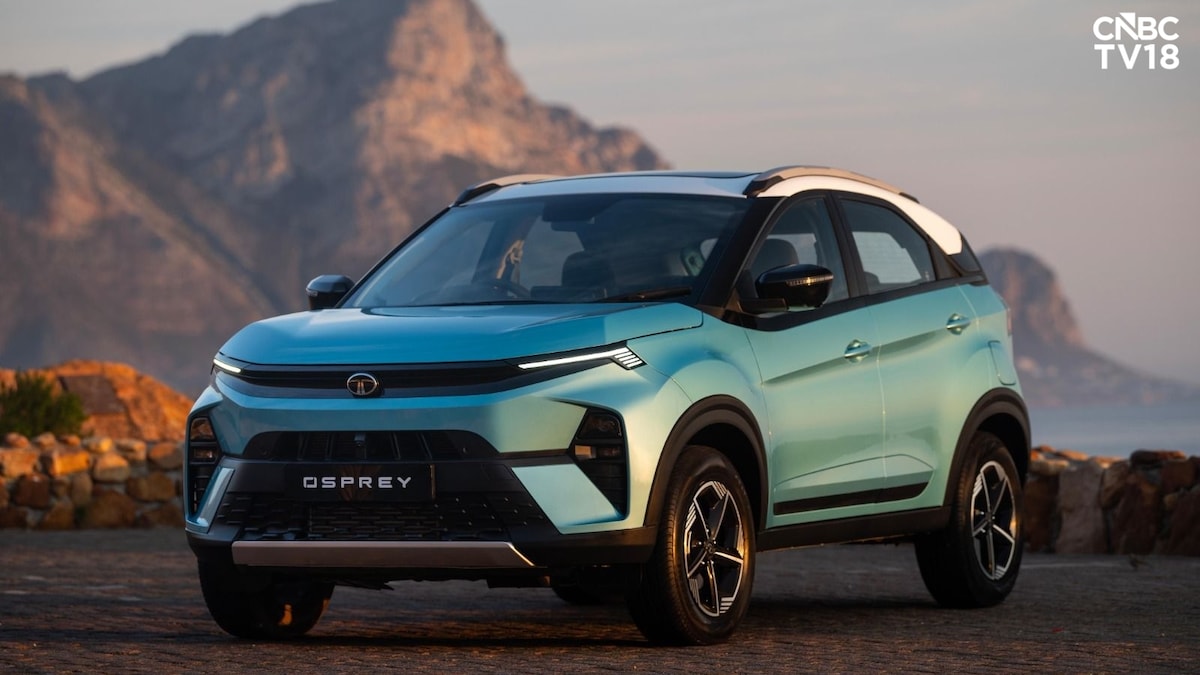
The company launched the SUV on Friday, Sepetmber 4, in partnership with Motus Holdings, a South African automotive group. The Osprey will be available in four variants, with prices ranging from 249,900 to 329,900 South African rand.
Tata Osprey variants and prices
| Variant | Price (South African rand) |
| Tata Osprey Smart+ MT | 249,900 |
| Tata Osprey Smart+ DCA | 279,900 |
| Tata Osprey Creative DCA | 309,900 |
| Tata Osprey Creative+ PS DCA | 329,900 |
Tata Osprey features
The Osprey comes with features including a panoramic sunroof, Bi-LED headlamps, LED DRLs, X-Graphic full LED taillights and 16-inch alloy wheels.
The SUV also gets automatic climate control, a cooled glove box, a 26.03-cm digital instrument cluster, wireless charging, passive entry with push-button start and cruise control.
For safety, the Osprey gets six airbags, electronic stability programme (ESP), tyre pressure monitoring system (TPMS), front parking sensors, automatic headlamps, rain-sensing wipers and a 360-degree HD surround-view system with blind-view monitor.
The company said the Tata Nexon was the first made-in-India car to achieve a 5-star Global NCAP rating, and the Osprey carries forward that safety legacy.
Tata Motors unveils TATA.CARS brand identity
Alongside the Osprey launch, TMPV unveiled its new TATA.CARS global, customer-facing brand identity in South Africa, with the brand promise “Nothing’s Too Far”.
The company said the new identity brings its passenger vehicle portfolio under a single master brand spanning hatchbacks, sedans, SUVs, electric vehicles and future mobility solutions.
The Osprey joins Tata’s South African portfolio alongside the Harrier, Curvv, Punch and Tiago, which were launched in the market last year.
The company said the Osprey, known as the Nexon in other markets, was India’s highest-selling SUV for three consecutive financial years from FY22 to FY24 and has enabled journeys for more than 1.1 million families.
Shares of Tata Motors PV ended 0.16% lower at ₹311.50 on Friday ahead of the launch. The stock has declined close to 9% so far in 2026 and more than 3% over the last 12 months.
Also read: SEBI greenlights the much-awaited NSE IPO