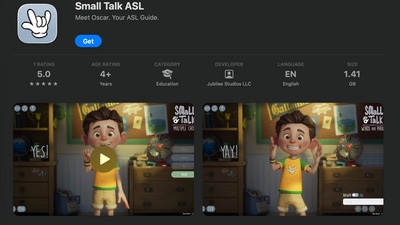
Opening thoughts. Josh Staub, a veteran Disney animator known for his visual effects and lighting work on films like Frozen, Tangled, and Wreck-It Ralph, has launched a free American Sign Language (ASL) learning app called Small Talk ASL, which is available for free on Windows PCs, and Apple macOS.
Staub’s journey began a few years ago when he started writing a script for an animated short film that featured a character which couldn’t hear. To ensure authenticity, he began taking ASL lessons, and immediately appreciated how this different ability forged deep friendships within the community, and an immense need to bridge a communication gap between individuals who cannot hear, and those who can.
The app features an expressive animated Deaf boy named Oscar. Because it is fully 3D, users can rotate the camera 360 degrees to view Oscar’s signs from any angle and adjust the speed of the animation to catch subtle hand shapes and movements. Oscar currently knows about 200 words and the developer is building this gently as Oscar moves up grades in school (at this stage, he is in 3rd grade). This app should also serve as a springboard for Staub’s in-development animated family series, also called Small Talk.
EDITOR’S MARGIN
TELECOM INFLATION
There was a time when prepaid mobile connections were supposed to be a smidgen more cost effective (with rolling flexibility of choice) than postpaid billing plans. The last couple of years have served well to close the door on that theory. A factor in that is the reality that consumers essentially have (to put it bluntly) two and a half choices — Bharti Airtel, Reliance Jio and Vi (which works well in some micro and macro geographical pockets, not so much in others). There are manifold reasons for arriving at a scenario wherein there is little competition in a critical space. Nevertheless, now when a telecom service provider makes a case for price hikes because their profit aspirations and expenses aren’t matching, there’s really no competitive balance to counter it.
Airtel has, instead of a direct price hike for prepaid users, chosen a way they hoped wouldn’t get much attention. Alas, it has; nothing beats my attention, just like many of you. Here’s a summary of the prepaid plans that have been removed: ₹299 (28-day validity), ₹319 (calendar month), ₹579 (56 days), ₹619 (50 days), ₹649 (56 days) and ₹749 (90 days). These plans, for their validity tenure brackets, were likely the most cost-effective ones. This also marks the end of the specific genre of ‘1.5GB data per day’ plans as well, for those who scouted value. The entry point to a 28-day validity prepaid recharge option that would be usable for most, is the ₹349 plan, which inches prepaid users closer to the ₹449 postpaid plan cost.
In simple terms, a change from Airtel’s ₹299 prepaid recharge to a ₹349 recharge plan means around a 16.72% hike in expense for users. Every 28 days. Some will argue that it’s simply a matter of “50 more rupees, heavens won’t fall,” but it is symbolic of a trend. A larger, working trend, driven by a lack of competition in the space. I have seen a time when India’s phone users had as many as 12 telecom choices, across GSM and CDMA. That is also the time India could claim to have the lowest data tariffs in the world — a perception that stayed for long.
Here’s the reality of India’s telecom space. And don’t be surprised if Jio follows in removing some more affordable prepaid plans as well in the coming days and weeks.
- Since consumers cannot easily port to a viable third or a fourth competitor, Airtel and Jio can raise prices or remove low-cost plans sequentially, with very little fear of mass customer churn. At best people will port from Airtel to Jio now, but its a matter of when and not if…
- Historically, prepaid was the domain of budget-conscious users who manually managed recharges for financial flexibility. By eliminating budget plans, the ultimate corporate goal seems to be to transition prepaid users into recurring postpaid subscribers. Ones Airtel or Jio don’t need to worry about, because porting postpaid isn’t as simple as porting prepaid.
- An affordable 1GB per day or 1.5GB per day tier was long considered an economic baseline average, more than enough data for some daily streaming, UPI payments, WhatsApp and browsing. Forcing users towards pricier 1.5GB or 2GB/day plans (like the ₹379 plan) essentially means many entry-level consumers may not even fully utilise what they’re saddled with (LinkedIn Premium, for instance—who has ever cared about that?) paying for, resulting in a forced luxury expense.
Reliance Jio has taken a different approach. That is to buy your temporary loyalty, and you will be loyal, having paid for a ₹300 subscription that enabled a ‘price lock’ on Jio’s prepaid recharge plans as they stand today. This is a subtle hint that price hikes are coming, at some stage—but this is nevertheless an opportunity to bundle a subscription too. There are some vouchers included for a new Jio SIM and a Jio Home connection, but I’ll stick with the main premise for the sake of some important calculations.
For that, I’ll refer to Jio’s ₹299 plan. If Jio is to go Airtel’s way and theoretically replace this with a plan around ₹349, that would be a straight up hike of around 16.72% as I’d established earlier. A ₹300 subscription pays for itself in the 6 months if these calculations hold true with the hikes, and you’re then essentially saving a similar amount over the remaining 6 months. Whether this method works for you is your call.
THE LATEST, ON NEURAL DISPATCH
TECH SPOTLIGHT
STUFFCOOL, ULTRAPROLINK, AND THE NUMBER 45
Mark my words. You can never have too many fast chargers. The gallium nitride (GaN) technology has allowed for faster charging speeds which underline more expensive and more versatile hubs, and also very specific use cases albeit in much smaller sizes now. The 45-watt chargers are just about right for the latest generation Apple iPhones, the latest Apple iPad and iPad Pros, the current Samsung Galaxy flagships and foldable portfolios, as well as the latest Google Pixel phones, for instance. Indian tech companies Stuffcool as well as UltraProlink have 45-watt chargers that are a must have for the work desk, or the bedside table.
Stuffcool has the Numen 45 Pro (this is priced around ₹1,499) and the Numen 45 (this costs around ₹1,899 with the 100W 5A Type-C to Type-C cable bundle) are incredibly compact. The Numen 45 Pro has two USB-C ports, and in case you use these simultaneously, the C1 port can deliver up to 25-watt peak speak with the C2 port limited to 20-watt. In single port usage, in which case both C1 and C2 deliver up to 45-watt, this charger can be enough to power some of the more recent Apple MacBooks, as well as some compact Windows laptops. The Numen, with a single port, is the most uncomplicated charger for clean and streamlined desks or charging requirements. In my experience, they hold the power delivery consistently. The smaller size of either doesn’t mean any compromise in the key experiential aspects of utility and versatility.
UltraProlink isn’t exactly making a case based on the small size as much, but it is very compact nonetheless. In fact, the Boost 45 (priced at ₹1,599) is based on the GaN III generational leap, which particularly focuses on the efficiency aspect. The result is, consistent charging speeds are delivered, because the charger can hold that for longer due to temperatures kept well in check. As is always the case with UltraProlink, the charger’s smart internals allow it to support multiple standards— AVS for iPhone 17, SFC2.0 for Samsung Galaxy phones, PD-PPS for Google Pixel, as well as SuperVooc for OnePlus & Oppo phones. If you use both C1 and C2 ports in tandem, power is equally shared across both.
SECOND THOUGHTS
ASK MAPS, AND CONTEXTUAL CONVERSATIONS
Google Maps keeps adding important updates for users in India, and a recent set is broadening the scope of a feature called Ask Maps. By the way, Google says this is Maps’ biggest transformation in a decade, and is underlined by the company’s Gemini models, with the idea being to conversationally ask Maps app specific questions about a place, discoverability and transit information. Now, Ask Maps rolls out in Hindi—this means conversational understanding and responses will extend in the language to include place discovery, route plans and local insights.
The second important addition is Personal Intelligence, in which a user can connect Ask Maps to their Gmail (support for Calendar is coming soon). This is, for the sake of privacy and choice, off by default. This connection gives Maps a better view of upcoming flight reservations, dinner bookings or calendar blocks, and generate relevant suggestions for new plans. Google explains this with an illustration: if you’re traveling, you can ask for ideas on how to spend a few hours near the hotel before your flight tomorrow. You’ll see nearby recommendations based on your hotel reservation in Gmail — along with tips for getting to the airport afterwards, like what time to leave.
Ask Maps can also pick up from past conversations if history settings are turned on, and this will include revisiting suggestion reminders you’d discussed with Maps previously. Ask Maps should prove relevant in contextualising possible travel information depending on traffic and weather conditions prevalent and predicted. Or check how busy a market, mall or restaurant may be, before finalising a plan.
Google says they are also adding live public transport updates—for buses, metro and trains. This sits in a new transit widget within Ask Maps.