
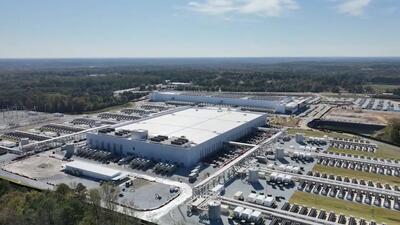
There’s a recent thread that holds together San Francisco, Vancouver, Tucson, Santiago, Dublin, London, Johor, Batam and the Indian port city of Visakhapatnam, also called Vizag. In an eerily fragmented geopolitical framework defining the world these days, the common element is a major pushback against AI data centres in these regions. At a time when India is opening doors to artificial intelligence (AI) data centre investments, global sentiment is in stark contrast, owing to impact on the environment including staggering local energy and water demands that underline this infrastructure.
The crux of this backlash can be best understood with data. First, question of electricity and infrastructure scaling required. Secondly, concerns about clean water. Fengqi You, who holds the prestigious Roxanne E. and Michael J. Zak Professor chair at Cornell University, tells HT that it is also a fairness issue at play.
“AI services may be used nationally or globally, but the water and power burdens are local. If a data centre uses scarce freshwater while nearby communities face rationing or farmers face irrigation stress that becomes a water-justice problem, not just a technology problem. The solution is to make water a binding design constraint,” he says.
It may be prudent to make data centre projects disclose expected water withdrawals and consumption, cooling tech, water sources, and drought contingency plans.
Global electricity consumption by data centres is poised to cross 1500 TWh (or Terawatt-hours) by the year 2035, up from around 400 TWh in 2020, according to the International Energy Agency (IEA). In an Indian context, government data suggests electricity demands will touch 2703 TWh by 2031-32, with data centres consuming 4% of that, at around 107 TWh.
To contextualise with something familiar, an individual server rack in an AI data centre is about the size of a large refrigerator—by 2027, each could have peak power demand equivalent to that of 65 households.
Ashish Banerjee, Senior Principal Analyst at Gartner, tells HT that India needs to build AI data centres only after carefully considering location and cost. “The next phase must be planned around power and water, not land availability alone. India’s data-centre capacity is already around 1.5 GW and could reach about 6.5 GW by 2030, with water use around 150 billion litres annually in 2025 and expected to more than double by 2030,” he says, pointing to three key considerations of grid readiness, non-potable water availability and credible renewable-plus-storage sourcing.
Data centres in India are scaling up in areas that are already experiencing severe water stress. Water security is a primary issue, and allocating massive volumes of potable water to cool AI servers is stoking public anxiety.
Water scarcity, alongside concerns about deforestation form the basis for protests by residents of Visakhapatnam. Most volatility comes from a proposed facility at Adavivaram-Mudasarlova, a site in close proximity to the Mudasarlova reservoir, a primary drinking water source.
The government, in a note issued earlier, insists regulation and control of groundwater extraction including for industrial purposes, is governed by guidelines issued by the Ministry of Jal Shakti, last amended in 2023.
There is a key difference between traditional data centres and AI data centres. Conventional enterprise server racks draw 15–20 kW of electricity, whereas AI and machine learning workloads use dense GPU clusters that can consume 80–150 kW per rack.
“The danger is inherently local, not national. A data centre may look small in national water accounts, but in a water-stressed district during peak summer it can become a very visible competitor to local citizens and farmers,” Banerjee says, adding that this has already been seen in some countries where local facilities have been strained.
Global examples point in that direction.
Slate Asset Management’s $10 billion “Steelport” data centre project in Canada’s Hamilton faced resident pushback over environmental concerns and water usage from the bay. Microsoft’s BUILD developer conference in San Francisco this month saw protests over land, water and power use by the company’s data centres.
In the US alone, an estimated $64 billion worth of data centre projects were blocked or delayed between May 2024 and March 2025—these include a $14 billion project in Arizona, and a $24.7 billion project in Virginia.
An environmental court in Chile has suspended Google’s $200 million data centre project in the Cerrillos district of Santiago following a lawsuit by residents. The government in Malaysia’s Johor banned new Tier 1 and Tier 2 data centres (facilities with lower efficiency standards) in November. UK’s energy regulator Ofgem is weighing ‘mandatory curtailment’ for data centres by reducing power usage during periods of grid stress.
Last year, Cornell researchers in a study co-authored with Sweden’s KTH Royal Institute of Technology, Canada’s Concordia University in Montreal, and RFF-CMCC European Institute on Economics and the Environment in Milan, noted the need for collaboration.
They said that even as “companies such as OpenAI and Google funnel more and more money into rapidly building AI data centres to keep up with demand, this is a pivotal moment for coordinated planning between industry, utilities and regulators to avoid local water scarcity and higher grid emissions.”
Distilling global lessons, for India
For Cornell’s You, India needs to focus on two key priorities. First, strategic siting which will define data centres be located where the grid can support large loads, where new clean power and storage can be added, and where cooling demand does not worsen local water stress. Secondly, the fact that much of the capacity expected by 2030 is not built yet, means India has the chance to design sustainability from the beginning instead of retrofitting it later.
“India can absolutely pursue AI leadership, but it should not treat data centres as only a digital-infrastructure issue. They are also large, continuous users of electricity and water. The key question is not simply how fast India builds, but where it builds, on what power, and with what cooling system,” he says.
Banerjee points to an interesting dichotomy in how AI data centres can be structured. “Ironically, high-density AI provides a technical escape hatch because massive AI racks surpass air-cooling limits, operators are forced to transition to closed-loop direct liquid cooling. Instead of evaporating millions of litres of municipal water into the atmosphere daily, these systems recirculate fluids internally,” he explains.
India has the option of banning open-loop potable-water cooling in high-stress zones, while mandating treated wastewater, seawater or closed-loop liquid architectures instead. For instance, Microsoft uses the closed-loop cooling system in its Fairwater AI data centres in Atlanta and Wisconsin (US), Norway, and the UK to remove hot liquid for chilling before returning it to the GPUs.
“Every aspect of the Fairwater AI data centres and networking innovations has been optimised to deliver AI computing power with the greatest efficiency and using the fewest resources,” says Alistair Speirs, Microsoft general manager for Azure infrastructure.
Cushman & Wakefield, in their latest Global Data Center Market Comparison 2026 report, note that electricity availability is an important determinants of data-centre development. They identify power infrastructure, grid readiness and transmission as critical constraints for expansion.
“The global data centre sector is moving into a more execution-driven phase of growth, where access to power, infrastructure readiness and delivery capability are becoming as important as demand itself,” says Gautam Saraf, Executive Managing Director, Mumbai & New Business, Cushman & Wakefield.
India’s key data centre projects include Reliance and Meta AI’s 168-megawatt data centre in Jamnagar announced this month, the Google Cloud expansion in Navi Mumbai, and CtrlS Datacenters’ 600-megawatt mega campuses in Navi Mumbai and Chennai.
“This world-class facility in Jamnagar will help us scale our AI infrastructure globally while deepening our long-term investment in India’s economy,” Mark Zuckerberg, Founder and CEO, Meta, said about the Jamnagar project.
No major data centre projects in India have so far been canceled, but the sector is beginning to face delays and localised pushback.
The United Nations University’s Institute for Water, Environment and Health in its latest report on uneven distribution of data centre facilities notes,“Carbon intensities vary by an order of magnitude across the major data centre hubs of the world. Indonesia, India, and Hong Kong (SAR) are among the most carbon-intensive grids with carbon footprints 62%, 51%, and 43% higher than the global average, respectively.”
Hongpeng Lei, Chief of the Mitigation Branch Climate Change Division, at the United Nations Environment Programme (UNEP) says, “Governments, local and national, should remember that managing power and water use more efficiently is essential to protecting electricity affordability, maintaining system reliability and attracting investment.”
While the US is already writing the backlash chapter, India is largely in an enthusiasm phase. But inevitably, same questions about natural resources will surface.
“I would not frame it as simply hitting the brakes. But India should avoid a build-first, regulate-later model. The better approach is a science-based green-light and red-light framework. Projects that demonstrate clean power access, grid readiness, low water intensity, responsible siting, transparent reporting, and fair cost allocation should move forward,” You points out.
Strong regulation to not approve and rework projects that don’t meet these conditions, is essential.
The future of AI may depend less on algorithms and chips than on whether societies have enough sustainable sources to power the cloud, which as it turns out, is becoming a resource-intensive industry.