
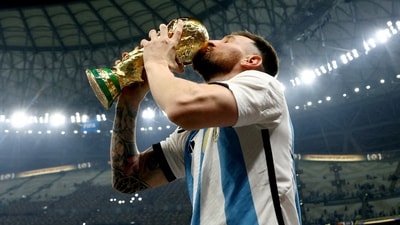
The 2022 FIFA World Cup final delivered one of the greatest spectacles the sport has ever seen. It was a match that seemed destined to complete Lionel Messi‘s story, as Argentina and France produced a dramatic contest that perfectly captured the magic and chaos of the tournament. More than a battle between two nations, it felt like a global audience willing Messi towards the one trophy that had eluded him throughout his extraordinary career.
Eight years earlier, Messi had come agonisingly close in Brazil. In 2014, he carried Argentina to the final with a series of inspiring performances, only for Germany to break their hearts through Mario Gotze’s extra-time winner. That defeat remained the defining scar on his international career and fuelled the belief that the World Cup might forever remain out of reach.
By the time Qatar arrived, the narrative surrounding the tournament was clear. It was expected to be the final World Cup in which both Messi and Cristiano Ronaldo would compete as the leading figures of world football. Ronaldo’s campaign ended in disappointment as Portugal were eliminated in the quarter-finals, but Messi’s journey was only beginning.
Argentina’s World Cup campaign could hardly have begun in a worse manner. Their stunning defeat to Saudi Arabia in the opening match sent shockwaves through the tournament and ended a 36-match unbeaten run. The loss stunned the football world and stripped Argentina of the favourites tag they carried into the competition.
What followed, however, was a display of resilience that defined their title-winning run. Messi responded in the way great players often do when they are backed against the wall. He led from the front and became the driving force behind Argentina’s revival. With a stronger supporting cast around him than he had in 2014, Messi consistently rose to the occasion, producing crucial goals and decisive moments throughout the knockout stages. The pressure keeps growing with so many expectations from him; he continued to deliver, helping Argentina navigate difficult tests and carrying them back to the World Cup final.
By the time Argentina reached the final, Messi had once again carried his nation to football’s biggest stage. This time, however, he was not alone. Backed by a team ready to fight for every ball, he stood one victory away from finally completing the greatest chapter of his career.
Messi had already experienced the heartbreak of falling short on football’s biggest stage. Before Qatar, he had endured four major final defeats with Argentina, including the painful loss to Germany in the 2014 World Cup final. Few players understood the weight of expectation, the scrutiny and the consequences of defeat better than he did. Yet the dream never changed. More than any individual honour, Messi wanted to win the World Cup wearing the colours of Argentina.
By 2022, the tournament had taken on the feel of a final opportunity. At 35, Messi arrived in Qatar knowing there might not be another chance. As Argentina progressed through the competition, the sense grew that the story was building towards a fitting conclusion. A World Cup triumph would not only complete his career but also strengthen his claim in the never-ending debate over football’s greatest player.
Standing in the way, however, was Kylian Mbappe. The French superstar was chasing a second consecutive World Cup title and was determined to spoil Argentina’s dream. What followed was a final that many regard as the greatest in the tournament’s history.
Also Read – Lionel Messi completed football in Qatar; now he reaches for untouchable greatness
The match eventually finished 3-3 after extra time before Argentina prevailed in a dramatic penalty shoot-out. Gonzalo Montiel converted the decisive spot-kick to secure a famous victory and leave France on the wrong side of an agonising defeat.
The final scoreline, though, barely tells the story of how dominant Argentina were for long stretches of the contest. For nearly 80 minutes, Lionel Scaloni’s side controlled proceedings and looked destined for a comfortable victory.
Their breakthrough arrived in the 21st minute when Ousmane Dembele fouled Angel Di Maria inside the penalty area. Messi stepped up and calmly sent Hugo Lloris the wrong way to give Argentina the lead. It was a moment of composure from a player carrying the hopes of an entire nation.
Argentina then produced one of the finest team moves of the tournament to double their advantage. A flowing counterattack carved France open before Julian Alvarez released Di Maria, who finished clinically to make it 2-0. The goal reflected everything Argentina had done well throughout the competition: intensity, precision and collective belief.
France were being outplayed in every department. Didier Deschamps responded by making two substitutions before half-time, withdrawing both Dembélé and Olivier Giroud in the 41st minute in an attempt to change the course of the match.
Even in the second half, Argentina remained in control for most of the time. France struggled to create chances and the contest appeared to be slipping away from the defending champions. Then everything changed.
Kylian Mbappe changed the odds out of nowhere
With 10 minutes remaining, Nicolas Otamendi conceded a penalty and Mbappe converted to give France a lifeline. Barely a minute later, he produced a stunning volley to level the score at 2-2. In the space of 97 seconds, Mbappe had transformed a seemingly one-sided final into an unforgettable contest and dragged France back from the brink, forcing the match into extra time.
Just when it seemed Argentina’s dream was slipping away, Messi delivered once more. Deep into extra time, in the 108th minute, he reacted quickest after Hugo Lloris could only parry Lautaro Martínez’s effort, bundling the ball over the line to restore Argentina’s lead. The goal sent the Lusail Stadium into delirium, with thousands of fans sensing that Messi was finally within touching distance of the trophy he had chased for so long.
But the drama was far from over. Mbappe, who had already dragged France back into the contest, refused to let the final belong solely to Messi. With just minutes remaining, France were awarded a penalty after Gonzalo Montiel handled Mbappe’s shot inside the box. The French forward stepped up once again and calmly converted in the 118th minute to complete his hat-trick and level the score at 3-3.
France nearly delivered the decisive blow moments later. In the dying seconds of extra time, Randal Kolo Muani found himself through on goal with a chance to win the World Cup, only for Emiliano Martínez to produce one of the greatest saves in World Cup history. Stretching out his left leg, the Argentina goalkeeper denied what looked like a certain winner and kept his nation’s hopes alive.
The final would be decided by penalties, fittingly beginning with the two stars who had defined the night. Messi and Mbappe both converted their spot-kicks, but Argentina soon gained the upper hand. Martínez saved Kingsley Coman’s effort before Aurélien Tchouaméni dragged his penalty wide, leaving France on the brink.
When Gonzalo Montiel stepped up for Argentina’s final kick, the weight of a nation’s hopes rested on his shoulders. He buried the penalty into the corner, sealing a 4-2 shootout victory and sparking scenes of pure emotion. Messi dropped to his knees as teammates raced towards him. He became the first player to win the World Cup Golden Ball twice, but individual honours barely mattered. He finally lifted the World Cup trophy, completing the one achievement that had eluded him throughout his career and cementing his place among football’s immortals.