
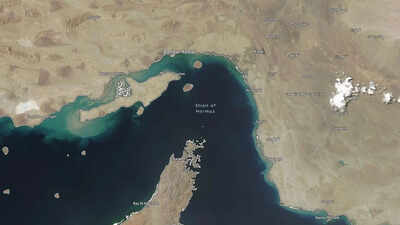
Sixty days. That is how long the United States and Iran have given themselves to negotiate a final deal, a window that will determine how the current world order will function.So how did Iran, a country so embroiled in its own internal chaos, bring the most powerful nation on earth to the table, and force it to negotiate on Iranian terms?The answer is not ideology, not a nuclear deterrent, not even military strength. It is geography.Iran fought the world’s most powerful military to a stalemate, not with nuclear weapons or a conventional army that could match American firepower, but with control over a chokepoint the world cannot do without.That is the first lesson for anyone trying to understand the new global order. Middle powers do not rise through military supremacy or ideological appeal. They rise through leverage, and leverage, in 2026, means control over something the world cannot bypass.
What is a middle power?
The Institute for Economics and Peace, in its January 2026 report The Great Fragmentation, counts 16 middle power nations globally, nearly double the nine that existed at the end of the Cold War (to be noted, IEP does not consider transitional powers in this list) . They define middle powers as states with meaningful regional influence and specialised global capabilities in specific areas. These are countries that exercise influence through multilateral institutions, alliances, and niche specialisations rather than direct power projection.
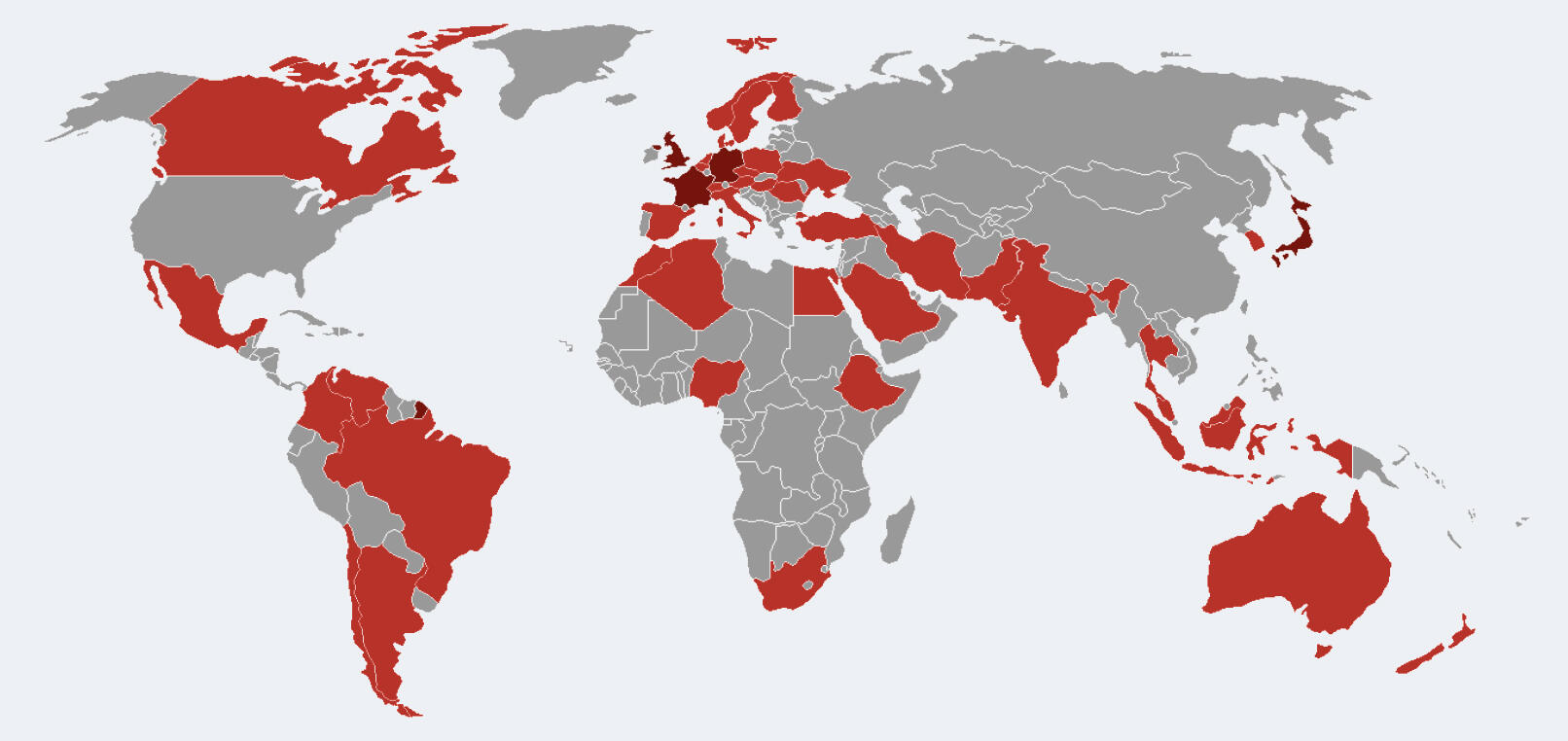
Map depicting middle and transitioning middle powers. Previous greater powers are marked in a darker shade. Source of data: Wikimedia Commons
That definition is useful but incomplete. TOI spoke with Saptarshi Ghosh, a senior political risk analyst based in London, who said: “The first issue is defining what a middle power is. What leverage do they have? Middle power has to have economic heft. Nuclear weapons don’t give much leverage beyond a point — North Korea, Pakistan.”The corrective Ghosh offers is simpler than the academic literature suggests. Middle powers rise when they control something structurally irreplaceable — a resource, a corridor, a chokepoint — and are willing to use that control as a negotiating instrument.Iran has Hormuz. Kazakhstan has uranium, 40 per cent of the world’s supply, sitting at the crossroads of China and Europe along routes whose value just rose sharply because Hormuz turned unreliable. The UAE has diversified so aggressively that oil is now just 25 per cent of its GDP, the rest split across logistics, finance, tourism and technology.The Middle East conflict has stress-tested exactly how much a middle power can push back and stand for itself.
Iran: The chokepoint playbook
Iran entered the war in a condition of severe economic distress. Its frozen assets abroad exceeded $100 billion, roughly a quarter of its annual GDP, scattered across China ($20 billion), India ($7 billion), Qatar and Iraq ($6 billion each), the US ($2 billion), the EU ($1.6 billion) and Japan ($1.5 billion).
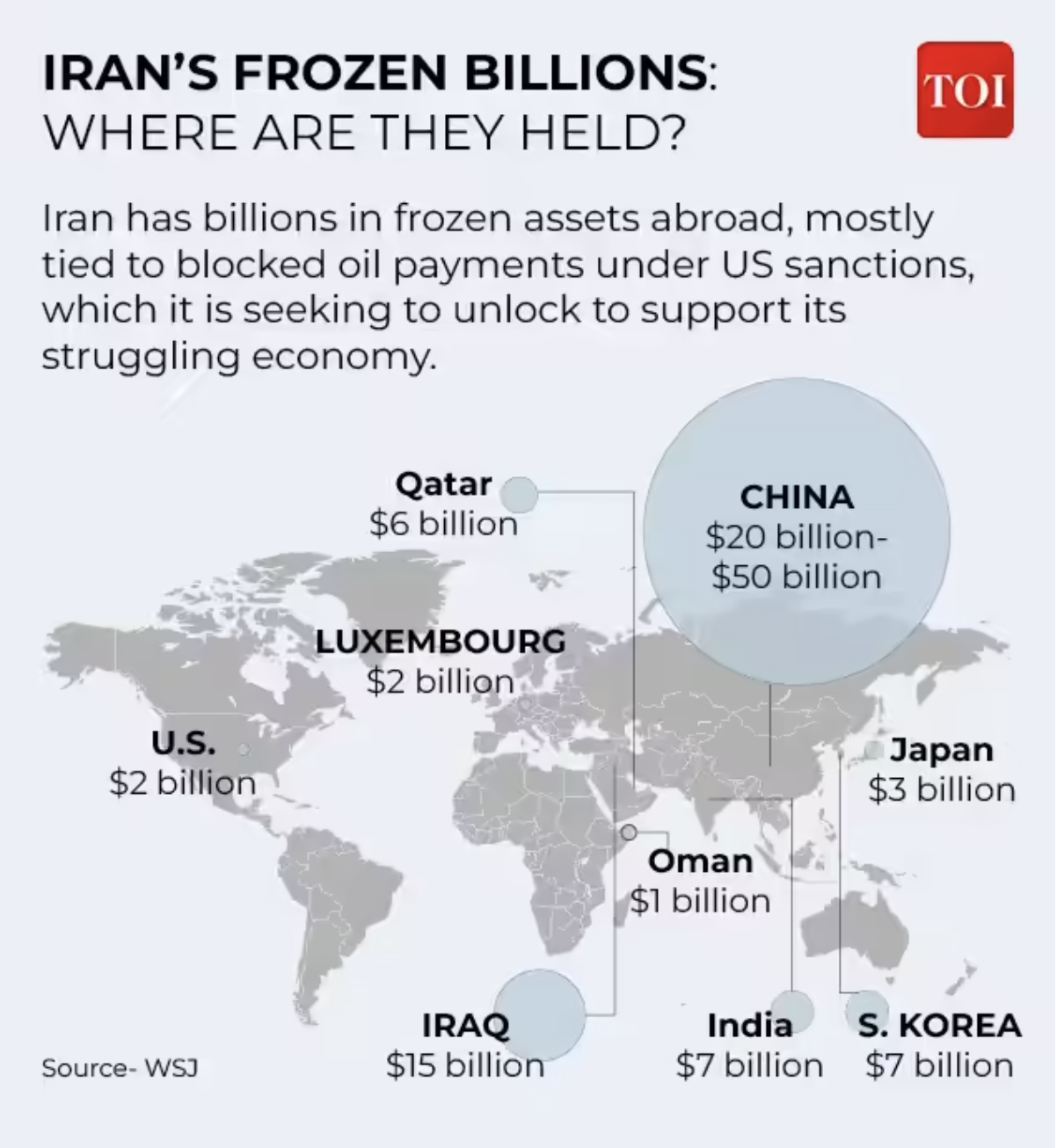
Global map showing where Iran’s frozen assets are kept across the globe.
Its currency had been in freefall for years. Its infrastructure was ageing, and anti-government protests had become frequent enough that they later became the pretext for the strikes that began on February 28.But despite all the shortfalls, Iran managed to prolong its conflict with America to a degree that few would have bet on.The reason is simple. Iran holds the Strait of Hormuz, a waterway through which 20 per cent of the world’s oil passes. It held this leverage not through drones or missiles that could match American technology, but through mines, small boats, and onshore firing units that created what the Foreign Affairs assessment of the war calls “persistent navigational uncertainty.”That uncertainty was enough to cause panic. Shippers raised insurance costs, global markets buckled, and the United States found itself firing more Tomahawks in a few weeks than it can produce in a year at its current rate of 90 to 100, expending 53 per cent of its THAAD interceptors and 46 per cent of its Patriot interceptors in the process.Iran’s three preconditions for talks tell the story of what leverage actually delivers. First: a permanent end to the war, with the ceasefire explicitly including Lebanon, ensuring Hezbollah did not end up like Hamas. Second: US recognition of Iranian jurisdiction over Hormuz. Third: sanctions relief and the unfreezing of assets. Washington, Ghosh notes, “has come around to the idea of a longer-term peace deal with Iran, from the Iranian perspective, they kept control over the chokepoint, and they will want that control to continue.“Control over maritime shipping in Hormuz, and through the Houthis, Bab el-Mandeb, gives Iran tremendous leverage going into the negotiations. They have clearly indicated that they would like to maintain their leverage by continuing to exercise their control over maritime traffic in that chokepoint.The deal America is signing has the potential to be more favourable to Iran than the JCPOA – the Obama-era agreement US President Donald Trump has repeatedly disavowed – ever was. The military war is ending. The political war is still in its early phases.As Dana Stroul, former US Deputy Assistant Secretary of Defense for the Middle East, wrote in Foreign Affairs this month: “Epic Fury will stand as the defining contradiction of US power — a display of unequalled military might that ushered in a post-American Middle East.”
Two winners, one fault line
The Iran war also carries the potential of strengthening another middle power, one again based on strategic leverage.The UAE entered the conflict in an uncomfortable position. Iran’s foreign minister Abbas Araghchi, speaking at the BRICS summit in India in May, called the UAE “an active partner in this aggression.” It was essentially pulled into the war and now may emerge from this as the conflict’s most strategically positioned beneficiary.Oil constitutes only 25 per cent of UAE’s GDP. The other 75 per cent, logistics, shipping, finance, tourism, technology, means that even if Iranian oil returns to global markets and prices fall below $80 a barrel, Abu Dhabi can absorb it. The UAE has already left OPEC, freeing itself from production constraints so it can pump more regardless of where prices settle. It holds a $1.1 trillion sovereign wealth fund, the third largest in the world. It has signed Comprehensive Economic Partnership Agreements with India, Israel and Indonesia. And now, as Ghosh explains, it is likely to “replicate the Israeli model of development — reliance on technology and innovation, along with significant expenditure on security and defence.”Saudi Arabia is in the opposite position, and the UAE’s choices make that position harder by the day. Vision 2030 requires oil revenues that Iranian re-entry into global markets will erode, Riyadh needs prices above $80 a barrel to fund a diversification plan it has not yet managed to deliver. Abu Dhabi’s exit from OPEC means it has no incentive to hold production back to protect that floor. The fault line between Saudi Arabia and the UAE, long managed, never resolved, is widening, and the war has accelerated it in ways few have yet written about.
Consequences in Asia
Beyond the Gulf, the Iran war has accelerated the formation of two distinct alliance blocs that are reshaping regional order.On one side: India, the UAE and Israel. The trilateral was formalised in stages. In 2026, India and the UAE signed a bilateral Strategic Defence Partnership. In May, Prime Minister Modi visited Abu Dhabi, condemned Iranian attacks on UAE civilians, and signed frameworks covering defence, energy, AI and space. UAE announced $5 billion in investments in India. The I2U2 grouping — India, Israel, UAE and the United States — provides the multilateral scaffolding.On the other side: Saudi Arabia, Pakistan and Turkey. Pakistan served as an intermediary between the US and Iran during negotiations, the IRGC would not talk directly to Washington. Turkey has positioned itself as the transactional power, maintaining NATO membership while refusing to sanction Russia, brokering the Black Sea grain deal, and now expanding its diplomatic footprint across the Middle East and Africa.In March, the US began relocating parts of its THAAD missile defence system from South Korea to the Gulf, a move that drew rare public opposition from Seoul, with President Lee Jae-myung acknowledging the country had “expressed opposition” but conceding it “cannot fully push through our position.” Cambridge’s John Nilsson-Wright told the BBC the move “strongly suggests the need for the US to compensate for its heavy use of existing missile defence capabilities in the Middle East.” Japan and South Korea are now openly discussing independent nuclear deterrents.
The middle power moment — or delusion?
Not everyone agrees that the Iran war vindicates the middle power agency. Michael Beckley, writing in Foreign Affairs in “The Middle Power Delusion,” argues that not choosing sides is not an option, that middle powers must ultimately align with one superpower or the other. The Institut Montaigne’s Michel Duclos is more nuanced: middle powers, he writes, “multiplied initiatives in the face of the war in Iran but in a dispersed order and without much impact”, the Turkey-Saudi-Egypt-Pakistan diplomatic push and the France-UK maritime summit were real but fragmented efforts that produced no functioning outcome.Both miss something the war makes hard to ignore. Beckley is right that most middle powers cannot single-handedly rewrite a great power negotiation, but Iran did exactly that, by refusing the premise that picking a side was the only form of leverage available. Duclos is right that the response was fragmented, but fragmentation is not failure.A chokepoint does not need allies to be effective; it needs only to exist and be defensible. That is a different model of power than either argument anticipates, not bloc politics, not multilateral consensus, but unilateral control over something irreplaceable, exercised by a country willing to absorb enormous costs to keep it.As Duclos himself concedes: “Iran after Ukraine shows that military superiority alone does not ensure political domination.” Two great powers, Russia in Ukraine, America in Iran, have now been checked by states weaker than themselves.The gap between great and middle powers is narrowing not because great powers are collapsing, but because middle powers are becoming structurally indispensable in ways military force cannot override.Kazakhstan illustrates this quietly. The world’s largest uranium producer, sitting at the crossroads of China and Europe, has spent years building middle power credentials through multilateral diplomacy. The Iran war, by making Central Asian land routes more valuable as Hormuz became unreliable, turbocharged Kazakhstan’s position without firing a shot or taking a side. A chokepoint closed in the Gulf opened a corridor through the steppes.
A trend bigger than one war
It would be a mistake to read this as a story about Iran alone. The war is the most dramatic recent illustration of a shift that has been building for nearly two decades, and the data on it is unambiguous. The Institute for Economics and Peace counts the number of middle power nations nearly doubling since the Cold War, from nine in 1991 to 16 in 2024, with their average nominal GDP growing 524 per cent over the same period — far outpacing the great powers, several of whom now hold a smaller share of global GDP than they did 30 years ago. Germany’s share has nearly halved since 1995; Japan’s has collapsed from 17.9 per cent to 4 per cent. Middle powers such as Brazil, Canada, South Korea and Australia now have higher nominal GDPs than Russia, a country still classified as a great power.This matters for Iran’s story rather than competing with it, because of timing. American and Chinese geopolitical influence, measured by the number of countries each superpower can meaningfully sway, has plateaued since 2015. Neither has expanded its sphere in a decade. That plateau created the vacuum middle powers have been quietly filling for years through trade diversification, sovereign wealth investment and coalition-building.India is the clearest case of a middle power whose rise has nothing to do with the Gulf. The Lowy Institute’s Asia Power Index ranks it the world’s third most influential state, behind only the US and China. Ghosh is unambiguous about why: “A middle power is essentially a regional power,” he says, and when asked what specific leverage India holds, his answer was not military, “It’s our ideology that threatens China and Pakistan. And our economy.”
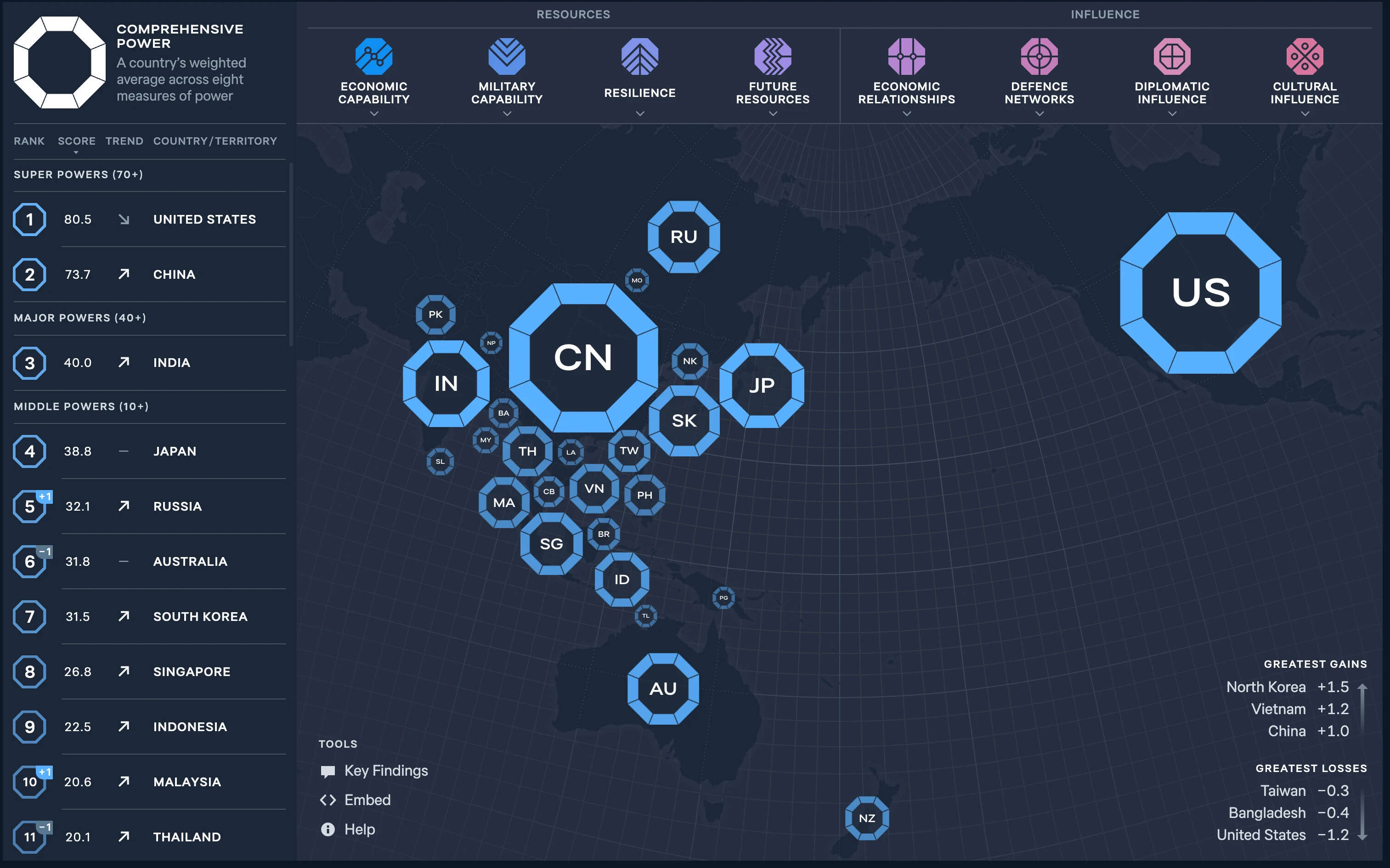
Lowy Institute Asia Power Index 2025 edition
India’s position inside the Quad, BRICS and now a trilateral with the UAE and Israel is not indecision; it is multi-alignment, extracting value from every power centre by refusing to fully commit to one.The same logic explains Kazakhstan’s rise and the UAE’s exit from oil dependence, both of which long predate February’s strikes. What the war did was compress a decade-long trend into three months and put it on the front page.
What it means
The Iran war did not create the rise of middle powers, but it demonstrated that a country can fight the most powerful military on earth to a stalemate if it controls something the world cannot bypass. The UAE demonstrated that diversification is a more durable form of power than alliance loyalty. India demonstrated that multi-alignment is not neutrality but active positioning — simultaneously in the Quad, in BRICS, and now in a trilateral security architecture with Israel and the UAE.None of this means superpowers have stopped calling the shots. The US still chose when to start this war, still possesses overwhelming military reach, and is still capable of reshaping multiple regions at once. Superpowers still set the outer boundaries of what is possible. Increasingly, they no longer control what happens inside them.“A lot of the middle powers are jockeying for some key position in the new global order that is going to be constructed,” Ghosh says. “But no one knows actually what that order is going to look like — or which countries are going to be the key pillars in building and maintaining it.”What happens next depends on whether these countries use their growing influence for competition or cooperation. Either way, the world will not look the same.