
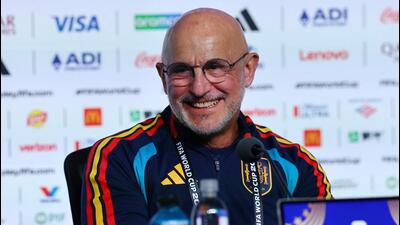
Mumbai: In December 2022, the Spanish men’s football team had reached a crossroads. They had been eliminated by Morocco in the round of 16 at the World Cup in Qatar, and the national coach Luis Enrique resigned as a result.
A decade prior, the golden generation of Spanish men’s football had won two European Championships with the 2010 World Cup in between, effectively raising the bar for what can be deemed a successful campaign for the team. By that standard, the defeat in Qatar marked a fifth consecutive failure at a major competition. One made worse by then Morocco coach Walid Regragui saying Spain went sideways more than forward.
So Spain needed a new coach who could infuse some new energy into a team in danger of taking far too many steps back than any forward. The federation turned towards the most unexpected candidate. Luis de la Fuente.
Aged 61 at the time, de La Fuente had never coached a senior international team. But in his first major campaign, he led Spain to the UEFA Nations League title in 2023, followed by the Euro 2024 crown. Now in North America, he will lead Spain as the former champions look to conquer a second World Cup title – that too as one of the favourites.
This is a remarkable turnaround for a team that has not won a World Cup knockout game since beatng the Netherlands in the final in 2010. The unassuming de la Fuente has been central to that change.
Most of his coaching experience came in his work with junior teams. But his tenure as the senior Spanish coach didn’t start well, as Spain lost 2-0 in an away Euro 2024 qualification match to Scotland. That defeat came in his second match in charge. What it did was prompt de la Fuente to adopt a different approach.
Since La Roja needed to redevelop, he decided to work with players he had helped develop from his time with the youth teams. Now 64, de la Fuente was in charge of the Spanish teams that won the U-19 European Championship in 2015, the U-21 European Championship in 2021, and won silver at the delayed Tokyo Olympics in 2021.
In his first 10 games in charge, 12 players made their senior international debut. He decided to make the younger players the crux of his team, and the changes brought in a new way Spain would play its football.
Tiki taka had run its course. In came a refreshing brand of attacking
football. There was pace on the wings, overlapping runs from full-backs, a traditional centre-forward ready to pounce onto crosses and loose balls, the calming influence of Rodri in midfield and a teenage wunderkid Lamine Yamal ready to showcase his talent to the world.
For the World Cup, de la Fuente has picked players he feels will help the Spanish charge. Even if that meant that Spain will compete at a World Cup without a single Real Madrid player in the squad for the first time. Instead, he’s focused on a youthful mix of players – a group he has known since their teenage days. From the list of 26
players at the World Cup, 10 (Mikel Merino, Unai Simon, Rodri, Fabian Ruiz, Dani Olmo, Mikel Oyarzabal, Marc Cucurella, Martin Zubimendi, Eric Garcia and Pedri) were a part of the junior Spanish teams de la Fuente had coached.
Since that defeat against Scotland in March 2023, Spain have been unbeaten in regulation time of each of the 31 competitive matches they have played. As unexpected as it was for de la Fuente to succeed at this level, in hindsight, it should never have been this surprising.
Born in Northern Spain, he was a defender for Athletic Bilbao for a majority of his playing career and was a part of the teams that won consecutive La Liga titles in 1982-83 and 1983-84, along with the Copa Del Rey title in 1983-84.
He did play junior football for Spain, including at the 1988 Olympics, but never made it to the senior team.
Later, as reported by The Guardian, while coaching Spain’s junior teams, he taught two subjects – the evolution of football and team building – as part of the Spanish federation’s UEFA Pro Licensing coaching programme.
And he has an illustrious list of students: among others, Xavi Hernandez, Xabi Alonso, assistant coach of Spain’s women’s team that won the 2023 FIFA World Cup Montse Tome, and 2022 World Cup winning coach for Argentina Lionel Scaloni.
Now in North America, the coach of coaches, armed with a group of players looking to take their country back to the highest pedestal of the sport, will hope to show them how it’s done.