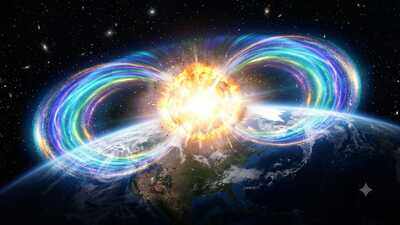
On 9 July 1962, during one of the most dangerous periods of the Cold War, the United States carried out one of the most extraordinary military experiments in history.In a test known as Starfish Prime, the US launched a 1.4-megaton thermonuclear bomb aboard a Thor missile and detonated it around 400 kilometres above Earth, roughly the same altitude where the International Space Station orbits today.Unlike nuclear explosions on Earth, the blast produced no mushroom cloud. Instead, it lit up the Pacific skies with artificial auroras, generated a powerful electromagnetic pulse (EMP) that disrupted electrical systems in Hawaii, and released enormous amounts of radiation into Earth’s magnetic field.The explosion created an artificial radiation belt that damaged several satellites and persisted for years, fundamentally changing scientists’ understanding of the near-Earth space environment.Originally intended to answer military questions about nuclear warfare in space, Starfish Prime ultimately became a landmark scientific experiment.It revealed the hidden dangers of detonating nuclear weapons beyond Earth’s atmosphere, reshaped international nuclear policy and continues to influence modern research aimed at protecting satellites from radiation more than six decades later.
Why did the United States detonate a nuclear bomb in space?
The reasons behind carrying out Starfish Prime were both Cold War competition and science. In the early sixties, the US and the Soviet Union had engaged in a nuclear arms race and a competition for supremacy in space. After the Soviet Union launched the Sputnik satellite in 1957 and Yuri Gagarin travelled in space in 1961, military leaders started contemplating how future wars would be fought in orbit.At that time, satellites became crucial for communication, reconnaissance, and missile detection while little was known about the behaviour of nuclear weapons in space. Scientists wanted to find out whether an exploding nuclear bomb at high altitudes could neutralise the enemy satellites, interfere with ballistic missiles, or disrupt communications between distant military posts.At the same time, researchers were curious about interactions of the exploding weapon with the Earth’s magnetosphere and Van Allen radiation belts – zones filled with charged particles, which surround the Earth.This curiosity gave birth to Operation Fishbowl, a sequence of high-altitude nuclear explosions carried out by the US in 1962.Starfish Prime was the largest and most ambitious of these experiments, designed to provide both strategic military insights and scientific data that could not be obtained through laboratory experiments alone.
What happened during the Starfish Prime explosion?
After an earlier launch attempt failed, a Thor missile carrying a 1.4-megaton thermonuclear warhead successfully lifted off on 9 July 1962. The warhead detonated at an altitude of approximately 400 kilometres, placing the explosion well above Earth’s atmosphere. The test, codenamed Starfish Prime, remains the most powerful nuclear explosion ever conducted in space, according to Guinness World Records.Because space is almost a vacuum, there was no conventional blast wave or mushroom cloud. Instead, the energy from the explosion interacted directly with Earth’s magnetic field and upper atmosphere. Within moments, a brilliant flash illuminated the Pacific, while spectacular artificial auroras spread across the skies. People in Hawaii, Samoa and even New Zealand reported seeing glowing curtains of red, green and purple light stretching across the horizon.The explosion also produced one of the strongest man-made electromagnetic pulses (EMPs) ever recorded. Although the detonation occurred roughly 1,450 kilometres from Hawaii, the EMP disrupted radio and telephone communications, triggered burglar alarms and knocked out hundreds of streetlights.Scientists quickly realised that a nuclear explosion in space could affect electronic infrastructure over enormous distances without causing direct physical destruction on the ground.
The hidden consequences of the experiment that lasted for years
While the spectacular light show captured public attention, the most significant effects of Starfish Prime were invisible.According to research, ‘Neoclassical Diffusion of Radiation-Belt Electrons Across Very Low L-Shells’ the explosion released vast numbers of energetic charged particles that became trapped within Earth’s magnetic field, creating an artificial radiation belt around the planet.Scientists had expected some radiation, but they greatly underestimated both its intensity and its persistence. Instead of disappearing within days, the artificial radiation belt remained for several years, exposing satellites passing through it to dangerous levels of radiation.The consequences were severe for the early space age. The experiment unexpectedly demonstrated that high-altitude nuclear explosions could threaten not only military assets but also civilian and scientific satellites.The EMP effects were equally revealing. At a time when electronics were far less advanced than they are today, the explosion still disrupted infrastructure thousands of kilometres away. Scientists later concluded that a similar detonation in the modern era, when society depends on satellites and interconnected digital systems, could have far more widespread consequences.
How Starfish Prime changed science and global nuclear policy
Although Starfish Prime was conceived primarily as a military experiment, it became one of the most influential scientific studies of Earth’s space environment. Researchers gained unprecedented insights into the behaviour of Earth’s magnetosphere, the motion of charged particles, the formation of radiation belts, and the hazards radiation poses to satellites and astronauts.Perhaps its most important lesson was that nuclear weapons in space are inherently indiscriminate. Rather than affecting only an adversary’s military assets, they can damage friendly satellites, disrupt civilian infrastructure and contaminate near-Earth space for years. These findings fundamentally changed military thinking about the use of nuclear weapons beyond Earth’s atmosphere.The experiment also strengthened international support for limiting nuclear testing. Just over a year later, the United States, the Soviet Union and the United Kingdom signed the 1963 Partial Nuclear Test Ban Treaty, which prohibited nuclear weapon tests in the atmosphere, underwater and outer space. The agreement became one of the first major arms-control treaties of the Cold War and helped prevent further nuclear explosions in space.
Why scientists are studying Starfish Prime again today
The lessons of Starfish Prime have become even more important in the 21st century. In 1962, only a handful of satellites orbited Earth.Today, thousands of satellites support GPS navigation, telecommunications, internet services, weather forecasting, banking, aviation, disaster response and national security. A similar nuclear explosion in space today could therefore have far-reaching consequences for the global economy and critical infrastructure.Recognising this growing vulnerability, researchers are once again studying the problem Starfish Prime created. According to research reported by Science, US scientists are investigating technologies that could rapidly remove artificial radiation belts if a nuclear explosion ever occurred in space.One promising approach uses very low frequency (VLF) radio waves to interact with trapped high-energy electrons, pushing them out of Earth’s magnetic field so they fall harmlessly into the atmosphere instead of continuing to damage satellites.Although these techniques remain experimental, they represent an effort to undo one of the most enduring consequences of Starfish Prime. More than six decades after the Cold War experiment, scientists are no longer asking how to weaponise space, they are searching for ways to protect it.