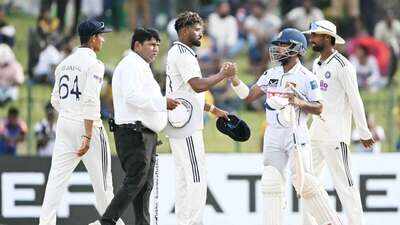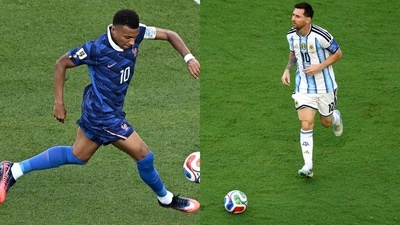
The 2026 World Cup has already given Lionel Messi and Kylian Mbappe two very different kinds of knockout nights. Messi’s Argentina survived Cape Verde, but only just. Mbappe’s France beat Paraguay, but only after being forced into a game that looked nothing like the smooth, high-speed football usually associated with them. The result, in both cases, was revealing. The two great match-winners still found their moments, but their opponents showed that even genius can be narrowed, delayed and dragged into discomfort.
Against Cape Verde, Messi scored his record-extending 20th World Cup goal, yet Argentina were pushed into extra time by a side playing their first tournament. Cape Verde equalised twice and forced the defending champions to live through a match of unease before a late own goal finally carried Argentina through 3-2. It was not a night where Messi disappeared. He rarely does. But it was a night where his control over the match was interrupted. Cape Verde made Argentina restart emotionally again and again. Every time Messi seemed to settle the game, Cape Verde reopened it.
Mbappe’s night against Paraguay carried a similar lesson. France won 1-0 through his second-half penalty, but Paraguay had turned the match into an abrasive, stop-start contest in which France’s usual fluency was badly reduced. The breakthrough came from a penalty after VAR intervention, not from Mbappe repeatedly flying behind the back line in open play. That matters because it shows the only realistic way to face him. You do not try to erase Mbappe. You remove the runway, slow the service, and make his danger arrive in isolated bursts.
That is the thought experiment. If this version of Messi and this version of Mbappe were placed in the same attack, what iconic defence could be built to survive them?
The problem: one wants the pocket, the other wants the runway
Messi and Mbappe together create a defensive contradiction. Messi wants the ball between midfield and defence, especially in the inside-right channel, where one turn can open the entire pitch. Mbappe wants grass behind the line, preferably from the left, where his diagonal run can turn one pass into a one-on-one.
If the defence drops too deep to protect against Mbappe, Messi receives near the box and begins to dictate. If the defence pushes too high to compress Messi, Mbappe has open field to attack. If the right-back tracks Mbappe alone, he gets isolated. If the centre-back moves across to help, Messi sees the central gap.
So the answer cannot be a heroic back four. It has to be a cage. The shape has to be a 5-3-2 without the ball, protected by an elite defensive midfielder. The chosen line: (peak) Manuel Neuer behind Lilian Thuram, Alessandro Nesta, Franco Baresi, Paolo Maldini and Ashley Cole, with Claude Makelele screening in front.
The cage: five icons and one lock
Thuram starts on the right because Mbappe cannot be met with adventure. He has to be met with patience. Thuram’s job would be to show him outside, delay the sprint and refuse to sell himself on the first acceleration. He does not need to win every duel. Against Mbappe, delaying the action by two seconds is already a defensive victory.
Nesta becomes the second wall. If Mbappe comes inside, Nesta protects the channel. If Messi slips the ball through the gap, Nesta reads the danger early. His value lies in his calmness. He was not a defender who survived through recovery alone; he prevented panic before it was born.
At the centre, Baresi controls the line. This is vital because Messi’s greatest weapon against quick defenders is timing. He waits for the line to lose discipline, then releases the runner. Baresi would be the brain of the trap, deciding when to hold, when to step and when to retreat. He would not chase Messi into midfield. He would preserve the structure and keep Mbappe in his eye-line.
Maldini, on the left side of the centre, gives the defence balance and dignity under chaos. If Messi drifts across, if Mbappe switches sides, if the game breaks into transition, Maldini is the cleaner. He sees danger before it becomes theatrical.
Ashley Cole completes the back five because Messi needs a certain kind of irritation. Not height. Not aggression. Balance. Low centre of gravity. Patience. Cole could jockey without diving in, recover after being beaten and avoid giving away cheap fouls around the box. Against Messi, that is priceless.
Also Read: Paraguay showed France can be rattled. Morocco should take the lesson, not the tactics
Makelele: the shadow Messi would hate
The most important player in the system may not be in the back line at all. It is Makelele.
Messi cannot be man-marked blindly. If you follow him everywhere, he drags you out of the game. Makelele’s task would be more intelligent: guard Messi’s receiving zone, attack his first touch and deny him the clean forward-facing moment. If Messi drops too deep, Makelele lets him go. If Messi receives between the lines, Makelele arrives from behind while Baresi blocks the forward lane.
This creates the real trap. Messi has Makelele behind him, Baresi in front of him, and Cole or Maldini closing his left-side exit. He can still pass, because Messi can always pass. But he cannot always pass where he wants.
The only realistic plan
The defence cannot sit on the six-yard box. That gives Messi too much territory around the area. It cannot play recklessly high either. That invites Mbappe into open field. The line has to live in a disciplined mid-block, compact enough to suffocate Messi but deep enough to reduce Mbappe’s runway.
The defensive rule is simple: Mbappe outside, Messi backwards. If Mbappe becomes a crosser rather than a finisher, the defence is winning. If Messi becomes a recycler rather than the final-pass master, the defence is winning.
The most dangerous action remains the Messi-to-Mbappe diagonal. Messi receives inside-right, Mbappe begins wide-left, then darts between Thuram and Nesta. That is the pass that destroys normal teams. Here, Makelele presses Messi’s foot, Thuram stays half-turned, Nesta protects the channel, Baresi controls the line, and Neuer sweeps behind.
Would they stop Messi and Mbappe completely? No. No honest football argument can claim that. But this defence could reduce them to moments rather than waves. It could turn genius from a constant storm into scattered lightning. Against these two, that is not merely survival. That is victory.