
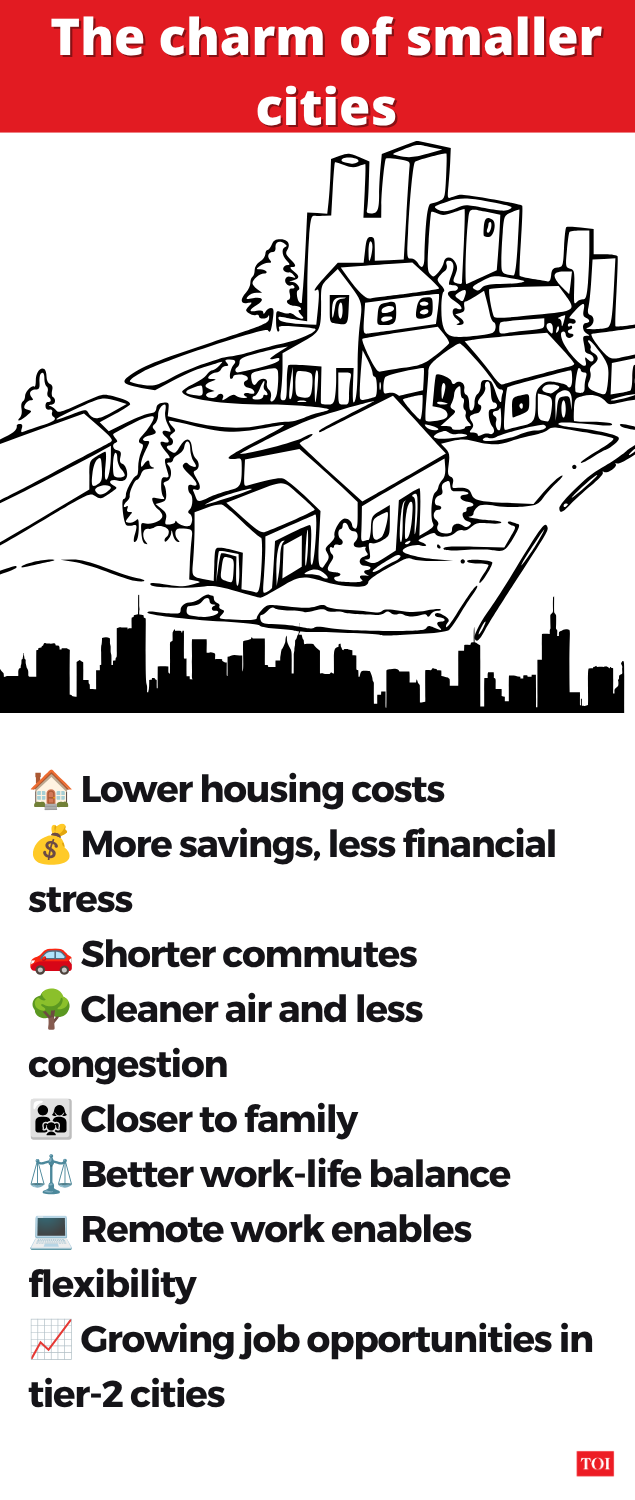
A quiet but significant shift is unfolding across the Indian landscape. Professionals are increasingly moving away from metro cities and settling in tier-2 or tier-3 cities.For decades, cities like Delhi, Mumbai, Bengaluru and Hyderabad were India’s biggest job magnets. They offered higher salaries, larger professional networks and the promise of faster career growth. But the same cities that once represented aspiration are now prompting many professionals to reconsider what they want from work and life.Some reasons are not very difficult to understand. Housing costs have soared, daily commutes have stretched longer, and concerns around pollution, stress and burnout have become increasingly common. At the same time, remote work, better digital connectivity and growing opportunities outside major urban centres have made it possible for many professionals to live elsewhere without necessarily compromising their careers.The trend is unfolding alongside the rise of India’s smaller cities. Hiring activity in tier-2 locations has grown steadily over the past few years, while businesses, startups and Global Capability Centres have expanded beyond traditional metropolitan hubs. The result is a growing willingness among professionals to explore alternatives to metro life.So, let’s understand the reasons in detail with insights from people who moved and a few firms based in the smaller cities.
Quality of life over the hustle
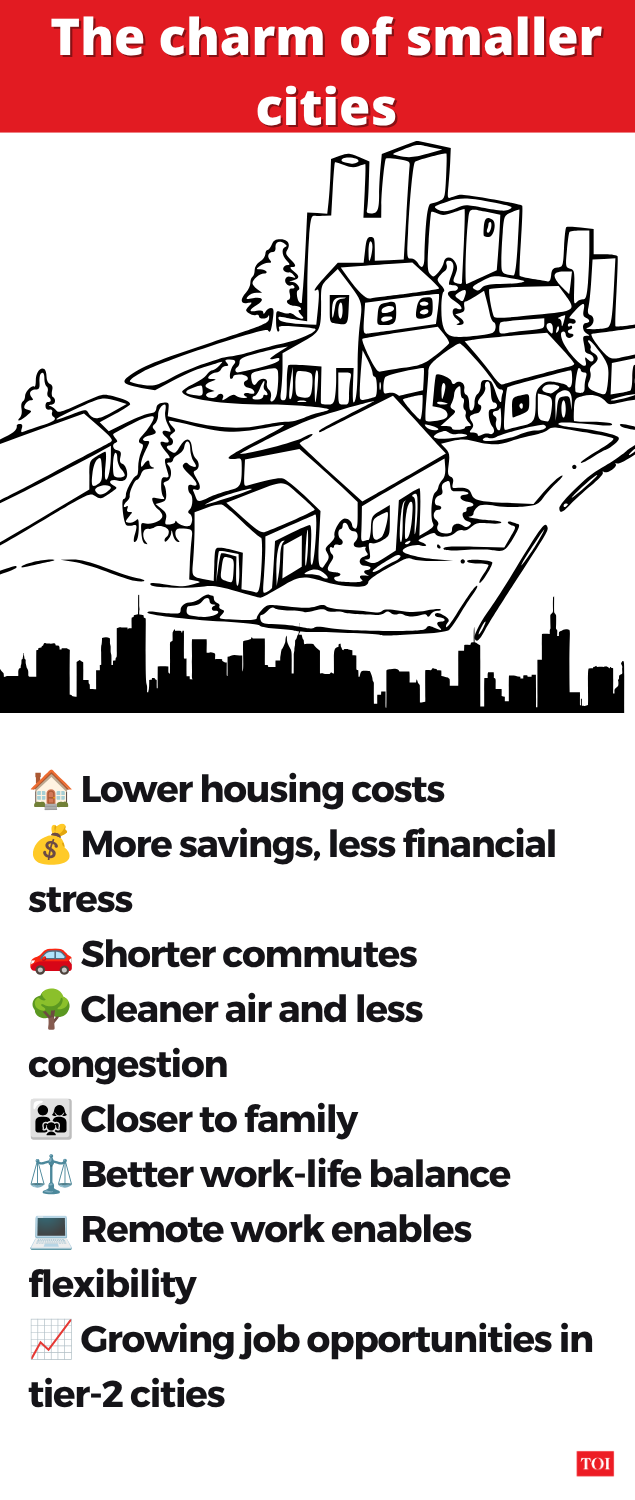
For many professionals, the decision to leave a metro city begins with a simple question: Is the lifestyle worth the cost?The answer, nowadays, for some, appears to be no.Rising rents, expensive housing, packed roads and long commutes have made daily life in major cities more demanding than ever.Although metros continue to offer unmatched opportunities, many professionals say the personal sacrifices required to access those opportunities are becoming harder to justify.Some describe a growing sense of exhaustion with the pace of urban life. As Misbah M, who relocated to Goa, said: “I was sick of the corporate facade. No real substance. Exorbitant housing rents, subpar lifestyle.”That sentiment is reflected in the experiences of many who have made similar moves.After spending 32 years in Mumbai, entrepreneur and communications professional Gayatri Sethi Jain relocated to Vadodara during the pandemic. “The biggest change has been moving from a life of constant hustle to one of intentional growth,” she said. “I was conditioned to believe that opportunity was tied to a pin code. When we moved to Vadodara during the pandemic to support my in-laws, it was initially a family decision rather than a lifestyle choice. Personally, our quality of life improved significantly,” she added.
I was conditioned to believe that opportunity was tied to a pin code.
Gayatri Sethi Jain, founder of CtrlA India, Vadodara
The move enabled her family to reduce financial pressure and invest in long-term assets. More importantly, it provided something she believed had become increasingly scarce in Mumbai, which was “Space to raise children, build a family, and create a more balanced life”.The appeal of smaller cities often goes beyond finances. Professionals also frequently cite better air quality, shorter travel times, improved mental health and stronger family support systems as major advantages.For Yash Sonkar, who moved from Delhi to Tanda (Uttar Pradesh), the decision involved balancing career ambitions with broader life goals. “The better opportunity of course has to be the starter, but then there are a lot of other factors to be weighed in, from investments and savings point of view to the health, and mental fatigue and stress,” he said.Yash added that moving away from Delhi’s pollution and relentless pace improved both his quality of life and financial situation. Lower expenses and reduced commuting have freed up time and money while allowing him to stay closer to family and the community he grew up in.
You might not have that very urban-high bang night life, but the peace of clear star night gaze hits different.
Yash Sonkar, a commucation specialist, Tanda (UP)
Thus, success is increasingly being measured not just through salary packages or job titles, but through a broader assessment of well-being, financial security and personal fulfilment.
Against the stereotypes
A decade ago, moving away from a metro often meant accepting fewer professional opportunities. Today, many professionals believe that the equation has changed.
Why professionals are moving
The growth of remote and hybrid work has made geography less important for many industries. For instance, Jaipur resident Amrita Gupta, Director of Manglam Group, says the post-pandemic years have led to “stronger talent retention in Tier-1 and Tier-2 cities”, with many professionals choosing to stay in or return to places they once left behind for work. “The conversation today is no longer about whether smaller cities can compete with metros,” she said, adding, “It is about recognising that growth is becoming more distributed.“
The widespread adoption of remote and hybrid work models, coupled with the rise of entrepreneurship, has created new opportunities beyond traditional employment hubs.
Amrita Gupta, Director of Manglam Group, Jaipur
Meanwhile, companies are expanding into smaller cities in search of talent, lower operating costs and new markets.Industry reports show increasing hiring activity across tier-2 cities, while sectors ranging from manufacturing and financial services to technology and education are creating opportunities beyond traditional metro centres.According to a 2026 report by ANSR, a firm that helps companies set up and scale Global Capability Centres (GCCs) in India, emerging cities already host more than 220 GCC units and are growing at nearly 11 per cent annually. The report identified cities such as Bhubaneswar, Coimbatore, Indore, Jaipur, Kochi, Lucknow and Visakhapatnam as increasingly attractive destinations for companies, citing improving infrastructure, talent availability and quality of life. It also noted that GCC job openings in emerging cities have grown by 42 per cent, compared with 19 per cent in metro hubs.The changing employment landscape is also encouraging professionals to look beyond traditional metro hubs. Aruna Yadav, founder of SD Campus in Noida, which is not a traditional metro city but has become closely linked in recent years, said improved infrastructure and connectivity are helping businesses expand into newer markets, creating opportunities in cities that previously saw talent migrate elsewhere. “The long-standing perception that high-quality jobs and leadership roles are only available in metropolitan areas will no longer exist,” she said.
A broader shift in India’s employment landscape is manifesting as professional migration from metropolitan areas to smaller cities.
Aruna Yadav, founder of SD Campus in Noida
Employers in actual smaller cities are noticing the shift as well.CA Ankit Jain, managing partner at Jain Ankit and Co, based in Dehradun and with a supporting branch in Gurugram, said his firm regularly receives applications from professionals who have previously worked in metro cities. “Many are keen to move to a Tier-II city to escape the constant hustle, noise and crowds in search of a calmer life, often willing to compromise on CTC to do so.”Jain further argued that the belief that serious professional opportunities exist only in metros is increasingly outdated. Many industries operate factories, business units and regional centres outside major cities and require skilled professionals locally.
In our line of work, a large share of companies operate their units and factories in Tier-II and Tier-III cities. They rely on professionals based locally to deliver services they simply can’t afford to outsource to metro cities because of the higher costs.
CA Ankit Jain, managing partner at Jain Ankit and Co, based in Dehradun
Raman Aggarwal, founder and CEO of Jupitice Justice Technologies in Chandigarh, also believes the shift reflects a broader change in how professionals view success.
Success should not be dependent on a change of pin code.
Raman Aggarwal, founder and CEO of Jupitice Justice Technologies in Chandigarh
He added that many talented professionals now want careers that allow them to remain close to their families rather than being forced to relocate simply to access opportunities.
The trade-offs still exist
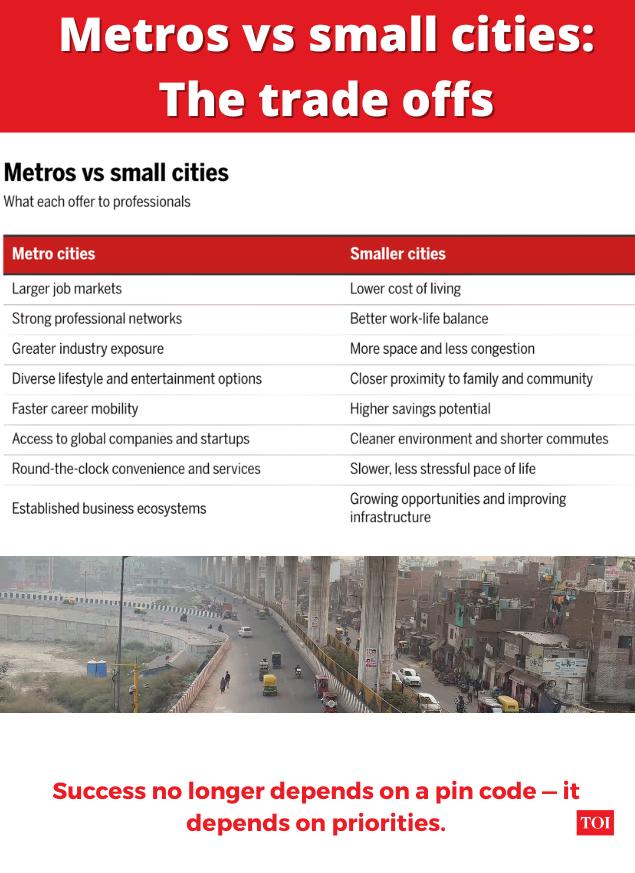
While some have found the silver lining in moving away from a metro, it is not a universal solution.The advantages are clear, but so are the compromises.
Metro vs small cities
Smaller cities, currently, often cannot match the sheer scale of opportunities available in Mumbai, Delhi or Bengaluru in many fields. Professional networks may be smaller, specialised roles may be fewer and lifestyle choices can be more limited.Those who make the move often discover that they miss aspects of metro life they once took for granted.Chirag Singh, who moved from Gurugram to Simhadri near Visakhapatnam earlier this year, says one of the biggest adjustments has been the lack of convenient facilities.“You also realise how much you take certain conveniences for granted. No Blinkit, and Swiggy/Zomato options are far more limited,” he said, adding that, despite the challenges, he’s adapting to the change.
The air is cleaner, there’s less chaos, and overall it feels like a healthier environment to live in. Over time, I’ve come to appreciate that more than the conveniences I miss.
Chirag Singh, working communication professional in Simhadri (near Visakhapatnam)
While such conveniences may seem minor, they reflect broader differences in urban infrastructure and lifestyle. Access to niche services, late-night dining, entertainment options and professional networking events remains significantly higher in metros.Even those who are happy with their decision acknowledge the trade-offs.Some pointed to cultural adjustments. Moving from a highly cosmopolitan city to a smaller town can require adapting to different social norms, work cultures and ways of thinking.The challenge, therefore, is not simply relocating. It is learning to thrive in a different environment.
Adaptation
Moving away from a metro city often requires more than a change of address. For many professionals, the transition involves adjusting expectations, developing new skills and finding ways to grow within a different environment.For instance, When freelance food writer Madhulika Dash left Mumbai for Bhubaneswar nearly 15 years ago, the move was widely viewed by her friends and colleagues as a professional risk. “Food writing was what I wanted to do but opportunities weren’t there in the city,” she said.Returning to her hometown meant lower living costs and being closer to family, but it also meant stepping away from a professional ecosystem she had spent years building.Initially, she expected the move to be temporary. Instead, she adapted. As opportunities in food writing remained limited, she diversified into new areas, becoming a columnist, exploring anthropology writing, working on culinary projects and eventually collaborating with the Odisha govt in their tourism committee. Over time, she adapted and now she believes, “anyone can shift to a small city as the cost of living comes down. Your health takes priority… But your complete life gets better.”
Anyone can shift to a small city as the cost of living comes down. Your health takes priority, food is still better. But of course we don’t get restaurants like in Hyderabad or Bengaluru.
Madhulika Dash, freelance writer (food), Bhubaneswar
A shift that may only grow
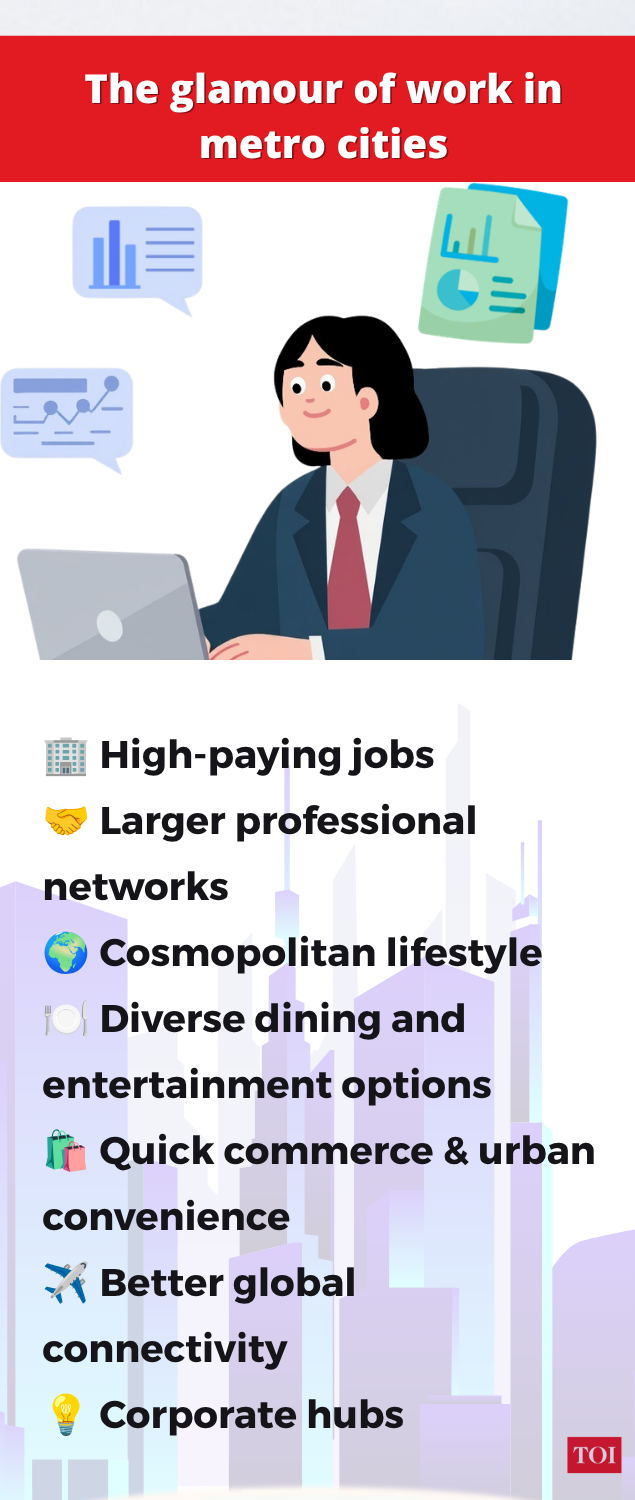
India’s metros remain critical economic engines and are unlikely to lose their appeal anytime soon. They continue to offer unmatched concentrations of talent, capital, infrastructure and opportunity.
The glamour is still there for many
But smaller cities are no longer merely alternatives for those who cannot make it in the metros.As infrastructure improves, businesses expand and remote work remains part of the employment landscape, the gap between metro and non-metro India is narrowing. Cities once seen as secondary destinations are witnessing major investments in urban infrastructure. In April, for instance, the Union Cabinet approved Jaipur Metro Phase 2, a Rs 13,038-crore project that will add a 41-km corridor connecting key residential, commercial and industrial hubs. Meanwhile, airports, organised retail, modern healthcare facilities and digital infrastructure are there in cities such as Indore, Bhubaneswar, Coimbatore and Kochi, making them attractive places to live and work.Thus, for a growing number of professionals, the question is no longer simply if they can build a successful career outside a metro city.It is whether they still have the glamour in a metro city. The answer, for many, appears to be changing or at least the shift worth considering.