
One of the first things I did when I returned to Pakistan in early 2000, this time as the Indian High Commissioner, was to pay my respects to an imposing bronze statue of Mahatma Gandhi. One of only two Gandhi statutes in Pakistan, Bapuji stands tall at the lobby of the Indian High Commission in Islamabad, famed walking stick in hand, gazing into the distance.The tale of how a pre-Partition statue found its way to its eventual home in the Indian High Commission is a fascinating saga reflecting the tangled tumultuous history of our two countries. It is a journey in which I was honoured to have played a small part.
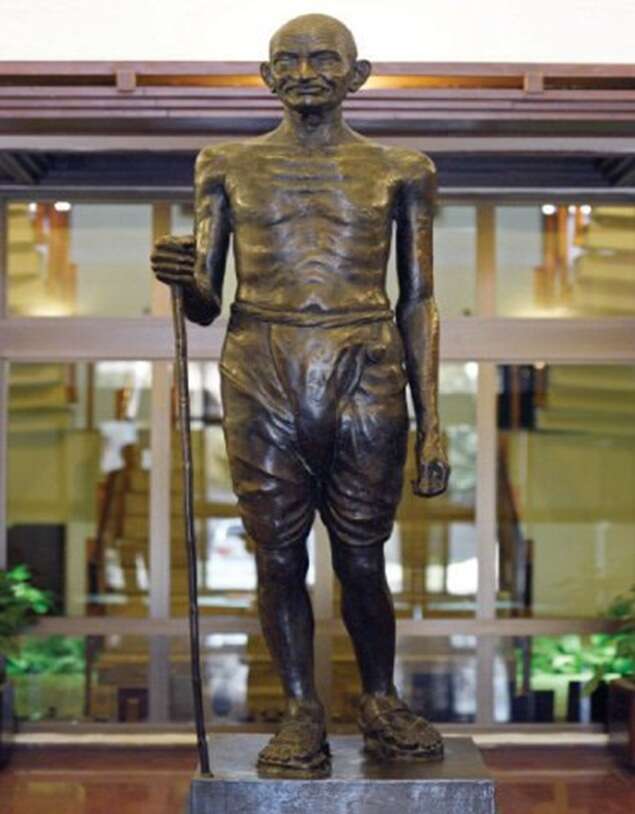
Gandhi statue in the Indian High Commission, Islamabad (Picture credit: Haider Sherazi)
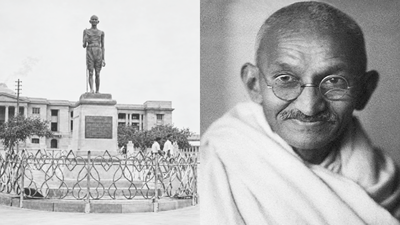
According to several accounts, the statue originally stood outside the Sindh high court on what was known as Kings Way in Karachi. It had been commissioned by the Indian merchant association sometime in the 1930s to commemorate the historic Karachi session of the Indian National Congress. The plaque underneath the life-size monument apparently read: “Mahatma Gandhi – the reputability of freedom, truth and nonviolence.”Partition brought the inevitable dislocation. With communal riots engulfing Karachi in 1948, there was fear that the statue would be torn down amidst mob fury. Accounts vary on what exactly happened, but apparently after the intervention of Jamshed Nussranwanji Mehta, a Parsi and former Mayor of Karachi, the statue was surreptiously taken down and moved quietly to the home of the Cowasjees, a leading Parsi family of Karachi.And there it lay for more than thirty years…A few months into my first stint in Pakistan as Consul General in Karachi, a middle aged Parsi gentleman approached me. He was a well known Karachi businessman, activist and columnist whose name I am withholding. Over the course of several meetings he told me his incredible tale. How he as a young man along with several of his school chums insouciantly removed the Gandhi statue in the dead of the night armed with some basic tools and a lorry – all while Karachi seethed with fear and hatred. It was then ferried to his father’s home, initially meant as a temporary abode until a handover to Indian representative could be organised. Unfortunately, the then Indian High Commissioner to the Dominion of Pakistan could not assure a safe passage and refused. And that was how the Cowasjees became the involuntary guardians of Gandhi in PakistanThe Parsi gentleman was clear that his part in the story had to come to an end. We were now in the early 1980’s. General Zia’s Islamisation project was well underway. Sharia laws had been introduced into the legal system. Strict Islamic punishments were to be meted out for crimes like adultery, theft and drinking of alcohol. Educational curriculums were being rigorously overhauled to promote religious studies and conformity with orthodox Islamic principles. Dress codes, especially for women, were being enforced. The sari, once common amongst upper class Pakistani women, was fast disappearing. An ongoing media clampdown weeded out content deemed as un-Islamic.Though historically Parsis, unlike other minorities in Pakistan, have enjoyed a somewhat protected status and though Ardeshir was and continued to be a fearless and outspoken critic of the political establishment, he was no longer comfortable with his role as the statue’s custodian. He asked me if the long delayed handover of the statue could finally take place.I immediately agreed. I was determined that the statue, now a priceless historical artifact, should come home on my watch. There was, however, a tricky logistical issue to navigate. Constant surveillance by Pakistani intelligence was a fact of life. So how could we transport the statue without compromising the Cowasjees.After clearance from Delhi, we decided to replicate the original midnight run. A non-descript truck, organised by the Consulate, picked up a large wrapped item from the Cowasjee residence and quietly brought it to the Indian mission late one summer night.I personally inspected the precious cargo. Through all its travails, the statue had endured some damage. One hand was broken and the glasses were cracked, but otherwise Gandhiji stood tall. We arranged for some minor repairs, and after a few weeks, the statue took pride of place in the Chancery reception. Suddenly confronted with this majestic but serene statue, surprised Pakistani visitors were often curious about its origins, but we remained tightlipped.Eventually, once the statue was properly restored, we arranged for its transportation to the High Commission in Islamabad. In hindsight, that last trek from Karachi to Islamabad turned out to be as consequential as the original journey in 1948. In 1993, following the demolition of the Babri Masjid, furious mobs in Pakistan attacked over 30 Hindu temples and in Karachi ransacked both the Consulate and the Consul General’s residence in which I had once lived.
Share your thoughts in the comments
Be respectful · TOI community guidelines
Valuable art was vandalised, including a beautiful painting by B. Prabha.Post the 1993 attacks, the Indian consulate in Karachi closed down. It remains shut to this day. In Islamabad, however, the Gandhi statue still stands, an enduring testament to “freedom, truth and non-violence” true to its original plaque.G. Parthasarathy has served as India’s Consulate General in Karachi and as India’s High Commissioner in Islamabad.