
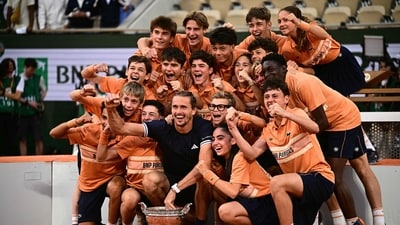
For the better part of a decade, Alexander Zverev carried a burden that was never truly his to bear. And perhaps a part of him knew there was no escaping it, not after his rapid rise through the rankings and the succession of victories that branded him the prince promised.
In 2016, he took down Roger Federer in three sets on grass at Halle. A year later, he pushed Rafael Nadal to five sets at the Australian Open, where he even led two sets to one in their third-round clash. Months later, he defeated Novak Djokovic in the final at the Foro Italico and then beat Federer again, this time in the Canadian Open final.
At 20, Zverev had raised the question that had long lingered over men’s tennis: was he the one destined to follow the Big Three? It was a flattering projection. It was also, in many ways, a curse.
By then, the German already had two Masters 1000 titles to his name. He added a third in Madrid the following year before defeating Djokovic in straight sets to win the ATP Finals. And if that wasn’t enough, in 2021, he captured Olympic gold in Tokyo. Zverev had already built a résumé that most would dare to dream of. But with every triumph, the bar moved higher, leading to the one question that mattered above all others: could he translate that form into Grand Slam success?
ALSO READ: Alexander Zverev ends Grand Slam curse in epic five-set French Open triumph over Flavio Cobolli
The pressure of that tag followed him into every major he played. And every time he stood at the business end of a Slam, something tightened. He became tentative, passive and withdrawn at key moments, and that mental blockage repeatedly stalled his progress. The 2020 US Open final, two sets up against Dominic Thiem and one set away from the title, slipped away in five. At Roland Garros in 2024, he clawed his way into the lead against Carlos Alcaraz before the Spaniard stormed back. A year later, at the Australian Open, he proved no match for Jannik Sinner, losing in straight sets in another final.
Three finals. Three painful defeats.
While Zverev stood still under the weight of expectation, Sinner and Alcaraz seized control of the sport. The question stopped being when Zverev would win a Slam and quietly became whether he ever would.
Sunday’s French Open final against Flavio Cobolli threatened to become another chapter in that story. He raced through the opening set 6-1 and then, with the title in sight, the familiar ghost appeared. He became cautious, the big forehand rationed rather than unleashed, waiting for Cobolli to make mistakes rather than forcing the issue himself. The tenth-seeded Italian, the surprise finalist at Roland Garros, sensed the shift, settled into the contest and forced a fifth set. As if on cue, the television cameras found Thiem in the stands, prompting fresh reminders of Zverev’s most painful Grand Slam collapse.
It was on this very court that Zverev suffered one of the most heartbreaking moments of his career, twisting his ankle and leaving the 2022 French Open semifinal against Nadal in a wheelchair. It was also here that he stood a set away from the title against Alcaraz in 2024, only to watch another opportunity slip away.
Except this time, he didn’t crumble.
The 29-year-old landed 80 per cent of his first serves and broke an exhausted Cobolli three times in the decider to close out the match in the manner long expected of him — composed, ruthless and finally unburdened. Years of agony, near-misses and doubt gave way to tears of relief and disbelief as he sank to la terre battue.
“I was kind of in a state where I was ready to keep playing,” he admitted afterwards. “But then I saw my box and they all raised their hands in the air and then I was like — okay, it’s over. I won and I’m a Grand Slam champion. It was relief, it was all the emotions. All came together.”
Standing with the trophy in his hands, he turned to the crowd and spoke with the rawness of a man who has known this court at its cruelest.
“This court is so special to me in so many ways. I’ve had the best moments of my life on these courts. I’ve had the worst moment of my life on these courts. But now, finally, it’s a happy end.”
He then addressed his team with the honesty of someone who had shared every scar of the journey.
“We’ve been through injuries, we’ve been through heartbreak, we’ve been through losses, we’ve been losers at times as well in the most important moments. But at the end of the day, we’re Grand Slam champions now, and that’s what counts.”
For now, that burden is over and the doubts have finally been put to rest. Yet a different question now presents itself.
The greatest champions use their first Slam as a launchpad. Others, having crossed the line they chased for so long, quietly lose the edge that drove them there. Thiem knows that. So does Daniil Medvedev, the only other man born in the 1990s to have won a major before Zverev joined the club.
Zverev has always possessed the talent to win more. That was never in doubt. But whether Paris represents the beginning of a dynasty delayed or simply the conclusion of a journey that took longer than expected remains unanswered.
Only time, and the next Grand Slam, will tell.