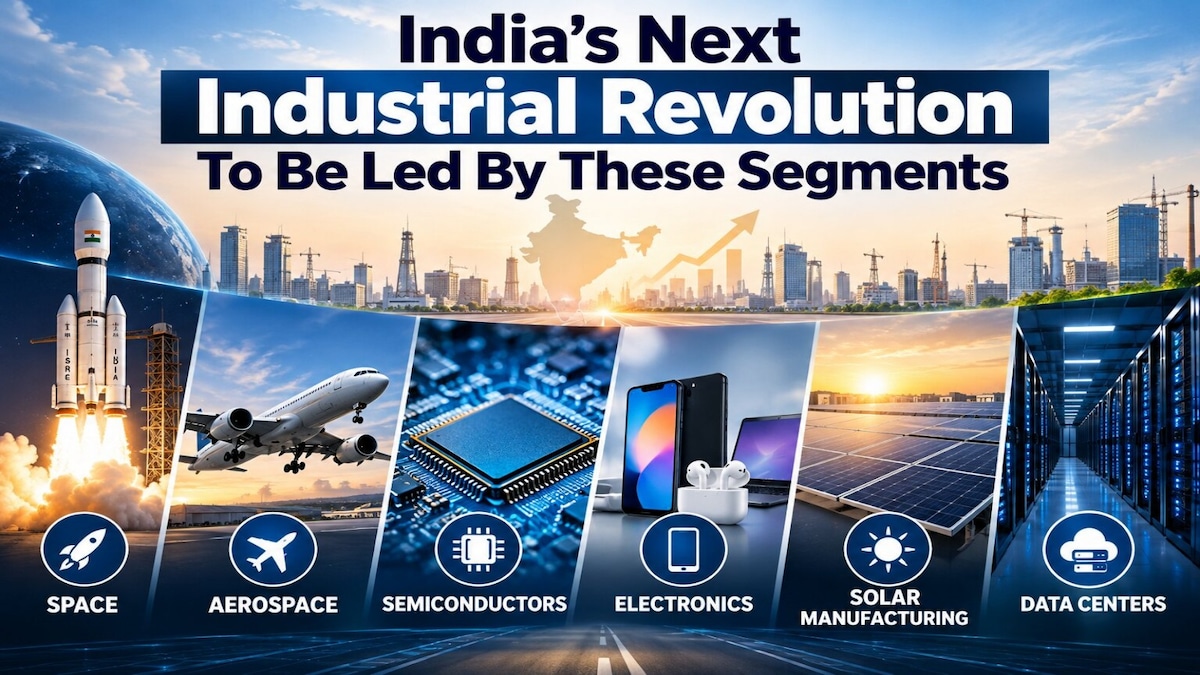
This large domestic opportunity is also driving participation from the private sector in these industries and support from the government is also visible with steps such as opening it up for the private sector, long tax holidays for data centers, large incentives schemes for semiconductors, and many such steps.
Lets break each sector down individually:
Space
India is targeting a 5x expansion of its space economy by 2030 to $40 billion – $45 billion. The sector was opened to the private companies in 2020 and the results are already being seen. Skyroot recently executed an orbital launch in July, Pixxel is working on high-resolution observation satellites, while Agnikul is working towards a 3D-printed rocket engine.
Semiconductors
Jefferies believes that a new $13 billion incentive plans for the semiconductor industry should further expand the ecosystem, boost value addition, including chip design as well. And while supply chain, depth, talent and global competition remain challenges, Jefferies believes that India is building the foundations of a credible semiconductor ecosystem.
Data Centers
The biggest talking point of them all, has been Data Centers which has now become a strategic digital infrastructure segment.
With colocation capacity already having expanded 5x over the last fie years, Jefferies expects that to grow another 5x over the next five years to 10 GW. This will be supported by favourable cost economics, policy support and strong demand from hyperscalers. Jefferies expects this to be a $9 billion revenue opportunity for data center operators and a $45 billion investment opportunity across power, cooling, construction and network infrastructure.
Electronics
A segment where India has grown leaps and bounds is Electronics and Jefferies believes that the segment is entering the next phase of growth with a greater focus on domestic value addition and component manufacturing. Exports have grown sharply and emphasis is also being laid on backward integration to reduce dependence on imports. The electronic component manufacturing scheme is likely to cover 50% of the mobile component value going forward, according to the Jefferies estimate.
Solar Manufacturing
Another area where India has shown strong growth is solar manufacturing, emerging as the world’s second-largest solar PV manufacturing. The country already has 35 GW of solar cell capacity which is already operational and another 100 GW is under construction. Policy measures announced are also accelerating the backward integration across cells, wafers and ingots. Jefferies now expects nearly 90% of the solar manufacturing value chain to be localized by 2030.
Aerospace
Lastly, India is also emerging as a beneficiary of the global demand supply imbalance in aerospace, with cost-competitive manufacturing and engineering talent among its leverage seeking capabilities. Indian exports are also on the rise with $1.4 billion – $1.6 billion already being sourced by Boeing and Airbus annually. Jefferies has listed companies such as Aequs, Azad Engineering, Bharat Forge, Samvardhana Motherson, Sansera Engineering among others as the key suppliers to global OEMs.
So, some segments with established presence, some segments in the nascent stage, but Jefferies believes that India’s latest industrial revolution is all set to take flight!