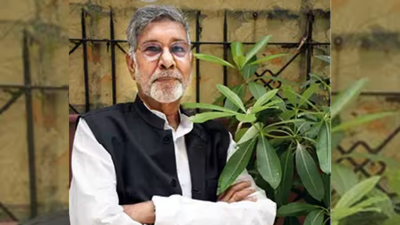
Shoeshine boy outside schoolIn 1959, on his first day to school as a five-and-a-half-year-old in Vidisha, Madhya Pradesh, Kailash Satyarthi (he was Sharma then) spotted a shoeshine boy sitting quietly outside the gate. Curious and confused, he asked a teacher, “Why is a child sitting outside the school?” He was told that it is not uncommon for poor kids to work.Satyarthi was not satisfied. Every day, he would see the boy, roughly his own age, sit there with his father until one day he gathered courage and asked his father why his son was not at school. The man spoke with a deep hopelessness, recalls Satyarthi. He said, “Babu, school jaane ke liye aap log to hain. Hum to yehi kaam karne ke liye paida hote hain (There are people like you who go to school. We are born to do this kind of work).”As a child, Satyarthi felt there was something wrong in this, but he couldn’t understand what. “I was taught that God has made us all equal. Why this inequality, I wondered,” he recalls.This encounter gave him a different perspective on life at a very early age.Friend who dropped outSatyarthi was just 11 when he found that his best friend and some other students had stopped attending classes in the new session. He was told that such dropouts happened because the poor could not afford even nominal fees and textbooks.Satyarthi wanted to do something. He got an idea and shared it with a friend. “My father had given me some money to buy sweets after I had cleared the examination. We went to a vegetable vendor, gave him the money and rented his pushcart,” he says.They went around the neighbourhood, urging people to donate the used books of their children, so that the needy could use them. “Within a few hours, the cart was full and we had to take a second turn. We collected 2,300 books that day,” he remembers.Soon, another idea — a permanent book bank for needy kids — was born, in which even headmasters and bookstore owners joined in. About 10,000 books were collected.Decades later, when Satyarthi went to Vidisha after winning the Nobel in 2014, he heard someone call out his name during an open-jeep parade. “The gentleman said, ‘I am a retired headmaster. I had almost quit my studies due to lack of money. But your book bank initiative allowed me to continue’,” Satyarthi recalls.It was quite a moment for both.Wasal Khan and SaboAt 27, Satyarthi had started a journal, ‘Sangharsh Jaari Rahega’, which spoke up for the marginalised and oppressed. The office was near Mandi House in central Delhi. One day, a sickly person in a lungi knocked on his door and passed out after a few words. He was carrying a copy of the magazine.When he regained consciousness, the man started whimpering, “Babuji, please save my daughter.” His name was Wasal Khan. Over the next few minutes, he poured out his life story. His wife and he were lured away from a village in Aligarh district, taken to Punjab’s Sirhind, where they had been enslaved in a brick kiln for 17 years. They worked without pay, given just food and used clothes to wear. “He said the owners were planning to sell Sabo, his 15-year-old daughter, to brothel agents from Delhi,” says Satyarthi. Wasal had escaped on the back of a truck and reached Chandigarh, where a magazine subscriber had given him an old copy and asked to go to Delhi for help.Satyarthi was faced with a tough choice: write an article or take action. He opted for the latter. He organised a truck and, on reaching the spot, he and his friends from Punjab — one of them had a camera — boldly told the lone gun-wielding chowkidar that they were journalists from Delhi. The watchman ran away. “We were about to leave with 36 men, women, and children when a police jeep arrived with the owners. They started slapping us and forcing the labourers to get down from the truck,” Satyarthi recalls. The truck driver had run away. Satyarthi and his friends too had to flee. “Our slippers were lost, our clothes torn.”Somehow they reached Chandigarh and then Delhi. “They had taken away the camera. But two reels, which vividly captured the labourers on camera, were with us. We had good evidence,” he says. Satyarthi approached Swami Agnivesh and, through him, renowned lawyer Gobinda Mukhoty, who filed a habeas corpus petition in Delhi high court. Since nobody knew the name of the brick kiln owners, a notice was sent to Punjab Police and the state.
Share your thoughts in the comments
Be respectful · TOI community guidelines
Eventually, Wasal Khan, Sabo and the rest were produced in court and freed.The children, who had grown up inside the brick kiln, had no idea of life outside. “As we walked from the high court towards our office, they were jumping like frogs released from a bucket, oblivious to the traffic. That day, I realised what true freedom really meant. I could feel God in their joy. We also knew this was the field where we have to work. Over the decades, our organisation, Bachpan Bachao Andolan, has rescued over 1,40,000 men, women and children,” he says.Compassion and AI ethicsThis is the age of AI and Satyarthi believes that technology should factor in compassion (karuna), which he defines as “a force born from feeling the suffering of others and drives us to take action.” Satyarthi feels that AI technology must be governed by a sense of responsibility during its designing, development and deployment. “AI should have a moral compass. It cannot just be profit-hungry,” he says.