
US President Donald Trump may not find it easy to get the new bill championing fresh sanctions on Russia and countries that trade with it passed. The proposed legislation would sanction Russian officials and authorise up to 100% tariffs on the five largest importers of Russian crude oil or natural gas, as well as the five countries considered to be the biggest enablers of Moscow’s efforts to bypass US sanctions and continue financing its war in Ukraine, now in its fifth year.The Russia sanctions bill pushed for more than a year by the late Senator Lindsey Graham is facing growing resistance in Congress, with Democrats and some Republicans objecting to provisions that would give President Donald Trump sweeping new tariff powers, according to a Reuters report.
More power for Trump: Why are lawmakers concerned?
Lawmakers from both parties, along with industry trade groups, have raised concerns over a section of the legislation that would allow Trump to impose hefty tariffs on countries that buy significant volumes of Russian oil and gas or on nations that his administration determines are helping Russia evade sanctions.While the bill does not identify those countries by name, they would likely include China, India and possibly certain European nations and Japan.Before his sudden death earlier this month, Graham had spent more than a year pushing for the measure. He secured Trump’s backing only in recent weeks, as the Republican president became increasingly supportive of Ukraine while growing more frustrated with Moscow, the Reuters report said.
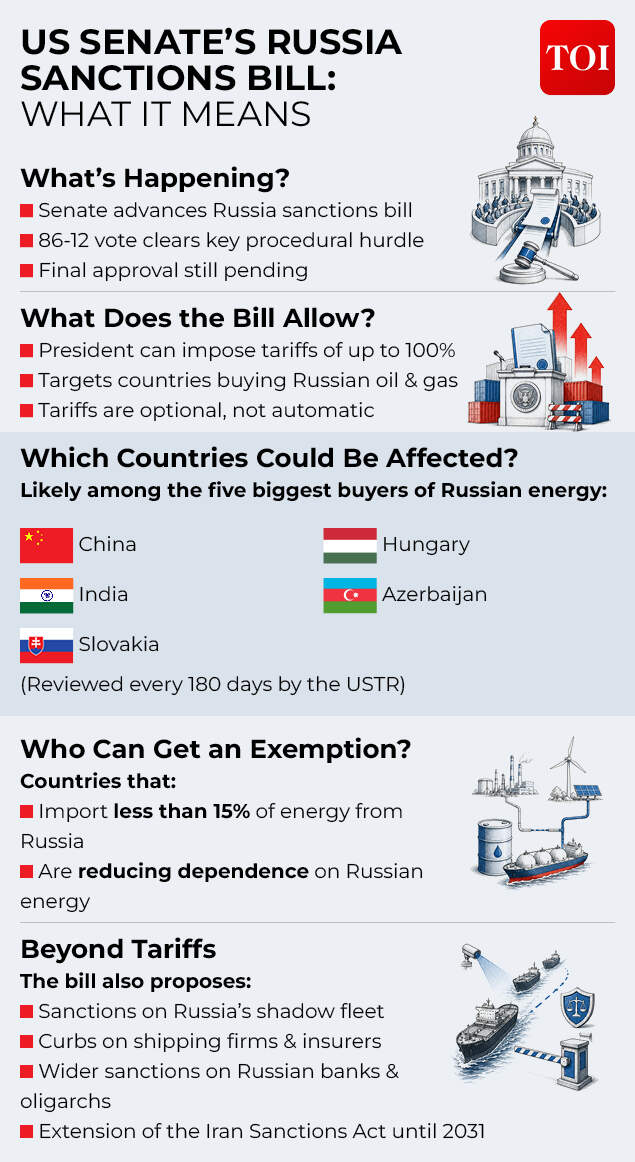
What is the US Senate Bill on Russia Sanctions?
The tariff provisions gained added significance for the White House after the US Supreme Court struck down Trump’s 10% to 50% “reciprocal” tariffs in February, prompting the administration to look for alternative legal authority to impose such trade measures.Also Read | India faces 100% Trump tariff threat as US Senate advances Russia Sanctions Bill – what it meansThe legislation also gives the president the authority to waive Russia-related sanctions for unspecified national security reasons. That provision has drawn opposition from pro-Ukraine Democrats, who cite Trump’s changing positions on Russia and Ukraine.In addition, the bill would renew for another five years the Iran energy and weapons sanctions first enacted in 1996, which are due to expire this year. That extension was included as a condition for securing Trump’s support. Earlier this week, Trump also insisted that tariffs on Iran be added to the legislation, despite the fact that trade between the US and Iran is virtually non-existent.With opinion polls indicating that Democrats could regain control of the House of Representatives and potentially the Senate in the November congressional elections, some lawmakers believe it would be better to delay passage of the Russia sanctions bill until Democrats have greater influence over legislation that many consider unprecedented, the report said.
Bill to face hurdles?
The legislation received overwhelming bipartisan backing in procedural votes in the US Senate on Tuesday and Wednesday, with lawmakers describing it as a tribute to the late Senator Lindsey Graham.Congressional aides said the bill could be approved by the full Senate before lawmakers leave Washington for their home states next week.However, the measure, which has been renamed in Graham’s honour, is expected to face a tougher path in the House of Representatives, which is in recess until August 31.Opposition has already emerged from some senior Democrats.Senator Ron Wyden and Representative Richard Neal, the ranking Democrats on the Senate and House trade committees, criticised the legislation, arguing that it would hand Trump broad new tariff powers that could push up inflation in the United States.“There is no question that the US government must take stronger action against purchasers of Russian energy who are fueling the unjustifiable war against Ukraine. But the latest draft of the Sanctioning Russia Act is a prescription for bedlam and higher tariffs,” they said in a joint statement.The bill has also sparked concerns among some Republicans.Mahur Patel, a former Republican congressional aide who is now with the Hogan Lovells Cadwalader law firm, said he was sceptical that the legislation would pass the House this year, citing the approaching election season and continued unease among Republicans over the scope of Trump’s tariff policies.According to Patel, many Republican lawmakers remain uncomfortable with Trump’s earlier sweeping tariffs, with some continuing to press for product-specific exemptions, such as the temporary relief granted this week for phosphate fertiliser imports from Morocco to prevent shortages linked to the Iran war.
New precedents on sanctions
Apart from concerns that the legislation could add to inflationary pressures in the United States, sanctions and trade experts say it would establish a new precedent by allowing future presidents to use secondary tariffs to target entire countries, rather than limiting action to individuals or entities accused of helping evade sanctions. Although the bill specifies that these powers would expire after five years, experts note that governments rarely relinquish authorities once they have been granted.Supporters of the legislation maintain that the five-year sunset provision sufficiently limits the tariff authority, allowing it to curb Russia’s energy revenues without creating broader unintended consequences.Jess Hoversen, a former senior US government official who is now chief economist at developer platform bank Column, said the legislation would, if enacted, hand the government an extremely broad tool capable of affecting entire bilateral trade relationships.“Secondary tariffs, as designed in this bill, would function as a much blunter instrument that could apply across-the-board duties to all goods from a country based on its energy trade with Russia or its role in sanctions evasion,” Hoversen said.