
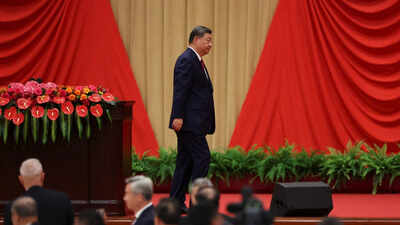
Chinese President Xi Jinping has intensified his sweeping anti-corruption campaign, with the Communist Party expelling 33 members, including senior military officers and prominent political figures, as a key leadership meeting exposed the scale of the ongoing purge.The expulsions were confirmed in a communique issued on Thursday at the end of a four-day, closed-door meeting of the Communist Party’s Central Committee in Beijing. Sixteen of those expelled were from the military, according to the BBC, as party discipline and political loyalty took centre stage at the gathering.Xi urged the Communist Party and the military to “turn the blade inward”, launch a self-revolution and root out “viruses” undermining their institutional health.The fifth plenum of the current Central Committee was marked by an unprecedented number of absences in the post-Mao era. Only 279 members attended, compared with 315 at the previous plenum in October 2025 and 364 in July 2024. The committee, which began its term in 2022 with more than 370 members, has been steadily depleted by Xi’s crackdown.The party cited “serious disciplinary and legal violations” in its announcements, without providing details of the specific allegations against the officials.Xi, who came to power in 2012, has made combating corruption a defining feature of his leadership. However, analysts say the campaign has increasingly become a means of enforcing political obedience and consolidating his authority, with even officials handpicked for senior positions failing to escape scrutiny.Military purge leaves top ranks depletedAmong those expelled were former Xinjiang party chief Ma Xingrui, former senior generals Zhang Youxia and Liu Zhenli, and prominent diplomat Liu Jianchao. Zhang Youxia was a vice-chairman of the Central Military Commission (CMC), the body responsible for overseeing China’s armed forces, while Ma and Zhang were former members of the powerful Politburo.The latest action follows the removal of former general He Weidong and other senior military figures in an earlier round of expulsions. The continuing purge has raised questions about the leadership and operational readiness of the People’s Liberation Army (PLA), even as China showcases advances in its military capabilities.The CMC has been reduced to just two members: Xi, its chairman, and Zhang Shengmin, its vice-chairman. The party elevated Zhang to the 24-member Politburo during the plenum, making him the only military representative on the top governing body.The party also adopted a resolution calling for stricter internal discipline, stronger anti-corruption enforcement and greater ideological purity. According to state news agency Xinhua, the leadership said it must strengthen its long-term governing capacity and maintain close ties with the people.The BBC reported that China’s top anti-corruption watchdog had disciplined 680,000 people across the party apparatus in the first nine months of this year. The latest expulsions bring the number of members removed during Xi’s third term to 51, compared with 35 in his first term and five in his second.Amidst the purge, Zhang Shengmin, vice chair of the Central Military Commission, was promoted to the ruling Communist Party’s Politburo.The 68-year-old veteran military official rose to become China’s second-highest-ranking general last year, during the fourth plenum.Xi tightens grip ahead of 2027 leadership reshuffleThe timing of the crackdown is significant, with the next Communist Party Congress scheduled for the second half of 2027. The gathering will determine the party’s next leadership line-up, and Xi is widely expected to seek a fourth term, extending his rule beyond the decade-long limit followed by his predecessors.The scale of the purge suggests that the leadership is scrutinising officials more closely ahead of the reshuffle. Xi has repeatedly warned against cadres who profess loyalty but fail to follow party directives, reinforcing the view that political allegiance is central to the campaign.Chong Ja Ian, a non-resident scholar with Carnegie China, told the BBC that the anti-corruption drive had increasingly become an effort to consolidate and maintain authority, rather than simply address graft.The crackdown has also extended beyond the party and military. Reports cited by The Economist have highlighted the detention or disappearance of business executives and figures linked to strategically important industries, raising concerns about the consequences for China’s business climate.