
Buchholz also cautioned that rising US bond yields could put further pressure on equities, although he noted that part of the rise reflects stronger-than-expected economic growth rather than purely negative market signals. He said heavy borrowing by governments, companies and sectors such as technology and aviation is also contributing to the upward pressure on rates.
This is an edited transcript of the interview.
Q: Typically, all these high-level bilateral meetings are full of show and a little light on substance, so very high on symbolism. What were your key takeaways? Were there any signs or signals? These two countries are at odds with each other on many issues. What should we expect from these meetings?
A: So far, the only actual takeaway is that instead of expiring in November, it will expire in January, which just means there’s more work to be done between the two countries, the two teams.
But the fact is that going into this meeting, President Trump wants to come back to America’s farmers with some kind of commitment, some sort of victory on beef or soybeans or something else, because the president and his own party, the Republican Party, face a very tough election in early November.
So, he is looking for signs of momentum. It is very clear that the tariff wars, the tariff skirmishes, have damaged American constituencies, and the president is still in favour of tariffs, but he recognises now might be a pretty good time to get a good deal from President Xi Jinping.
And that’s why there are flags and trumpets, and crusted sea bass, and lovely creamy desserts and soups served at a fancy dinner.
Q: What are the polls saying in the US? I mean, midterms are what, five weeks away?
A: Yes, and it is a very narrow majority that the Republicans have. They have three or four seats in the Upper House, our Senate, and a three- or four-seat majority in our Lower House, the House of Representatives.
So, in the best of times, for the incumbent party, it is very difficult. But when the sliver of separation between the majority and minority is as it is, it makes it even more perilous.
So, at the moment, the betting would be that the Democrats take at least the House of Representatives, if not the Senate. And what that then leads to is an immediate feeling that the Republican Party needs to look beyond President Trump and look to their next candidate.
They don’t know who the next candidate is going to be, but right after that election, there will be many Republicans camping, driving, flying, being airlifted into the state of Iowa to begin campaigning for the nomination.
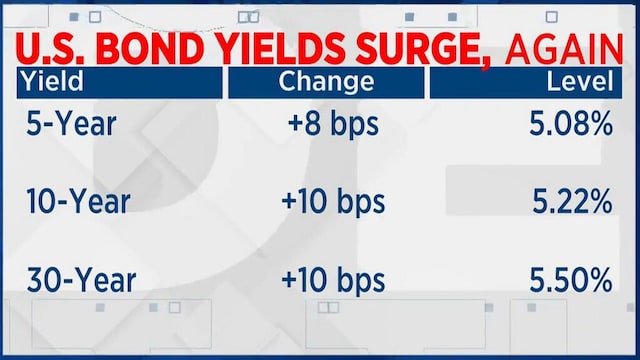
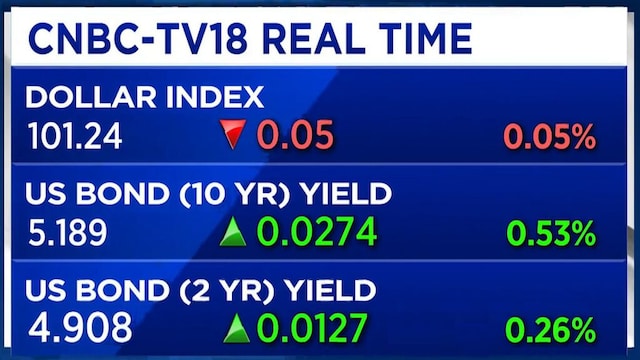
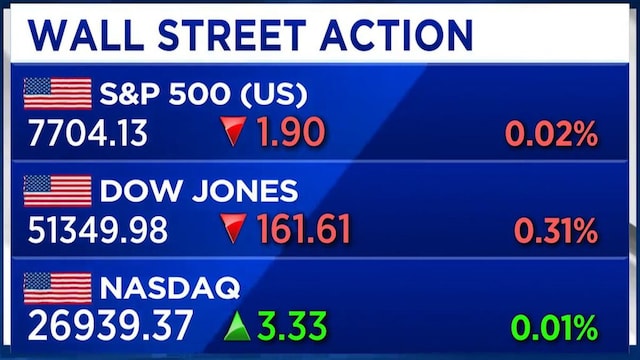
Q: Where are markets at? What’s top of mind for you? As someone who’s worked in the industry, bond yields, for example, are ripping higher. 25-odd basis points up on the 10-year yield in two sessions. This is huge: 5.2%, 5.25%. Will this start to weigh on equities, in your opinion? So far it has not.
A: It is already weighing on certain equities. So, for instance, the US housing industry is in terrible shape, and stocks like Home Depot, which sell goods for the home and construction materials, have hit lows.
So, there are certain parts of the equity market that have already been punished by these higher interest rates. And yes, if these rates move higher, it will be a further weight on shares.
On the other hand, one has to ask: is one of the reasons why rates have moved higher because real gross domestic product (GDP) growth is higher?
The Atlanta Fed, which publishes a forecast every quarter, is forecasting our current growth rate at 4.5% or 5%. If you knew nothing else about what was happening in the world, and you said, “Well, if growth in one year goes from roughly 2% GDP to 5% real GDP growth, wouldn’t you expect higher interest rates?”
To some extent, this push-up is a reflection of the fact that the US economy and the world economy are not slumping into a recession, and even Europe is a little stronger than it had been.
Now, I’m not saying that accounts for most of the move, and certainly these almost violent moves of the last couple of days and weeks can’t be explained simply by stronger GDP. But I would just caution that part of the reason might actually be a result of positive news, not negative news.
We know there’s an enormous amount of borrowing going on. It’s being done by tech companies building data centers. It’s done by airlines buying airplanes, and perhaps President Trump’s going to come back with big airplane orders for Boeing over the next couple of days.
Watch the full conversation here

And it’s also the last factor, which is the one that I think is most unheeded: government borrowing. The government borrowing of the US and other countries is outrageous.
Now, I have to tell you, it was about 12 or 13 years ago, I wrote a piece in the Wall Street Journal arguing the US should issue 100-year bonds to lock in the most extraordinarily low interest rates the modern age had ever seen.
We could have issued 50- and 100-year bonds at 2% or 3%. Instead, we’re borrowing 10-year now at over 5%.
Catch all the latest updates from the stock market here